
The God of Wine, Freedom and Ecstasy: Bacchus
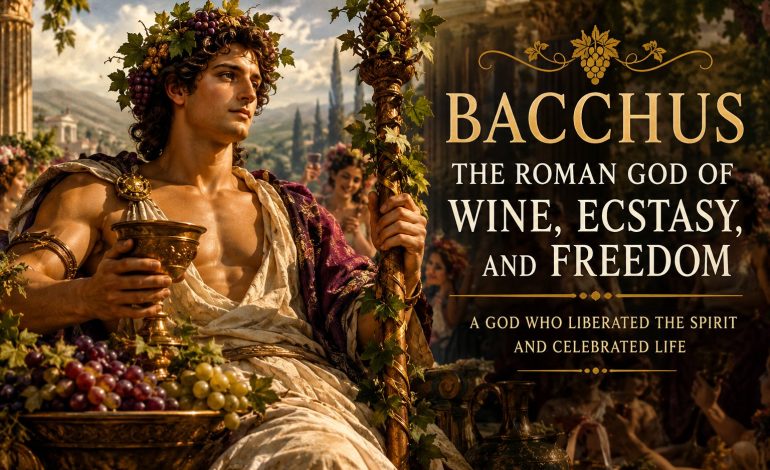

The God of Wine, Freedom and Ecstasy
Imagine a world where wine was more than a drink. A world where a single sip could dissolve social barriers, awaken creativity, and transport people into a state of divine ecstasy. In ancient Rome, this extraordinary power belonged to one God—Bacchus, the God of Wine, Freedom and Ecstasy. Far more than a patron of feasts and celebrations, Bacchus embodied the untamed side of human nature. He represented freedom from convention, the courage to embrace joy, and the transformative power of altered states of consciousness. To the Romans, Bacchus was not merely a deity of intoxication; he was a force that unlocked hidden emotions, inspired artistic expression, and encouraged people to experience life beyond ordinary limits.
The Origins of Bacchus
The story of Bacchus begins with the merging of two powerful traditions. His identity was shaped by Dionysus, the Greek god of wine and ecstatic celebration, whose mythology was adopted by the Romans during the second century BCE. At the same time, Bacchus inherited characteristics from Liber, an ancient Italian deity associated with freedom, fertility, and wine.
Even his name reflects this fascinating blend of cultures. The Latin name Bacchus derives from the Greek word Bakkhos, an epithet of Dionysus. This term itself originated from bakkheia, which described the frenzied and ecstatic state inspired by the god. In adopting the name, the Romans embraced the powerful emotional and spiritual experiences associated with Dionysian worship.
Some scholars also connect the name to the Latin word bacca, meaning “berry” or the fruit of a tree or shrub. If so, the name may directly reference grapes—the essential ingredient in wine and a symbol forever linked to Bacchus.
The Liberator of the Human Spirit
Among all Roman gods, Bacchus occupied a unique place. He was known as Eleutherios, meaning “the Liberator.” This title captured the essence of his influence.
Romans believed that Bacchus worked through the experience of intoxication. Under his influence, individuals could temporarily escape rigid social expectations and explore new ways of thinking, feeling, and acting. His gift was not simply drunkenness but liberation—a release from constraints that allowed creativity, spontaneity, and emotional expression to flourish.
This belief made Bacchus a beloved figure among those seeking joy, inspiration, and a deeper connection to life’s pleasures.
Symbols and Characteristics
Bacchus was celebrated as the ultimate reveler. He governed every stage of wine production, from the growth of grapevines to the art of winemaking. Farmers and vintners looked to him for guidance and abundance, while artists and poets drew inspiration from his association with creative ecstasy.
In Roman art, Bacchus was typically portrayed as a youthful and handsome figure. He was often shown beardless, relaxed, and sometimes visibly intoxicated. One of his most recognizable attributes was the thyrsus—a staff wrapped in ivy and topped with pinecones or covered in honey, symbolizing prosperity, fertility, and divine power.
His imagery captured a perfect balance between beauty, celebration, and the mysterious forces that shaped human experience.
A God Born Twice
The mythology of Bacchus is filled with extraordinary events, but none is more remarkable than his unusual birth.
According to mythological tradition, Bacchus was born twice.
In one version of the story, his divine lineage began with Jupiter, king of the gods, and Proserpina, daughter of Ceres. Later traditions describe his rebirth through Jupiter and Semele, a mortal woman who became his second mother.
This dual birth symbolized transformation and renewal—ideas that perfectly matched Bacchus’s role as a god who changed people through his gifts of wine and ecstasy.
The Dramatic Birth of Bacchus
The most famous account of Bacchus’s birth begins with Jupiter’s love for Semele. Their relationship, however, attracted the jealousy of Juno, Jupiter’s wife. Determined to destroy Semele, Juno disguised herself and persuaded the young woman to ask Jupiter to reveal himself in his full divine form. Bound by his promise, Jupiter reluctantly agreed.
When he appeared before Semele surrounded by thunder, lightning, and the overwhelming brilliance of his godly power, the mortal woman could not withstand the sight. She was instantly consumed by the divine flames. Yet the unborn child survived.
To save his son, Jupiter performed an extraordinary act. He removed the infant from Semele’s womb and sewed him into his own thigh. There the child continued to grow until he was ready to be born again.
When the time came, Bacchus emerged safely from Jupiter, earning his reputation as the “twice-born” god. After his birth, Jupiter entrusted him to protective nymphs, while Mercury helped ensure his safety from further threats.
The Lasting Legacy of Bacchus
Bacchus remains one of the most fascinating figures in Roman mythology, the God of Wine, Freedom and Ecstasy. He was a god of contradictions—both civilized and wild, joyful and mysterious, liberating yet powerful enough to inspire awe.
His influence extended beyond vineyards and festivals. He represented humanity’s desire to break free from limitations, celebrate life, and embrace moments of inspiration and transformation. Through wine, music, dance, and ecstatic celebration, Bacchus reminded the ancient world that freedom could sometimes be found in surrendering to joy.
Thousands of years later, his image still survives in art, literature, and popular culture as a symbol of celebration, creativity, and the enduring human pursuit of liberation.