
When Daughters Swear: Why Modi Calls Women’s Anger a “Culture Shock”
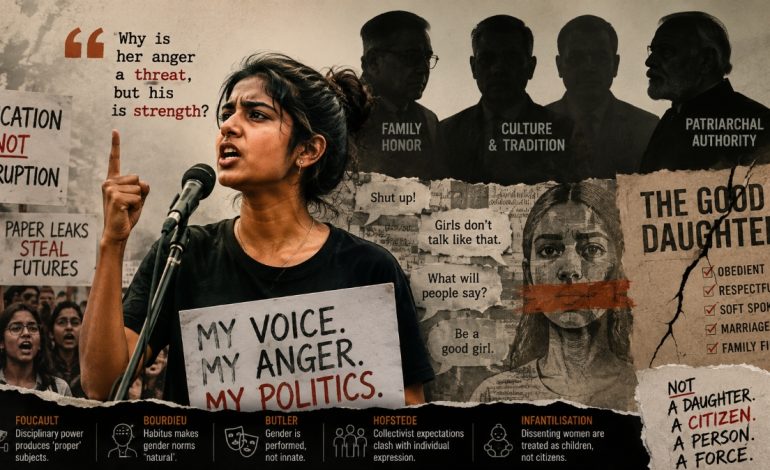

There is an unsettling question hiding beneath young women’s language: are we really offended by the words? or are we just pretending that the question of profanity becomes bigger when it comes out from the mouth of young women? The bigger question is why Prime Minister MODI felt cultural shock when some young protestors at the Jantar Mantar protest hurled abuses against him. This artciles delves into exploring what happens When Daughters Swear.
This article delves into unravelling assumptions behind Modi’s cultural sock remark. Does cultural sock exclusively originate from linguistic profanity of young women? And, it has nothing to do with abuses hurled on daily prime time shows, or foul language used by Modi himself in his several speeches, or is it purely a case of selective morality?
The case of Ruchika Singh, a resident of Noida, exposes duplicity involved in establishing morality in the society. She used abusive language against the Prime Minister at the Jantar Matar protest site during a movement led by the Cockroach Janta Party (CJP) in July 2026. Police registered a zero FIR against her under section 352 (1), 353(1) and 356 (1) of Bhartiya Nyaya Sanhita (BNS). The applied sections deal with breach of peace, promoting public mischief and defamation. This explains in volume abuse of profanity has not been criminalised by the BNS. Importantly, she is only a 15-year-old minor girl. The police not only lodged FIR but also facilitated IT cell members to threaten the girl, make an apology video and post on social media.
Referring to the Ruchika Singh case and many other abusive videos, Prime Minister Modi says that he has experienced a cultural shock. Why he does not encounter similar experience when his supporters such as IT cell and abusive people whom he follows on X use abusive and intimidating language against his opponents. Why does he not encounter cultural shock when his own party members use abusive language in the parliament?
In a late-night selfie video released on Instagram, Prime Minister Modi says that kids are misguided and he is ready to forgive them (Deccan Herald, 2026). Modi acts as the cultural Guardian of India. But some recent incidents expose the duplicity involved in Prime Minister Modi’s cultural exposition video, where he categorically states that he has experienced cultural sock due to abusive language used by young women.
Why do some profanities hurled against the Prime Minister become a cultural catastrophe, particularly when it emerges from the mouths of young women, not boys? This distinction is everything: boys can swear but girls must behave. This also invokes the question of patriarchy.
According to anthropologist Kalervo Oberg, people experience cultural shock when they practice in conflict with familiar cultural expectations. But what if unfamiliar practice originates from the same culture? What if it comes particularly from young women, your own daughter? This is where the concept of cultural shock becomes fascinating.
For a patriarchal observer, this so-called cultural shock becomes more intriguing. In fact, the real cause of this shock is not profanity as it is hardly new, as it has always remained part of the society, culture and politics, but within the exclusive domain of men. This sock becomes real when it comes out from the mouth of a female speaker.
It is important to note that profanities are not a language in themselves, but are used and understood across languages or bhasas, as they sharpen any expression or language of protest (Chishti, 2026). Importantly, the linguistic corpus of the mainstream political discourse has continued to visualise inhabitants of Indian republic within domains of reformed domesticity and familial morality, concentrating on the exclusive role of women in maintaining purity. Proponents of Ram-Rajya will always invoke societal order where Sita must prove her chastity (Agni-Pariksha).
The concept of patriarchy has been deeply encoded in societal norms since epic eras such as Ramayana and Mahabharata, although modernity has gradually dampened the chilling effect of patriarchy. Yet hierarchical gendered identifies, ideological constructs and institutions continue to define sexuality, conjugality, womanhood and motherhood as an inherent part of the moral order of the nation building project, where female sexuality becomes more controlled, monogamous, reproductive and embedded in attributes such as affection, care, sacrifice and benevolence. Patriarchal power therefore expects exhibition of these attributes from women.
Pierre Bourdieu provides a useful vocabulary for understanding this phenomenon. His concept habitus expounds social norms are embodied by society through the deeply embodied disposition. Patriarchal power has continued to embed morality of Sita, not Draupadi who questions, in social norms. Society continues to treat men and women differently. Men are aggressive but women must be graceful. It is normal for society that Rama abandoned his pregnant wife to maintain Rajdharma.
We are simply made to feel that way: a shouting man sounds powerful but a shouting woman sounds hysterical. A man confronting authority can appear rebellious but a woman can be labelled as out of control if she dares to confront authority. This hierarchical lens becomes common sense.
Judith Butler’s theory of gender performativity expounds the concept of cultural sock as experienced by Prime Minister Modi. By invoking the concept of gender performativity, she Butler argues that femininity is performed continuously through repeated acts and speech is an inherent part of repeated acts. The good woman is expected to speak in a retained, polite, non-threatening and measured manner. This can be considered as a gendered script of language. But what happens when a young woman refuses that gendered script? FIR? Intimidation? Arrest?
Micheal Foucault’s concept of disciplinary power insinuates that power does not only operate through censorship but also operates through classification of speech. Some speeches are called respectable. Some speeches are rendered vulnerable. Some speeches are considered as rational whilst some are dismissed as emotional. When the Prime Minister himself makes grossly offensive remarks against opponents, they are merely termed as a powerful attack on opposition parties. But the Prime Minster demonstrates he is ready to forgive young women, who have engaged with abusive linguistic discourse against him, because they are misguided kids.
This is nothing but infantilisation of the subject. Here the authority (Modi) assumes the position of parental authority and young women protestors become children. Rather than responding to political criticism, Modi treats young autonomous women as immature and misguided children. The motive of the Prime Minister is not dispelling voices of young women protestors in totality but to produce a properly behaving subject. A good daughter does not speak like this, for instance.
Hofstede’s framework of cultural dimension distinguishes societies as how people are primarily considered as autonomous individuals or as members of closely interconnected social groups. India is predominantly a collectivist society, although focus on young people is shifting towards more individualistic norms. In collectivist cultural settings, identity is strongly seen as relational. The concept of relational identity does not perceive young women as autonomous individuals, rather identity is seen in relation to her parents, her upbringing, her community and her gender. The patriarchal figure responds: how can our daughter speak like this?
In a collectivist society, social harmony, respect for hierarchy and family reputation carry significant weight. Patriarchal figures associate profanity with purity and impurity, and Patriarchal figures have often fascination with Sita’s Agni-Pariksha. The onus of maintaining purity exclusively resides with women.
The reaction of Prime Minister Modi towards young women protestors therefore can be considered as the reaction of the patriarch who is still reluctant to grant women with autonomous status. Profanity by a man can be seen as normal but profanity by a woman becomes an embarrassment to an entire culture. Yet India Gen Z has started abandoning collectivist norms, which can be considered as a powerful step towards dismantling or smashing patriarchy.
Chandra, D. 2026
Bibliography
Deccan Herlad, 2026. ‘Abuses never solve anything’: PM Modi’s new video message: https://www.deccanherald.com/india/abuses-never-solve-anything-pm-modis-new-video-message-4095094
Ibrahim, S.M. 2020. Individualism-collectivism score for India has me baffled…: PennState: https://sites.psu.edu/global/2020/11/02/individualism-collectivism-score-for-india-has-me-baffled/
Mamnani, H. 2026. The selective morality of online outrage, Frontline: https://frontline.thehindu.com/politics/ruchika-singh-bulli-bai/article71309148.ece
Pandey, G. 2026. The question dominating Indian politics: Is it worse when women swear?, BBC: https://www.bbc.com/news/articles/cy0zn6gy7zjo
Chishti, S. 2026. Neem ka Patta Kadwa Hai…Offended by B*, C*, M* and F* Words?, Wire: https://thewire.in/politics/neem-ka-patta-kadwa-haioffended-by-b-c-m-and-f-words
O’Neill, J., 1986. The disciplinary society: from Weber to Foucault. British Journal of Sociology, pp.42-60.
Sarangi, A., 2009. Languages as women: The feminisation of linguistic discourses in colonial North India. Gender & History, 21(2), pp.287-304.