


After a long spell of Puritanical Republicanism, The period of Restoration (1600-1700) brought about a deliberate reversal of the puritan ethic. The restoration of Charles II brought an abrupt break with the Republican past and subsequently to the monarch’s natural inclination – created an atmosphere in which occasional promiscuity and systematic frivolity was favoured and concomitantly the system paid much more attention to the arena of “social mannerism “largely appealing to the city-dwellers, lords, gentlemen and merchants (Narayan, pp.112-113). As per the ‘M.H Abrams and Geoffrey Galt Harpham glossary of literary terms’ – The phase of Restoration was emblematic of urbanity, courtesy, wit and licentiousness which was crystallized in and around the court, positing itself in stark contrast with the gravity and sobriety of the Puritanical regime (Abrahms & Harpham, pp.282).
The period of restoration tried to alter the social fabric of the English society through the aid of restrained measures and consequently provided a tapered window of representation to women dramatists, writers and actors. However, in the literary-cultural domain it cannot be attributed as an movement that sprouted equality between the two genders, it was more of an entertainment-centric approach to break the ice of puritanical ethicality that condemned entertainment and pleasure as devious and conniving acts (Kanwar & Prakash,pp.13-14). However, this novel web of social interactions, pleasures and hedonism attracted women belonging to aristocratic circles towards the centre of this ‘London social-world’ where they crossed swords with men in the battle of wits and arts. Considerably, the theatres witnessed the spectacle of women actors- who in turn must have titillated the male audience with their unavoidable presence. Thus, the restoration theatre ascribed an unparalleled public presence and social character to women (Hughes, pp29). conversely, Women actors were subjected to objectification, were seen as objects of lust, gossip, seduction and occasional assault as per ‘Derek Hughes’ who neglects the very idea that Restoration theatre provided the ultimate artistic liberty which women actors and writers aspired, even though this paradigmatic shift offered admiration and approbation to women artists- it remained restricted to those who keenly followed the hegemonic conventions of this abhorrently male-dominated circuit of literature and culture. In this purview, Aphra Behn’s writings, thoughts and her ultimate unadulterated, uncensored expression of female sexuality often proffers her the reputation of a deviant woman dramatist. Behn’s position as the first British woman to earn her living as a creative writer might make her seem a susceptible and marginal figure, and it is easy to locate misogynist satire mocking her and her unflinching capability to utilize female sexuality as a poignant instrument of social and political liberation for women.
In this respect, this paper makes a sincere attempt to discuss and further examine Aphra Behn’s “Rover” as a restoration drama which endeavors to accentuate the political condition of Britain with the aid of sexual politics.
Robert Gould, a preeminent satirist attacked Behn at several occasions – In his “satyrical Epistle” he wrote;
“For Punk and Poesie agree so pat
You cannot well be this, and not be that. “
Shortly, Gould appreciatively quoted the Earl of Rochester’s observation that ‘Whore’s the like Reproachful Name / As Poetress [sic]’. These instances are routinely produced as strong evidence of the marginal, vulnerable and despised position of Women writer’s even in the ambit of Restoration dramas, which were supposedly less conservative in comparison to Elizabethan and Jacobean plays. It is again imperative to note that Gould warmly admired Katherine Philips; however his criticism and violent remarks were exclusively reserved for women dramatist like Behn, who indulged in “dirty plays” involving explicit portrayal of female sexual desire (Hughes, pp.30-31).
Restoration drama significantly made a drastic departure from the Elizabethan and Jacobean plays in terms of its portrayal of sexuality, as in the case of the former – sexual desire was often viewed through the lens of immorality, sin or an exclusive characteristic of love and marriage. Asha kanwar and Anand Prakash quite scrupulously notes that “sexuality had all along been a question of male activism and domination in relationships while women were constricted to beautiful, aesthetic and gullible expressions of sexual desire.”However, Restoration drama broke these gendered notions of sexual expression and tried to place male and female sexual conduct on the same pedestal. But a social evaluation of sexual and erotic expression outside the domain of artistic representation reveals an alternate reality – the pseudo-expression of female sexuality offered by the mainstream market male dramatist was mere display of eroticism as per Aphra Behn. Behn was simply not content with presenting ‘eroticism’ on stage; her intention was to fabricate authentic female expectations in sexual love which is evident through her fictional and poetic pieces such as “The Disappointment”, “Desire”, “Love Letters between a Nobleman Contemporary and His Sister”. Thus, Aphra Behn endeavored during her period, torn between the ‘Republican sincerity’ and the ‘ethos of Royalism’, she embraced the Royalist artistic freedom to evolve woman in an earthly material entity, a human being whose biology deserved elaborate mention in her inventive agency and artistic presentation (Prakash, pp.163).
Shyamala A. Narayan in her essay titled “The Rover as a Restoration Comedy” lays substantive arguments validating Aphra Behn’s Rover as a Restoration comedy, however her work equally delves in addressing the important strain as to how Behn’s restoration comedies are crucial commentaries on the social status of women in an grossly patriarchal social framework. Narayan in her essay underscores the significance of the title “Rover”. Since the play is set during the interregnum (1642-1660), a period when numerous Royalists, referred to as “Cavaliers” had pursued the path of Prince Charles into exile. The leading male characters in Behn’s play – Belvile, Willmore and Fredrick were all cohorts of the English monarch in exile. Subsequently, the word “Rover “connotes to multiple meanings; a traveler, a sea-robber and someone with a roving eye attributed to an inconstant male lover (Narayan, pp.117).
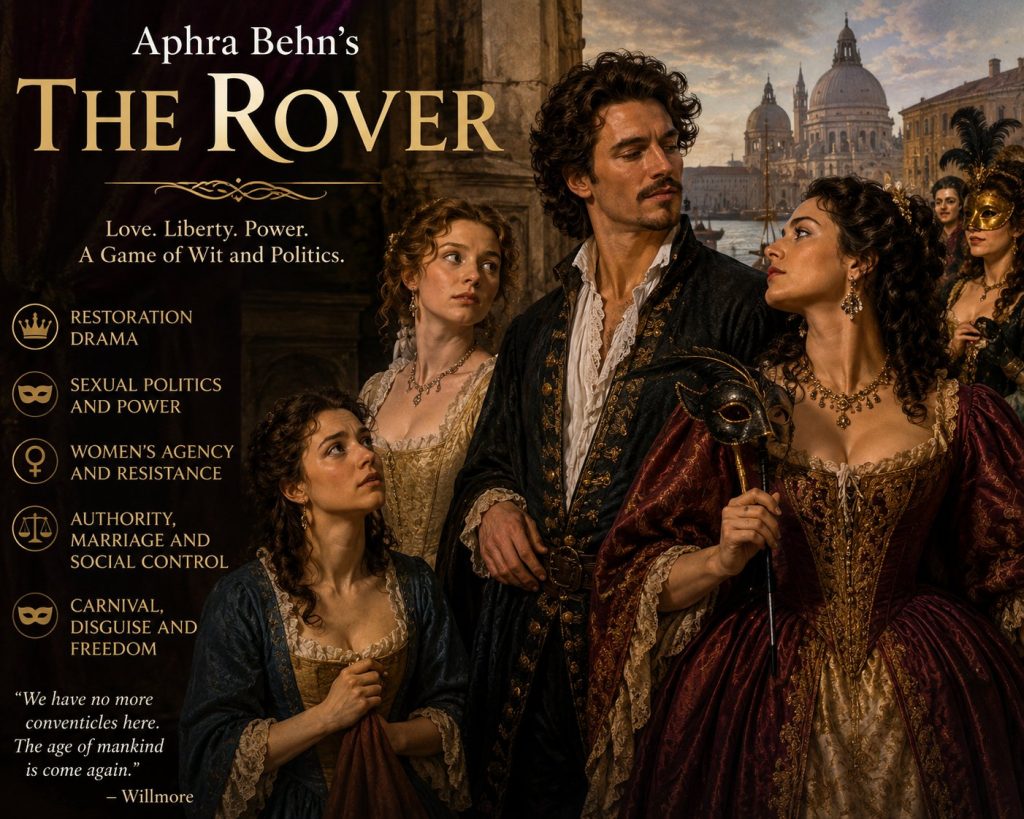
The Rover appears to be actively celebrating the “Carnivalesque” – where masquerade, overindulgence, promiscuity and disguises are sanctioned, allowing a distinctive exploration and subversion of social ideals and realities. The inherent idea of the “Carnivalesque” was concretized by the Russian critic Mikhail Bakhtin in his study of the seventeenth – century prose satirist – “Francois Rabelais”. Bakhtin enumerates upon carnival as an event which negates all rules, inhibitions, restrictions and regulations specifically in the hierarchical structure of the society. Thus, The Rover as a restoration comedy interweaves issues of gender dynamics, social hierarchies and identity in a carnivalesque backdrop wherein subterfuge is used as an effective instrument to pit characters against social rebellion and to test their virtues. The women in the drama or as per Critic Elin Diamond the “Virgin commodities” employ the masquerade as a means of obscuring their identity and rather emphasizes on their otherwise subdued sexuality (Stevens, pp.1-2).
The drama commences with an effective exposition; laying out emphasis on its major thematic currents of sex, marriage and rebellion;
“Florinda ; with indignation; near soever my father thinks I am to marrying that hated object, I shall let him see I understand better what’s due to my beauty, birth and fortune, and more to my soul than to obey those unjust commands” (The Rover; Act 1, scene1, pp.6).
“Hellena ; And dost thou think that ever I’ll be a nun? Or at least till I’m so old I’m fit for nothing else? Faith no, sister; and that which makes me long to know whether you love Belvile, is because I hope he has some mad companion or other that will spoil my devotion. Nay; I’m resolved to provide myself this Carnival, if there be e’er a handsome proper fellow of my honour above ground, though I ask first” (The Rover; Act 1 scene1, pp.7)
Herein, parental and patriarchal tyranny has been explicitly served – denying liberties to Florinda and Hellena. Florinda has been forced by her brother Don Pedro to marry rich old Don Vincentio and consequently, Hellena who has been established as a fearless and opinionated personality has been compelled to join a nunnery – as a way of repressing her ripened appetite for sexual adventure. Further to this Narayan comments that ‘the young girls are filled with a spirit of rebellion.’ Aphra Behn introduces this proffering as to how women become the commodities in transactional relationship between men, evident in the case of Don Pedro and Don Vincentio. On the other hand, Behn overtly presents this idea as to how religion has been exploited as an sturdy medium of repressing the sexual agency of women, as a way of taming them and further succumbing them to patriarchal suppression, lucidly expressed through the case of Hellena.
Scholars have widely juxtaposed the socio-political views of Hellena and Aphra Behn collectively; the analogy drawn between them quite prominently reveals a stern alikeness of their thoughts pertaining to women aspirations, subjugation, sexuality and desire (Narayan, pp.118).
“Hellena : What jewels will that cavalier present you with? Those of his eyes and heart?”
“Hellena: Better than to believe Vincentio’s deserve value from any women. He may perhaps increase her bags, but not her family “(The Rover, Act 1, and Scene1, pp.8).
Here, Hellena’s overt mockery of Don Vincentio, her sheer act of valour to stand up against the patriarchal forces corroborates the arguments posed by many scholars and critics’ including Shymala A. Narayan that Hellena is identical to Aphra Behn in terms of her character and thoughts. Moreover, Hellena’s audacity to talk about sexuality and offer pre-eminence to her sexual desires over moral and social codes reflects the intrinsic concerns of Behn. Therein, Hellena’s inherent visualisation as a female Rover serves as Behn’s careful portrayal of a female character that can be posited together with the male Cavaliers both in terms of explicit display of sexuality, political affinities and being a potential catalyst for a social reform.
“Rover” tries to embody Behn’s intrinsic political affinity with the “Royalists” through its portrayal of “cavaliers” like Willmore and Belvile. Szilagyi in his essay forays that “The Rover” could be seen as anachronistic, either ahead of its time or behind it; its revival of the myth of the cavaliers, its link of Charles’s reinstatement to an unambiguously celebrated ethos of pleasure and wit, stands suggestively between the comedies of Restoration and the revival of Stuart iconography that follows on Charles’s decision to rule without parliament” (Szilagyi, pp.436). Aphra Behn’s carefully pieces and places her protagonist – “The Rover “, Willmore within the larger narrative structure. Aphra Behn carefully weaves many topical references into her play; Blunt’s reference to the debonair cavaliers being “Kept so poor with parliaments and protectors” would have stroked a sympathetic chord in the court audience, many of whom had their land confiscated by the British parliament headed by Oliver Cromwell. Such allusions frequently reverberated Behn’s political ideology.
Conclusively, the carnival and the ‘carnivelasque’ in the Rover thus confront individual and social identities in terms of women’s sexual liberties and patriarchal dominion. The standpoint that Aphra Behn takes on the carnival is coupled with social change, and she dramatizes a cultural conflict between moralistic, didactic and transgressive imperatives, equanimity and subsequently adventure. Through the vibrant imagery of the “Cavalliers”, Behn tried to present her innate political opinions staunchly supporting the “Royalists”. Concomitantly, Behn tried to emphasize the social characterization of women as “Virgin commodities” who are compelled to subdue their sexual desires in order to fulfill patriarchal expectations.
REFERENCES AND CITATIONS
- Abrams & Harpham. “A Glossary of Literary Terms”, eleventh edition, 2020, pp. 282
- ”APHRA BEHN’S (NON) CANONICITY AS A RESTORATION PLAYWRIGHT”. Quaderns de Filologia. Estudis Literaris. Universitat de València, Vol. X (2005) 231-246
- Bakhtin, Mikhail, Problems of Dostoevsky’s Poetics, ed. and trans. by Caryl Emerson (Manchester: Manchester University Press, 1984).
- Corse, Taylor. “Seventeenth-Century Naples and Aphra Behn’s ‘The Rover.’” Restoration: Studies in English Literary Culture, 1660-1700, vol. 29, no. 2, University of Tennessee, 2005, pp. 41–51, http://www.jstor.org/stable/43293972.
- Franceschina, John. “Shadow and Substance in Aphra Behn’s ‘The Rover’: The Semiotics of Restoration Performance.” Restoration: Studies in English Literary Culture, 1660-1700, vol. 19, no. 1, University of Tennessee, 1995, pp. 29–42, http://www.jstor.org/stable/43293595.
- Gallagher, C. (1999). “Who was That Masked Woman? The Prostitute and the Playwright in the Comedies of Aphra Behn”. In: J. Todd (ed.) (1999): 12-31. This article was originally published in Women’s Studies, 15 (1988), and reprinted on several occasions.
- Hughes, D. (2001). The Theatre of Aphra Behn. Basingstoke: Palgrave.
- Narayan, S. The Rover as a Restoration Comedy, “Aphra Behn; the Rover worldview critical editions”, Worldview Publications, Delhi, 2018, pp.111-125
- Pacheco, Anita. “Rape and the Female Subject in Aphra Behn’s ‘The Rover.’” ELH, vol. 65, no. 2, Johns Hopkins University Press, 1998, pp. 323–45, http://www.jstor.org/stable/30030182.
- Szilagyi, Stephen. “The Sexual Politics of Behn’s ‘Rover’: After Patriarchy.” Studies in Philology, vol. 95, no. 4, University of North Carolina Press, 1998, pp. 435–55, http://www.jstor.org/stable/4174621.
- Wynne-Davies, Marion. “Orange-Women, Female Spectators, and Roaring Girls: Women and Theater in Early Modern England.” Medieval & Renaissance Drama in England, vol. 22, Rosemont Publishing & Printing Corp DBA Associated University Presses, 2009, pp. 19–26, http://www.jstor.org/stable/24322796.
Chandra, S. 2026


