


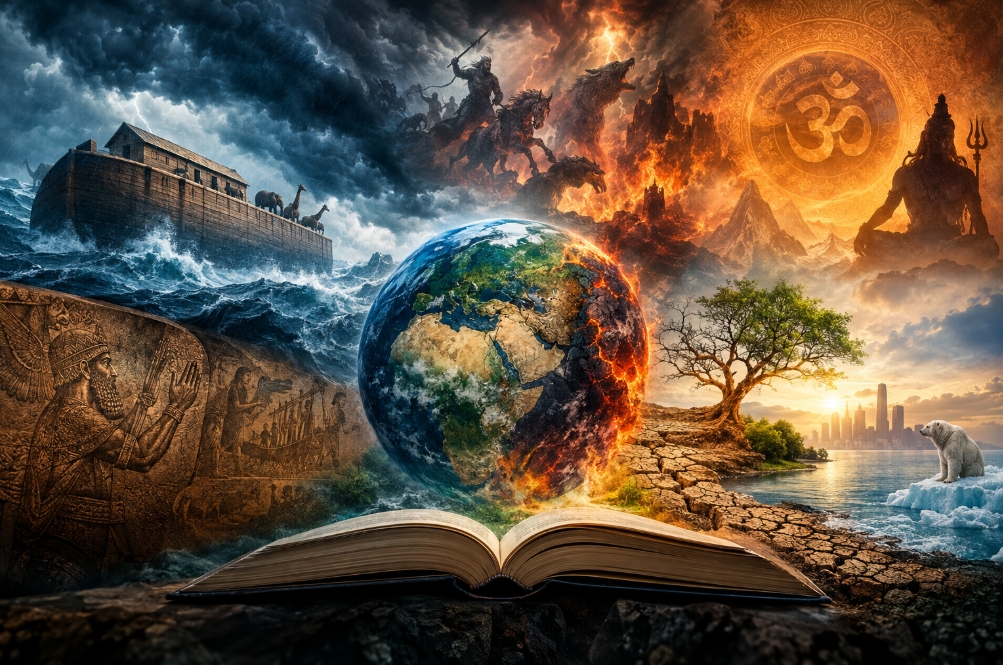
For millennia, the high peaks and glaciers in the Himalayas have remained held together by an invisible frozen cement (The Guardian, 2026). Several climate disasters, including the recent one in Nepal, caused by glacial collapse, reminds us that the end of the world is far nearer than we imagine (Wong, 2026). The World Meteorological Organisation (WMO) has warned that situations of extreme floods, droughts and extreme heat across the globe will worsen in coming years (Aljazeera, 2026). But what Apocalyptic Imaginaries say about the world’s destruction?
The subject ‘the imagination of the world’s destruction’ has occupied significant position, but with diverse interpretation, across religious texts, mythology, epic literature and contemporary cultural narratives. Yet the catastrophic flood has remained a common cause the world’s destruction across mythological and epic literature, ranging from the Epic of Gilgamesh to Norse mythology to Hindu cosmological traditions. Apocalyptic Imaginaries have continued to shape humanity’s understanding about mortality, divine judgement, ecological disaster and renewal, although these narratives emerge from radically different cultural, theological and historical contexts.
In the Epic of Gilgamesh, the god Enki (Ea) revealed Utnapishtim to prepare a giant ship to preserve life because the forthcoming giant flood would wipe out all life. The most popular account of flood myth linked to Noah finds prominence in the Old Testament (bible). The biblical tale finds linkage with ancient Sumerian mythology, wherein a group of gods, the Annunaki send a flood to destroy earth just as they get angry with the noise created by humans. Similar accounts of flood stories appear in Jewish and Islamic myths.
In the 21st century, myriad factors including rising temperatures, rise in sea-level, biodiversity loss, droughts, wildfires and ecological displacement have continued to generate apocalyptic imagery. Yet reading climate change through mythological and cultural lens can provide a completely new perspective about looming environmental catastrophe. It can provide better understanding of how different cultures have historically negotiated anxieties concerning collapse and reconstruction of their worlds.
Every culture expounds flood mythology differently. The earliest reference of flood in Hindu mythology is found in Satapatha Brahmana. This story has been repeated in the Vishnu Purana. The story begins with Manu, the first man and legendary author of Manusmriti. Manu saves a small fish and facilitates the fish to grow. Many years later, a small fish transforms into a gigantic fish. The fish tells Manu to build a boat to protect himself from the forthcoming flood.
Here flood is shown as the result of human greed, cultural corruption or the aging process of the world. It has nothing to do with the gods’ anger or the disobedience of humanity. A radically different model of apocalypse emerges from Norse mythology through the narrative of Ragnarök. The mythology explains that an environmental catastrophe emerges out of a profound collapse of divine, cosmic and social order. Fire and water together contribute to an environmental catastrophe due to break-down of established relationships between gods, humans and monsters.
Hindu cosmological imagination conceptualises existence through vast cycles of creation, preservation, dissolution and recreation. The concept of pralaya can be associated with cosmic dissolution. The concept of destruction has remained the central foundation of almost all mythological storytelling. Both mythological storytelling and cultural narratives imagine natural forces as powerful and unpredictable. Environmental scientists predict that glaciers and ice sheets in polar and mountain regions are melting faster than we imagine, causing rise in seal levels. Almost 40% of the world population live within 100 KM of coastal regions. The world is already at 1.4 C above pre industrial level, which is not far from the scientifically accepted limit of 1.5 C (the Paris climate accord). Importantly, the UN has admitted that the earth has lost its chance to prevent some of the worst global warming. The ‘End of the World’ is therefore nearer than we imagine.
Mythological Apocalyptic Imaginaries are more than stories of destruction or renewal. They provide literary perspective concerning the very foundation through which different cultures have historically confronted environmental vulnerabilities, and what causes a climate disaster? Human greed or something else.
Greed can be certainly accepted as the most imperative reason behind climate disasters and the biggest even climate disaster that is looming. Literature cannot predict climate change but it offers an ethical lens and vocabulary through which catastrophe can be understood. It provokes us to pose a pertinent question of morality: to what extent can we tolerate the greed of industrialists and conglomerates? We must raise our moral voice for preserving our planet before it is too late. Otherwise, we each must build a vessel to save our lives, just like our epic heroes Gilgamesh and Manu.
We all must pose a final question: “What kind of world will we choose to imagine—and therefore attempt to preserve—before it does?”
Author: Chandra, D. 2026
Citations
Aljazeera, 2026. UN warns El Nino could be ‘off the charts’, strongest in decades: https://www.aljazeera.com/news/2026/9/3/un-warns-el-nino-could-be-off-the-charts-strongest-in-decades
The Guardian, 2026. Nepal’s glacial collapse foreshadowed a future of climate disaster: https://www.theguardian.com/commentisfree/2026/sep/01/nepal-flooding-climate-disaster
Wong, T. 2026. Collapsed glacier likely caused devastating Nepal-Tibet floods, scientists say [online] https://www.bbc.com/news/articles/cly464k252yo
https://www.britannica.com/topic/Utnapishtim
https://devdutt.com/flood-myths/
https://www.un.org/en/un75/climate-crisis-race-we-can-win
https://www.cbc.ca/news/science/unep-climate-paris-global-warming-9.7329305


