


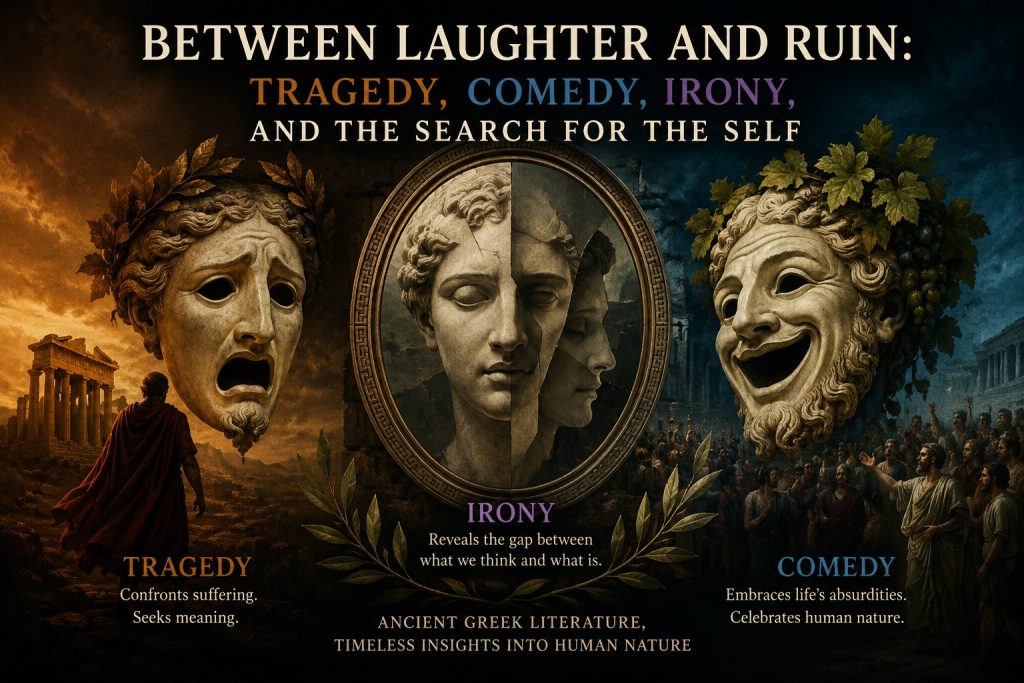
Who Are We? The Ancient Question Hidden Inside Modern Selfhood
The modern world is fascinated with the idea of the “self.” Psychologists investigate identity, philosophers debate consciousness and agency, and sociologists examine how relationships shape who we become. We often treat the self as a distinctly modern concept—a coherent center of thought, memory, and experience.
Yet long before the emergence of modern psychology, the ancient Greeks were already grappling with questions that continue to haunt us today: What makes us who we are? Are human beings unified or fragmented? Do our lives follow a meaningful pattern, or are they governed by chance, contradiction, and reversal?
Although ancient Greek literature lacks a direct equivalent to the modern term “self,” its poets and playwrights relentlessly explored the human condition. Through the intertwined genres of tragedy, comedy, and irony, they offered profound insights into identity, agency, and human experience. These literary forms became laboratories for examining what it means to be human.
The story of self-understanding in Greek thought unfolds not through philosophical definitions alone, but through dramatic encounters with suffering, laughter, contradiction, and Tradegy-Commedy Paradox
Aristotle’s Tragic Self: Searching for Order in Human Experience
No discussion of tragedy can begin anywhere other than Aristotle’s Poetics, perhaps the most influential work of literary criticism ever written.
Aristotle’s project emerged from an intellectual battle already centuries old: the conflict between philosophy and poetry. In Plato’s Republic, Socrates challenges the authority of poets as interpreters of human life. Philosophers sought to replace poets as guides to morality, truth, and conduct. Yet Aristotle took a different path. Rather than dismissing poetry, he attempted to explain its unique power.
For Aristotle, poetry is not merely entertainment. It produces pleasure, but a pleasure intimately connected to human flourishing. Tragedy, in particular, possesses a remarkable ability to awaken powerful emotions—fear, pity, grief—and then guide audiences toward catharsis, a state of emotional clarification and release.
What makes tragedy so powerful is its ability to transform isolated events into meaningful patterns. In everyday life, suffering often appears random and incomprehensible. Tragedy reorganizes these experiences into coherent narratives, revealing connections that might otherwise remain hidden.
This raises a crucial question: Is the pattern presented by tragedy merely artistic, or does it reflect the true structure of human existence?
Aristotle leaves this question unresolved. Yet his theory suggests a compelling vision of selfhood. The tragic hero becomes more than an individual character; he stands as a representative figure through whom audiences encounter universal truths about human vulnerability, ambition, responsibility, and fate.
The Aristotelian self is therefore fundamentally patterned and intelligible. Human life acquires meaning through narrative coherence. The tragic stage becomes a mirror in which audiences glimpse the deeper structure of their own existence.
When Laughter Takes the Stage: Aristophanes and the Comic Self
If Aristotle seeks order, Aristophanes celebrates disorder.
The comic world of Aristophanes operates according to very different principles. His plays move effortlessly between political satire, parody, obscenity, fantasy, and social commentary. His language is playful, excessive, unpredictable, and constantly shifting in tone.
Where tragedy searches for unity, comedy thrives on discontinuity.
Aristophanes fills his works with interruptions, absurd reversals, unexpected intrusions, and linguistic surprises. Characters transform suddenly. Events unfold through improbable chains of action. Rational causality often gives way to comic association.
Yet beneath the laughter lies a sophisticated understanding of human nature.
Unlike Aristotle, who imagines the self through patterns of coherence, Aristophanes presents human beings as fundamentally inconsistent. His characters frequently contradict themselves, shift identities, and reveal conflicting desires. They do not necessarily develop psychologically; instead, they undergo reversals, inversions, and transformations.
This comic vision feels strikingly modern.
Contemporary theories of identity often emphasize fragmentation, contradiction, and multiplicity. Rather than possessing a single unified essence, individuals navigate competing roles, desires, and social expectations. Aristophanes anticipates this perspective centuries before modern psychology.
His comedy suggests that selfhood may not be a stable structure waiting to be discovered. Instead, it may be a dynamic process of negotiation, performance, and reinvention.
Why Tragedy Needs Comedy—and Comedy Needs Tragedy
A common assumption treats tragedy and comedy as opposites. One deals with suffering, the other with laughter. One descends toward catastrophe, the other rises toward celebration.
Aristophanes challenges this neat division.
His plays repeatedly draw upon tragic themes, tragic language, and especially the innovations of Euripidean drama. Rather than mocking tragedy from a distance, comedy enters into dialogue with it. Tragedy becomes a source of creative energy for comic experimentation.
This relationship reveals something profound about human experience.
Life itself rarely conforms to strict generic boundaries. Moments of despair can suddenly become absurd. Triumphs often contain seeds of failure. The tragic and comic constantly overlap.
Aristophanes demonstrates that these genres exist not as opposites but as points along a continuum. Each illuminates aspects of reality that the other cannot fully capture on its own.
Tragedy reveals the weight of human existence; comedy exposes its instability.
Together, they produce a richer understanding of what it means to be human.
The Role of Irony: Living Between Contradictions
Between tragedy and comedy stands irony.
Irony emerges whenever expectations collide with reality, whenever certainty gives way to ambiguity, whenever human beings discover that they understand less than they imagined.
In many ways, irony is the defining condition of selfhood.
We imagine ourselves as rational and coherent, yet our actions frequently contradict our intentions. We pursue goals that transform us unexpectedly. We construct identities that are continually challenged by circumstance.
Irony exposes the gap between who we think we are and who we become.
In tragedy, irony often appears as fate. Characters move toward outcomes they unknowingly create. In comedy, irony emerges through reversals, misunderstandings, and absurd transformations.
In both forms, irony forces self-recognition.
By confronting contradiction, individuals become aware of the limits of their knowledge and the instability of their assumptions. Irony therefore serves as a bridge between tragedy’s search for meaning and comedy’s celebration of uncertainty.
A Fragmented Yet Meaningful Self
The contrast between Aristotle and Aristophanes reveals two enduring models of selfhood.
Aristotle imagines a self that seeks coherence. Human experience gains significance through narrative patterns, moral choices, and emotional understanding. Tragedy becomes a means of discovering the universal dimensions of existence.
Aristophanes offers a different vision. The self appears fragmented, discontinuous, and endlessly adaptable. Comedy reveals human beings as creatures of contradiction, improvisation, and transformation.
Neither vision is sufficient on its own.
The human self is both coherent and fragmented, both stable and changing, both serious and absurd. We seek meaning while simultaneously encountering uncertainty. We construct identities while constantly revising them.
Tragedy teaches us to confront suffering. Comedy teaches us to survive it. Irony teaches us to reflect upon it.
Together, these literary modes do more than entertain. They provide frameworks through which human beings can understand themselves.
Conclusion: Why the Greeks Still Matter
The ancient Greeks did not possess our modern vocabulary of identity, psychology, or selfhood. Yet their literature remains astonishingly relevant because it addresses the same fundamental questions that continue to define human existence.
Who are we?
Are our lives governed by order or chaos?
Can suffering reveal truth?
Can laughter expose reality?
The enduring power of tragedy, comedy, and irony lies in their ability to stage these questions rather than resolve them. Aristotle and Aristophanes offer contrasting but complementary visions of the self—one searching for unity, the other embracing discontinuity.
Together, they suggest that self-understanding emerges not from choosing between order and disorder, but from learning to inhabit both.
Perhaps that is why tragedy moves us, comedy liberates us, and irony humbles us: each reveals a different face of the human self.
Chaandra, S. 2026
References
Myers, Henry Alonzo. “Aristotle’s Study of Tragedy.” Educational Theatre Journal, vol. 1, no. 2, 1949, pp. 115–27. JSTOR, https://doi.org/10.2307/3203554.
May, Regine & Silk, M.. (2004). Aristophanes and the Definition of Comedy. The Journal of Hellenic Studies. 124. 184. 10.2307/3246166.


