


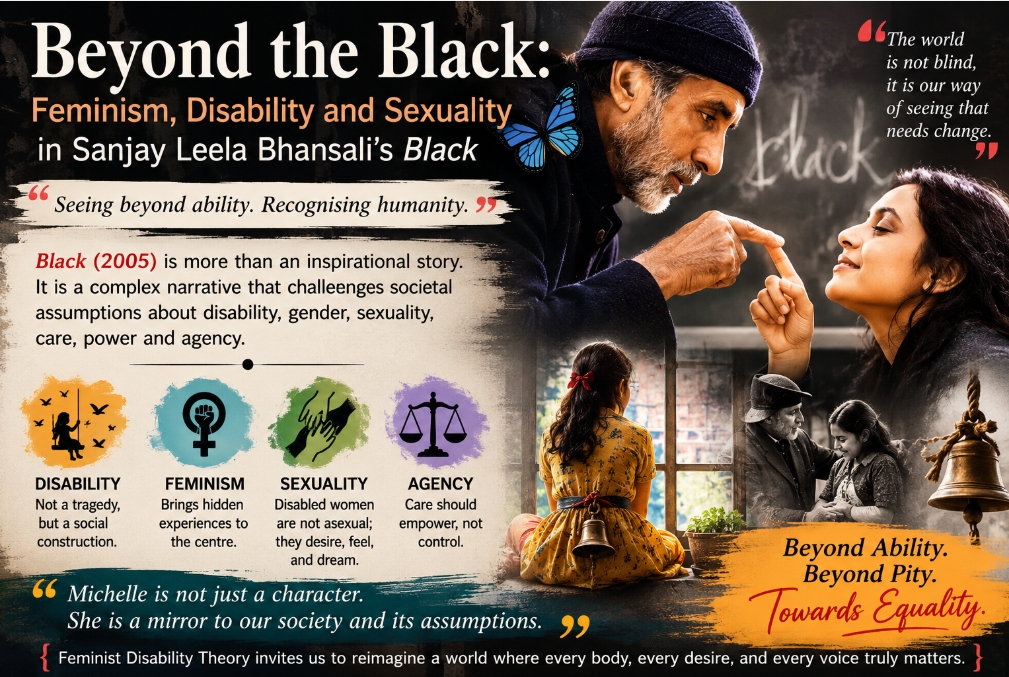
What happens when disability is not simply a condition to be “overcome,” but a question of gender, sexuality, autonomy and social power?
Sanjay Leela Bhansali’s Black (2005) is often remembered as an emotionally powerful and compelling story of Michelle McNally, a deaf-blind girl whose life is eventually transformed by her teacher, Debraj Sahai. However, beneath its inspirational narrative lies a more complex question: does Black genuinely challenge societal assumptions about disability, or does the film reproduce some of the very structures it appears to resist?
Analysing the film through feminist disability theory opens a different way of understanding Michelle’s story. Feminist disability studies ask us to examine disability not in isolation, but through its intersections with gender, bodily difference, sexuality, dependence, care and power. As Rosemarie Garland-Thomson (2020) argues, bringing feminist and disability perspectives together can transform the questions we ask about embodiment and social difference.
When Feminism Forgets Disability
Feminist theory has historically examined questions of patriarchy, bodily autonomy, oppression, reproductive politics, eugenics, equality, and the ethics of care. Nonetheless, disability has often remained marginal within these debates. Concomitantly, disability studies have not always engaged enough with feminist questions of gender and sexuality.
This separation is particularly important because disability is never experienced outside social structures. For instance, a disabled woman encounters disability through gendered expectations about beauty, dependence, marriage, sexuality and femininity.
Feminist disability theory therefore emphasizes two interconnected processes: integration and transformation. Integration means bringing experiences traditionally excluded from feminist discourse into the centre of inquiry. Transformation goes further: it requires us to rethink the assumptions through which knowledge about bodies, sexuality, dependence and normality is produced.
Black becomes particularly interesting when viewed through this framework.
The Bell Around Michelle’s Waist: Disability and Dehumanization
The opening of Black immediately establishes the extent to which Michelle is controlled by her family. A bell is tied around her waist so that her movements can be tracked.
The image is disturbing because it establishes a striking analogy between the treatment of a disabled child and the treatment of an animal. Michelle is not initially understood as a person with agency, desire and communicative possibilities as she is treated as someone whose movements must be monitored and controlled. Her father’s coercive methods reinforce this logic.
Ironically, Debraj Sahai recognizes the dehumanizing nature of Michelle’s treatment withing household confinement, but his own teaching methods overtly depend upon coercion, physical control and discipline. The film therefore creates a paradox: the teacher who liberates Michelle from one form of control often exercises another form of authority over her body.
This contradiction complicates the film’s apparent progressive message.
A feminist disability reading thus asks a perplexing question: Can empowerment be achieved through coercion?
The Problem with the “Inspirational Disabled Person”
Mainstream representations of disability frequently rely on the narrative of overcoming. The disabled character becomes inspirational because they transcend their impairment, usually through exceptional effort or the intervention of a non-disabled person.
Black partially participates in this tradition.
Michelle’s development is presented as a remarkable journey from isolation towards communication, education and independence. Debraj becomes the central agent of this transformation.
But feminist disability theory encourages us to look beyond the individual transformation. Instead of asking only, “How did Michelle overcome disability?”, we should ask:
Why was Michelle excluded in the first place? Who defined her as incapable? Why was her body treated as a problem? And who possessed the authority to decide what a meaningful life should look like?
These questions shift attention from individual impairment to the social construction of disability.
Michelle and the Denial of Disabled Sexuality
Perhaps the most fascinating aspect of Black is its treatment of sexuality.
Disabled people are frequently desexualized in popular culture. Disabled women, in particular, are often represented as innocent, dependent or childlike rather than as sexual subjects capable of desire.
The film exposes this assumption through Michelle’s relationship with marriage and sexuality.
When Michelle’s sister suggests that she will never become a bride, the statement reveals a deeply rooted social assumption: a disabled woman is not imagined as a future wife or sexual being.
More troublingly, Michelle appears to internalize this expectation. Her social environment has taught her that marriage and romantic intimacy belong to other women, not to her. However, the film compellingly captures innate sexual desires and aspirations of Michell when she longs for a kiss to her teacher, Mr Sahay.
This is where Black becomes more than an inspirational story. It reveals how society can regulate sexuality by deciding who is considered desirable, marriageable and capable of intimacy.
Michelle’s Desire: A Radical Moment?
Michelle’s longing for a kiss from Debraj is therefore one of the film’s most significant moments.
Her desire disrupts the cultural fantasy of the asexual disabled woman.
Michelle is not merely a student, a daughter or a person requiring care. She is also a woman with emotional and sexual desires.
That representation is important because feminist disability theory insists that disabled bodies should not be reduced to bodies requiring protection or care. They are also bodies capable of desire, pleasure, intimacy and sexual agency.
However, the film does not completely resolve the ethical complexity of this desire.
The relationship between Michelle and Debraj is structured by a profound power imbalance. He is her teacher, caregiver and guide. She is dependent upon him for communication and education. Consequently, Michelle’s desire cannot be examined only as an uncomplicated expression of sexual freedom.
The film simultaneously challenges the desexualization of disability and raises questions about consent, dependency and power.
That tension is precisely what makes Black worthy of feminist disability analysis.
Feminism, Care and Power
The ethics of care is another important feminist concept through which the film can be read.
Care is frequently associated with dependency, and disability exposes the limitations of a culture that equates independence with human worth. Michelle requires assistance, but requiring care does not make her less autonomous or less human.
The problem begins when care becomes control.
In Black, the boundary between care and domination repeatedly becomes blurred. Michelle’s family controls her because they believe she cannot control herself. Debraj controls her because he believes discipline is necessary for her development.
The film therefore raises an uncomfortable but important distinction:
Care should enable agency, not replace it.
A feminist disability perspective would demand that Michelle be recognized not simply as someone to be cared for, educated or transformed, but as a person entitled to participate in decisions concerning her own body and life.
Does Black Integrate Disability?
The answer is complicated.
The film certainly brings disability into mainstream cinematic discourse. It challenges the assumption that deafblindness automatically means intellectual or emotional incapacity. Michelle is shown as intelligent, ambitious, emotional and capable of learning.
Yet the film does not entirely escape the conventional framework through which disability is represented.
Its narrative remains strongly dependent on the figure of the exceptional teacher. Debraj becomes the person who unlocks Michelle’s potential. This risks shifting attention away from structural exclusion and towards individual heroism.
In this sense, Black makes sporadic but significant attempts to challenge disability-related dogmas, while simultaneously reproducing some of the conventions of inspirational disability narratives.
Its achievement is therefore paradoxical.
It makes Michelle visible—but often through the intervention of another person.
It recognizes her desire—but does not fully resolve the question of her sexual agency.
It challenges dehumanizing treatment—but repeatedly employs coercive pedagogy.
It presents disability as difference—but sometimes frames difference as something that must be overcome.
Beyond the Binary: What Feminist Disability Theory Adds
The greatest contribution of feminist disability theory is that it refuses to treat disability and gender as separate categories. Michelle is not simply disabled. She is a disabled woman, and that distinction matters.
Her experiences of family control, education, sexuality, marriage, care and social exclusion are shaped by disability and gender concomitantly. Her body is interpreted not only according to assumptions about ability, but also according to assumptions about femininity.
This intersectionality allows us to see why the statement “Michelle will never become a bride” is so compelling and powerful. It is not merely an assumption about disability. It is a gendered judgment about who can occupy the socially valued position of wife and sexual partner.
Garland-Thomson’s feminist disability framework is useful here because it encourages us to rethink bodily difference rather than simply accommodate it. Disability should not remain an “additional issue” within feminist theory; it should help transform feminist understandings of embodiment, dependence, sexuality and autonomy.
The Paradox of Black
Ultimately, Black is most compelling not when it offers simple answers, but when its contradictions become visible.
The film challenges the social invisibility of disabled people while retaining elements of the inspirational disability narrative. It exposes the desexualization of disabled women while placing Michelle’s desire within a relationship marked by unequal power. It rejects the treatment of Michelle as an animal while presenting education through methods that can themselves be coercive.
These contradictions do not make the film irrelevant. They make it more productive for feminist analysis.
A feminist disability reading does not have to ask whether Black is simply “progressive” or “problematic.” Instead, it can ask what the film reveals about the cultural construction of disability, femininity and sexuality—and where the film itself remains trapped within those constructions.
Conclusion: Seeing Michelle Beyond Disability
The most important question raised by Black is not whether Michelle can learn to communicate with the world.
It is whether the world is willing to recognize Michelle as a complete human subject—a woman with desires, ambitions, emotions, sexuality and the right to agency.
Feminist disability theory helps us move beyond the familiar narrative of disability as tragedy and overcoming. It asks us to examine the social systems that decide which bodies are normal, which bodies are desirable, which bodies require control and which bodies are permitted autonomy.
In this sense, Black occupies an intriguing middle ground. It does not completely dismantle conventional representations of disability, but it creates moments in which those representations become unstable.
And perhaps that is where its most valuable feminist potential lies.
Michelle does not simply need the world to teach her how to live. The world needs to learn how to see Michelle.
SChandra Literature Team
References
Garland-Thomson, R. (2020). Integrating disability, transforming feminist theory. In Feminist Theory Reader (pp. 181-191). Routledge.
NEGOTIATING SEXUALITY IN THE CONVENTION ON THE RIGHTS OF PERSONS WITH DISABILITIES
Selfie


