


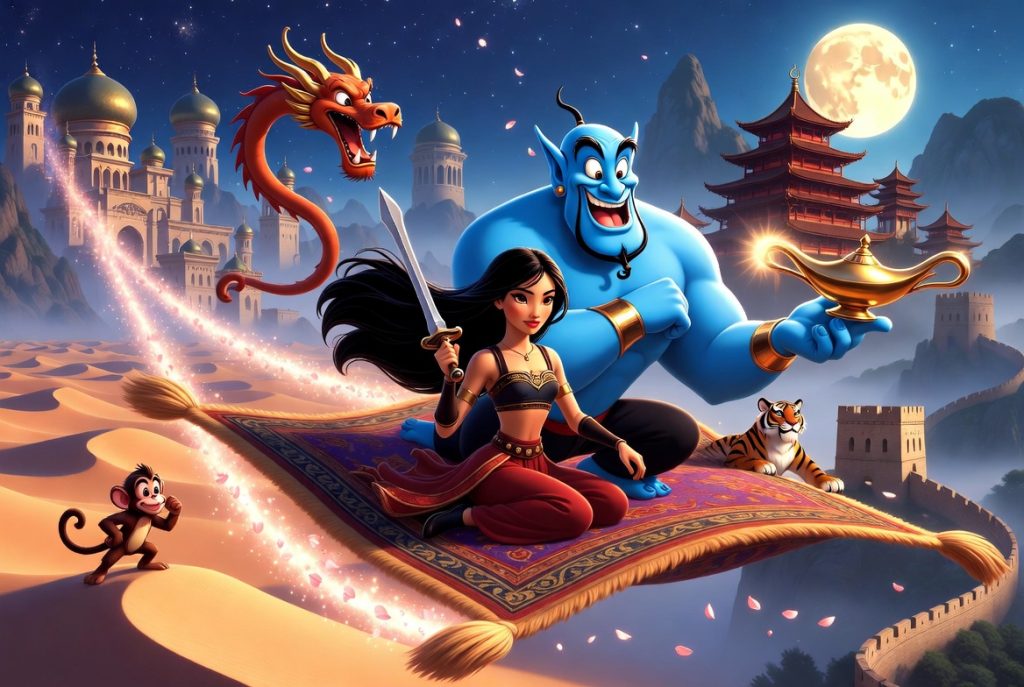
Disney has long been celebrated for transforming folklore into timeless animated classics. Yet beneath the enchanting songs, unforgettable characters, and visually captivating worlds lies a more complicated question: whose stories are being told, and through whose eyes? Disney’s Aladdin (1992) and Mulan (1998) are often praised for introducing audiences to Middle Eastern and Chinese cultures. However, a closer look reveals that Disney’s Aladdin and Mulan do not merely represent the East—they reinterpret it through a distinctly Western lens. The result is not cultural authenticity but a carefully packaged fantasy where exoticism often overshadows reality.
Jorge Luis Borges once remarked that “a major event in the history of the West was the discovery of the East.” This observation captures the historical fascination that has shaped Western portrayals of Asia and the Middle East for centuries. Disney inherits this legacy, transforming diverse civilizations into colorful spectacles that are visually rich but culturally reductive. While the studio appears to celebrate diversity, its narratives frequently rely on Orientalist assumptions that simplify complex societies into familiar stereotypes.
Take Aladdin. Set in the fictional city of Agrabah, the film blends elements from Arab, Persian, Turkish, and Indian cultures into a single imagined landscape. Rather than presenting a coherent cultural setting, it creates an “Orient” that exists only in Western imagination. The opening song introduces the city as a place “where they cut off your ear if they don’t like your face,” immediately associating the Middle East with barbarism and violence before softening the statement with the ironic refrain, “but hey, it’s home.” Even though later versions removed this controversial lyric, the original reveals the ideological framework underpinning the film.
The visual language of Aladdin further reinforces this manufactured East. Characters wear costumes borrowed from different regions without regard for historical or cultural distinctions. Belly dancers are shown with Indian bindis, while architecture, marketplaces, and clothing merge Islamic, Persian, Turkish, and South Asian aesthetics into one indistinguishable backdrop. Rather than acknowledging cultural diversity, Disney compresses centuries of history into an exotic fantasy designed primarily for Western audiences.
If Aladdin constructs an imagined Middle East, Mulan attempts a more respectful engagement with Chinese culture—but ultimately falls into similar patterns. The film opens with majestic images of the Great Wall, traditional Chinese architecture, and the Emperor dispensing wisdom through proverbial sayings such as, “A single grain of rice can tip the scale.” Rice bowls, chopsticks, dragons, and ancestral rituals quickly establish a recognizable cultural atmosphere. Unlike Aladdin, these symbols are not overtly derogatory. Yet they remain stereotypical shorthand for “Chinese-ness,” reducing an immensely complex civilization to a collection of instantly recognizable icons.
The deeper tension emerges in Mulan’s characterization. Within her society, she struggles against rigid gender expectations symbolized by the “perfect bride” sequence, where obedience and domesticity define feminine virtue. While the critique of patriarchy is significant, Disney frames Mulan’s resistance through values that closely resemble contemporary Western individualism. She becomes heroic precisely because she appears ideologically detached from the culture around her. In effect, Chinese tradition becomes the obstacle, while Western ideals of personal freedom provide the solution.
This narrative echoes what feminist scholar Uma Narayan critiques as a colonial tendency to portray Third-World cultures primarily through the lens of oppression. Colonial discourse frequently represented indigenous customs as evidence of backwardness while presenting Western modernity as inherently liberating. Such portrayals often overlook the complex historical struggles within these societies and erase indigenous forms of resistance. In Mulan, the heroine’s empowerment is undeniably inspiring, but the cultural framework surrounding her often serves merely as a backdrop against which Western ideals can triumph.
Perhaps the most revealing similarity between Aladdin and Mulan lies in Disney’s tendency to homogenize Asia itself. In Aladdin, cultural boundaries collapse as Indian, Persian, Arab, and Turkish influences become interchangeable visual motifs. In Mulan, critics have pointed out instances where Japanese-inspired clothing appears within a Chinese narrative setting, illustrating the same tendency to blur distinct cultural identities. Such inaccuracies may seem insignificant individually, but together they reinforce the notion that Eastern cultures are interchangeable—a perception rooted in Orientalist thinking.
Film scholar Suzanne Scurry argues that Aladdin demonstrates not the decline but the persistence of Orientalism in American cinema. Disney’s multicultural turn during the 1990s certainly expanded the geographical scope of its storytelling. Yet inclusion does not necessarily guarantee authenticity. The studio frequently substitutes genuine cultural understanding with recognizable symbols that communicate “foreignness” rather than historical or social complexity.
This raises an important question: do these films embody cultural relativism, or do they merely present a more sophisticated version of the same colonial imagination? Cultural relativism demands an attempt to understand societies on their own terms, respecting internal values and historical contexts without imposing external judgments. Disney’s narratives, however, often evaluate Eastern cultures through Western moral frameworks. Diversity is celebrated visually while remaining ideologically constrained.
None of this diminishes the artistic achievements of Aladdin or Mulan. Their memorable music, emotional storytelling, and iconic protagonists have inspired generations of viewers. Yet appreciation and critique are not mutually exclusive. Revisiting these films today invites audiences to recognize how entertainment can simultaneously enchant and shape perceptions of cultures far removed from their own.
As global audiences increasingly demand authentic representation, the conversation surrounding these classics becomes even more relevant. Modern storytelling has the opportunity to move beyond exotic landscapes and symbolic dragons toward narratives that embrace cultural complexity rather than flatten it into spectacle. The real magic lies not in reinventing the East for Western imagination, but in allowing cultures to speak with their own voices.
Disney opened a window to distant worlds. The challenge for contemporary cinema is to ensure that what audiences see through that window is not merely a reflection of Western fantasy, but a richer, more truthful portrait of the cultures that inspired these stories.
References
Borges, Jorge Luis, and Eliot Weinberger. “The Thousand and One Nights.” The Georgia Review, vol. 38, no. 3, 1984, pp. 564–574. JSTOR, www.jstor.org/stable/41398722.
Narayan, Uma. “Dislocating Cultures.” 2013, doi:10.4324/9780203707487.
Scurry, Samuel, “Orientalism in American Cinema: Providing a Historical and Geographical Context for Post-Colonial Theory”(2010). All Theses. 789.https://tigerprints.clemson.edu/all_theses/789


