


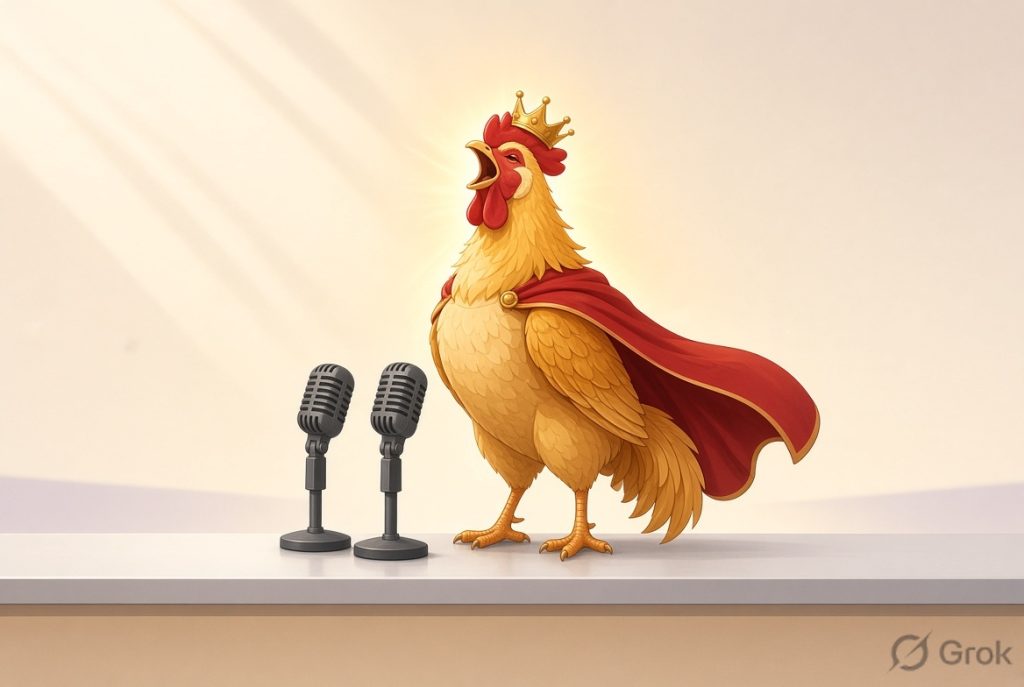
Geoffrey Chaucer’s Nun’s Priest’s Tale remains one of literature’s sharpest exercises in mock-heroic comedy. A rooster named Chauntecleer—proud, vain, well-feathered, and given to portentous dreams—struts about a humble farmyard while the narrator dresses every cluck, every preen, and every near-disaster in the full regalia of epic poetry. Classical allusions rain down. Courtly rhetoric soars. The fate of nations seems to hang on whether a fox will succeed in flattering a chicken. The joke is precise: elevate the ordinary until the elevation itself becomes the comedy.Geoffrey Chaucer’s Nun’s Priest’s Tale shows uncanny similarity with the Mock-Heroic Genius of Godi Media’s Modi Worship
Contemporary Indian television and digital “Godi media” (the affectionate critical shorthand for outlets accused of residing permanently in the prime ministerial lap) has independently rediscovered the same technique. Narendra Modi is rendered not as a skilled politician navigating the messy realities of coalition arithmetic, economic data, and institutional friction, but as a mythic figure whose every gesture is already half-way to the Mahabharata. The result is unintentional Chaucerian genius.
Consider the classic moves of the Nun’s Priest’s Tale. Chauntecleer’s morning crow is not merely a farmyard noise; it is compared to the song of mermaids and the music of the spheres. His dream of a reddish beast is treated with the gravity of prophetic vision. When the fox eventually flatters him—“O gentle Chauntecleer, the purest voice that ever crowed”—the rooster’s vanity does the rest. The narrator piles on philosophical digressions, rhetorical flourishes, and learned citations until the reader is laughing at the disproportion.
Godi coverage operates with comparable inflation. A routine foundation-stone laying becomes “a historic masterstroke that will transform the destiny of Bharat.” A speech containing standard campaign promises is framed as “a clarion call that shook the conscience of the nation.” Adverse data is either ignored or transmuted into evidence of still-greater long-term vision. Opposition criticism is rarely engaged on its merits; it is treated as the envious yapping of lesser creatures who fail to grasp the hero’s cosmic significance. The visual grammar completes the effect: slow-motion walks, dramatic lighting, swelling background scores, and super-imposed graphics that would not look out of place in a trailer for an epic about a warrior-king.
The parallel is most delicious when flattery enters the frame. In Chaucer the fox succeeds by praising the rooster’s voice and lineage until Chauntecleer stretches his neck and closes his eyes. In the contemporary version, anchors and panelists compete to discover new superlatives, often inventing crises that only the Leader can resolve, then celebrating the resolution with the solemnity once reserved for the fall of Troy. The audience is invited to share the elevated emotion. To question the scale of the praise is to risk being cast as a naysayer who cannot appreciate true greatness—much as any medieval peasant who pointed out that Chauntecleer was, after all, still a chicken would have ruined the mood.
The insight Chaucer offers is that mock-heroic rhetoric does not merely exaggerate; it exposes. By applying the language of high seriousness to low material, the tale reveals how easily vanity and rhetoric can detach representation from reality. The same detachment is visible when every policy announcement is greeted as epochal and every setback is reframed as strategic depth. The comedy intensifies when the same outlets that once applied more ordinary standards of skepticism to previous governments now treat measured scrutiny as a form of lese-majesty.
None of this requires denying political achievements or popular support. Effective politicians attract strong narratives; democratic publics often prefer heroes to technocrats. The mock-heroic mode simply thrives when the narrative machinery refuses any sense of proportion. Chaucer’s rooster is genuinely handsome by barnyard standards and genuinely cunning in the end. The humor arises from the refusal to keep the praise inside the farmyard. Godi media’s contribution to the genre is to keep the camera permanently zoomed in on the strutting, the crowing, and the dramatic escapes, while the ordinary barnyard—inflation figures, institutional capacity, messy federal politics—remains softly out of focus.
The Nun’s Priest’s Tale ends with a moral about the dangers of flattery and the virtues of keeping one’s eyes open. Chaucer delivers it with a wink. Modern practitioners of the form are less self-aware, which only improves the comedy. One can almost hear the narrator of the tale clearing his throat in a Delhi newsroom: “And thus, lo, the mighty Leader crowed, and the nation trembled with admiration, and the ratings were good.” The chicken, as always, remains a chicken. The rhetoric, as always, threatens to convince everyone otherwise.
Chandra, S. 2026
References
Abrams, M. H. (Meyer Howard), 1912-2015. A Glossary of Literary Terms. Boston, MA: Thomson, Wadsworth, 2005.
Chaucer, Geoffrey. The Canterbury Tales. Translated by Nevill Coghill, Penguin Classics, 2003.
HITT, RALPH E. “Chauntecleer As Mock-Hero Of The ‘Nun’s Priest’s Tale.’” The Mississippi Quarterly, vol. 12, no. 2, 1959, pp. 75–85. JSTOR, http://www.jstor.org/stable/26473177. Accessed 22 Dec. 2023.
Shallers, A. Paul. “The ‘Nun’s Priest’s Tale’: An Ironic Exemplum.” ELH, vol. 42, no. 3, 1975, pp. 319–37. JSTOR, https://doi.org/10.2307/2872707. Accessed 22 Dec. 2023.


