


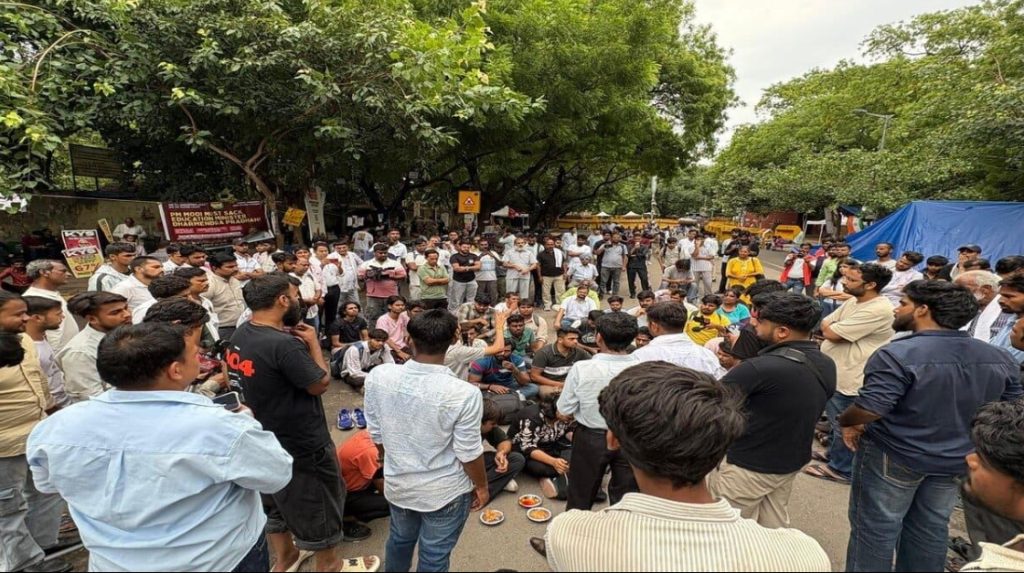
Under Delhi’s unforgiving summer sun, a quiet act of resistance unfolds every day. At Jantar Mantar, young protesters continue an indefinite hunger strike. Their bodies grow weaker, but their faith in democracy appears to grow stronger. What began as outrage over alleged irregularities in the education system—symbolized by the unconventional Cockroach Janta Party (CJP) and amplified by Sonam Wangchuk’s fast—has evolved into something far more profound. It is no longer merely a protest against policy failures. It is a generational conversation about what democracy means when institutions lose public trust.
At first glance, the cockroach seems like an odd political mascot. It is rarely admired, often despised, and instinctively crushed whenever it appears. Yet therein lies its political genius. The cockroach survives hostile environments, adapts when circumstances change, and returns despite repeated attempts at elimination. It is perhaps the most underestimated metaphor for democratic resilience in contemporary India.
The power of this symbol lies precisely in its ordinariness. Democracies do not survive because their citizens are heroic all the time. They endure because ordinary people repeatedly refuse to surrender their belief that institutions can be made better. Like the cockroach, democracy survives not because it is invincible, but because it continually regenerates itself through citizen participation.
Democracy Beyond Elections
Much of contemporary political discourse equates democracy with elections. Once votes are counted, democratic participation is often assumed to have ended until the next electoral cycle. The protests at Jantar Mantar challenge this narrow understanding.
Here, democracy is practiced rather than performed.
The hunger strike, public discussions, handwritten placards, student assemblies, and intergenerational participation represent democracy as an ongoing process of accountability rather than a periodic ritual of voting. The protesters are not rejecting democratic institutions; they are demanding that these institutions remain faithful to their constitutional promise.
This distinction is crucial.
When citizens occupy public spaces peacefully to demand transparency, they are not weakening democracy. They are exercising one of its deepest constitutional rights—the right to dissent.
The Cockroach as a Democratic Metaphor
Political movements have long relied on symbols. The spinning wheel represented self-reliance during India’s freedom struggle. The raised fist came to symbolize solidarity across labour movements. The cockroach introduces a radically different political vocabulary.
It symbolizes survival rather than victory.
Unlike grand revolutionary symbols that promise dramatic transformation, the cockroach represents persistence in imperfect systems. It acknowledges that institutions may fail repeatedly, yet citizens continue returning to demand accountability.
This makes the metaphor unexpectedly contemporary.
Today’s generation faces institutional uncertainty unlike previous decades. Competitive examinations are increasingly viewed through the lens of transparency debates. Employment opportunities remain unpredictable. Public trust in institutions often fluctuates with every controversy. Social media amplifies both hope and frustration simultaneously.
In such an environment, resilience becomes a political act.
The cockroach does not defeat the system overnight. It simply refuses to disappear.
Perhaps that is precisely what democratic citizenship requires today.
Gandhi’s Return Through Generation Z
One of the most striking aspects of the movement is not merely its demands but its methods.
At a time when digital outrage often lasts only a few days, hundreds of students have chosen one of the oldest forms of political resistance available—fasting.
The satyagraha pioneered by Mahatma Gandhi was built upon a simple but radical idea: moral force can challenge political power without reproducing violence. Many scholars have questioned whether such methods remain effective in an age dominated by algorithms, hashtags, and twenty-four-hour news cycles.
Yet the scenes at Jantar Mantar suggest otherwise.
Young people—often caricatured as politically apathetic or digitally distracted—are rediscovering the discipline of non-violent protest. Their resistance is neither performative nor impulsive. It is patient, physically demanding, and morally grounded.
This may represent not the revival of Gandhian politics but its reinvention.
An Intergenerational Democratic Space
Perhaps the movement’s most remarkable feature is who participates.
Students on hunger strike stand beside middle-aged social workers concerned about their children’s futures. Parents who once trusted institutions now question them openly. A ten-year-old girl arrives simply to support her elder brother preparing for the NEET examination.
These encounters transform the protest site into something larger than a demonstration.
It becomes a democratic classroom.
Conversations replace slogans. Personal anxieties become collective concerns. Individual grievances evolve into public questions about fairness, accountability, and institutional legitimacy.
In a deeply diverse society like India, such spaces are increasingly rare.
Reclaiming Accountability, Not Rejecting Institutions
The movement should not be interpreted as anti-state or anti-democratic. Quite the opposite.
Its central argument is that democracy demands stronger institutions, not weaker ones.
Calls for structural reforms in education emerge from a belief that public institutions matter. Hunger strikes arise because constitutional mechanisms still command moral legitimacy. Protesters invoke democratic ideals precisely because they have not abandoned them.
Their frustration stems from unmet democratic expectations rather than democratic rejection.
This distinction deserves attention in an era where dissent is frequently misunderstood as disloyalty.
Healthy democracies are not defined by the absence of protest.
They are defined by their capacity to absorb criticism without criminalizing it.
Democracy’s Most Difficult Question
The movement ultimately poses a question that extends far beyond educational reforms:
What should citizens do when they believe the system itself requires correction?
Withdrawal breeds cynicism.
Violence erodes legitimacy.
Silence normalizes dysfunction.
The protesters at Jantar Mantar propose a fourth alternative—persistent, peaceful, constitutional resistance.
Their answer is not revolution.
It is democratic renewal.
The Politics of Survival
History often celebrates dramatic revolutions while overlooking quieter acts of democratic persistence. Yet democracies rarely collapse in a single moment, and they are rarely rescued by a single event. They endure because citizens repeatedly choose engagement over apathy.
The cockroach reminds us that survival itself can be political.
Not glamorous.
Not immediate.
But deeply consequential.
Perhaps this is why the symbol resonates so strongly with India’s youth. They are not claiming to possess all the answers. They are simply refusing to disappear from the democratic conversation.
And in that refusal lies the movement’s greatest significance.
The real contest, then, is not between cockroaches and the system. It is between resilience and resignation. If democracy is to flourish, it will depend not only on the strength of institutions but also on the persistence of citizens willing to hold those institutions accountable—even under the harshest summer sun.
In that sense, the cockroach is not merely an insect.
It is a reminder that democracy survives through those who refuse to stop believing that it can be made better.


