


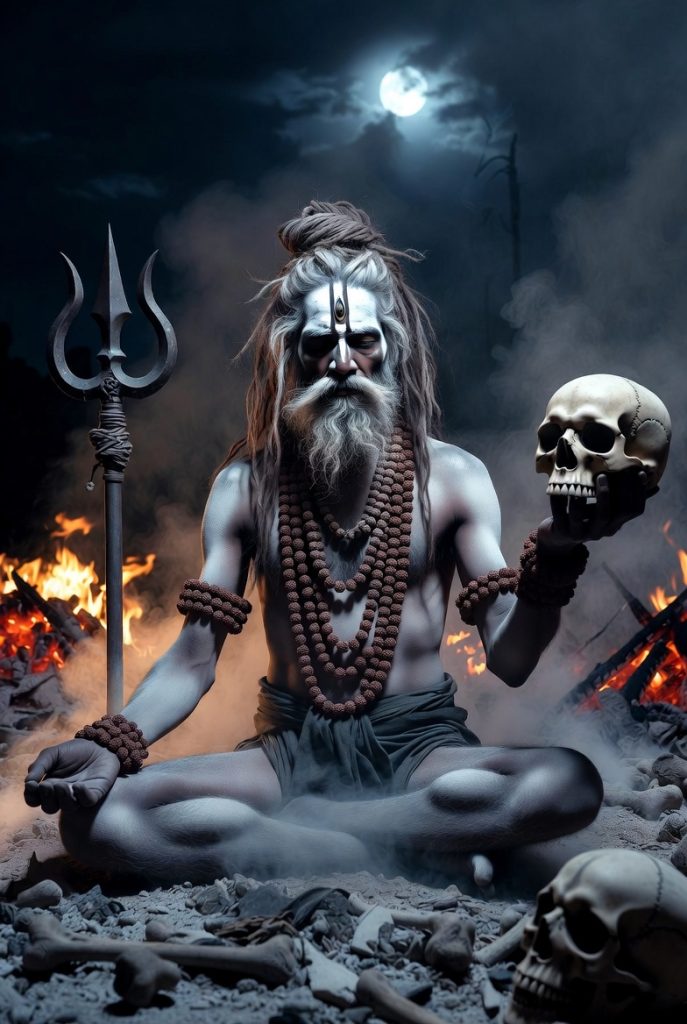
Philosophical grounding
Aghor asceticism as a philosophical, social, and ontological intervention into the mainstream Hindu cosmological fold has been regarded with a mixture of fear, bewilderment, and disgust. Their overarching spiritual goal is primarily to achieve a salvific state of non-duality by overcoming quotidian oppositions (pure/impure and pleasant/disgusting) and in its pursuit they dwell naked in cremation grounds and are rumored to partake in antinomian practices including the consumption of alcohol, feces, and ritualistic indulgences into necrophagy or cannibalism. Aghora’s philosophy within the broader picture of Hinduism can be excavated as a site of polarities, where materialism and spirituality collide in a way that cannot be explained. From a spiritual and transpersonal vantage point, the word ‘Aghora’ is the metamorphosis of darkness into light; a transformation of the finite human consciousness into the effulgence of the Absolute Reality or the whole.
“Aghor” comes from Sanskrit: A (negation) + Ghor (intense, terrible, dark, or fearful). It means “that which is not terrible”, “beyond fear”, “light without darkness”, or “the simple/natural state”. It represents a fearless, non-discriminating state of consciousness. Advaita philosophy advocates that there is no difference between God and Man, self and other, good and bad, or purity and impurity. They are all segments of the Brahman. This world is a mere illusory projection of the one Reality (Parthasarathy, 2001). Therein the cardinal principle that pronounces the Aghori’s practice to be spiritual in temperament is the monistic or non-dualistic approach to life. The Aghori, following the tenets espoused in the Advaita philosophy, believe there is only one reality, it is vital to obliterate all perceptions of duality. Thus the Aghori partakes in a philosophical thought that makes no distinction between life and death. The antinomian rituals are a catalyst that allows the self to realize the elusive nature of all phenomena. The Aghora philosophy utilizes these rituals symbolically to transform the prosaic mind into one that is only concerned with the divine. The interstitial or rather peripheral position of the Aghora cult concerning the mainstream Hindu ritualistic proclivity towards purity, allows the Aghoris to embrace the impure, aberrant, the ‘abjected other’ without indulging in an active revolt against the structure codified by the mainstream Hindu cosmology. The spiritual state of non-discrimination and non-reality transforms into an ethnographic-social model of accepting and venerating the pathologized, the defiled, the abjected, profane elements of the human corporeality and creating a cultural correlative that weaves spiritual paraphernalia around death, decay, and disease. Therefore, the proposed paper through a cultural lens attempts to anatomize the Aghora philosophy within the broader landscape of Hindu ritualistic practices to understand the cultural significance of death, disease, and disability in the social and spiritual model of Aghora philosophy. This paper further attempts to look at the polymorphous interactions between the ‘spiritual’ and the ‘social’ in the course of attaining the ideal state of non-duality and non-discrimination within the Aghora fold.
Core Principles of Aghor Philosophy
Non-Duality (Advaita)
Everything in existence is one — a manifestation of the divine (Shiva/Brahman). There is no real separation between pure and impure, sacred and profane, good and evil, life and death. All dualities are illusions created by the mind and social conditioning.
Everything is Shiva
Aghoris see God (Shiva, in his fierce Bhairava form) in everything — including what society rejects (corpses, waste, cremation grounds, etc.). Rejecting anything means rejecting the divine.
Transcending Fear and Attachments
The main obstacles to liberation are fear (especially of death), ego, and societal taboos. By confronting these directly, one achieves freedom (moksha) from the cycle of birth and death (samsara).
Breaking the Eight Bonds
Aghoris aim to break eight bonds that keep the soul ignorant: sensual pleasure, anger, greed, obsession, fear, hatred, pride, and discrimination.
Sahaj (Natural/Effortless) State
The goal is a natural state of awareness where one remains equanimous — no intense likes/dislikes, no discrimination. One sees divinity equally in all things.
Historical Roots
- Linked to ancient Kapalika tradition (skull-bearers) in Tantric Shaivism.
- Revived in its current form by Baba Keenaram (18th century), considered an incarnation of Shiva.
- Traces back philosophically to Shiva himself as the Adi Yogi.
The essence
“Everything is Shiva. Nothing is impure. See the divine in all.”
Aghor is considered one of the most intense and direct paths to liberation, but it is also one of the most misunderstood and socially marginalized traditions in India. While their methods shock mainstream society, their ultimate goal — realizing the Self as Brahman — is the same as other Hindu paths.

References and Works Cited
Barrett, Ron. Aghor Medicine: Pollution, Death, and Healing in Northern India. 1st ed., University of California Press, 2008. JSTOR, http://www.jstor.org/stable/10.1525/j.ctt1pn7f4
Suri, R., & Pitchford, D. B. (2010). Suri, R., & Pitchford, D. B. (2010). The gift of life: Death as a teacher in the Aghori sect. International Journal of Transpersonal Studies, 29(1), 128–134. International Journal of Transpersonal Studies, 29 (1). http://dx.doi.org/10.24972/ijts.2010.29.1.128


