


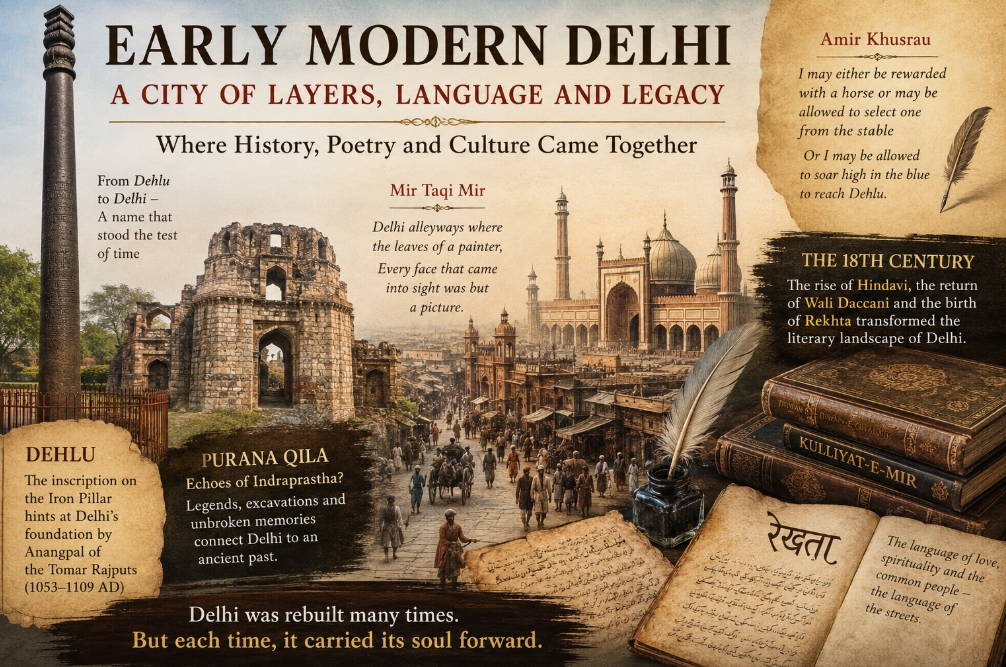
Delhi has never been merely a place on a map. It has been rebuilt, renamed, repopulated and reimagined so many times that its streets almost seem to carry layers of different centuries beneath them.
To study early modern Delhi is therefore not simply to study the past. It is to understand how a city remembers, transforms and reinvents itself.
The idea of the early modern period itself is complex. As Pius Malekandathil suggests, it represents both a break from the past and a new way of being—an age in which the roots of institutions, knowledge systems and organizational structures familiar to us today began to take shape. In South Asia, the period broadly covers the fifteenth to eighteenth centuries, a time of political change, economic expansion, cultural exchange and increasing connections with the wider world.
Delhi offers perhaps one of the richest windows into this transformation.
A City That Refused to Disappear
Long before Delhi became the capital we know today, it had already lived several lives.
During the medieval period, Delhi emerged as a major centre of political power, education, literature, religion and culture. Its madrasas, khanqahs, serais, bazaars and public spaces brought together scholars, mystics, merchants, poets and travellers. Foreign invaders repeatedly attacked the city, yet Delhi continued to attract people from distant regions.
That resilience is central to understanding Delhi’s past.
The eighteenth-century poet Mir Taqi Mir captured the city’s extraordinary visual and cultural richness in his poetry. For him, Delhi’s lanes seemed filled with paintings—every face, every street and every encounter becoming part of the city’s living canvas.
But Delhi’s story is even older.
Historians and archaeologists have long debated the connection between Delhi and the legendary city of Indraprastha. The association of Purana Qila with ancient Indraprastha remains a matter of debate because archaeological evidence is limited, but the persistence of the tradition itself is revealing. Legends about the Pandavas and the five villages—Inderpat, Baghpat, Sonepat, Tilpat and Ranipat—have continued to stimulate archaeological curiosity and historical investigation.
Delhi’s very name carries another layer of memory.
An inscription associated with the Iron Pillar at the Quwwat-ul-Islam mosque refers to the place as Dehlu and connects its foundation with the Tomar ruler Anangpal. Centuries later, Amir Khusrau also used the name Dehlu in his poetry.
A city’s name surviving across centuries is more than a linguistic curiosity. It is evidence of continuity amid change.
Delhi changed—but it did not forget itself.
The Eighteenth Century: When Delhi’s Language Changed
If architecture reveals the physical memory of Delhi, language reveals its emotional memory.
The eighteenth century witnessed a remarkable transformation in Delhi’s literary culture. Persian remained an enormously influential language of intellectual and literary expression, and poets such as Haatim, Aabru, Aarzoo and Bedil contributed to the development of Sabk-e-Hindi, or the Indian style of Persian poetry.
Yet something new was happening beneath the dominance of Persian.
A language that had travelled away from Delhi was beginning to return.
That language was known by different names—Dehlavi, Hindavi and Zaban-e-Dehli. Having travelled from Delhi to other parts of India between the fourteenth and fifteenth centuries, it absorbed vocabulary, expressions and linguistic influences from languages such as Gujarati, Marathi and Telugu. In the Deccan, this evolving linguistic tradition developed into what came to be known as Daccani.
Then came Wali Mohammad, or Wali Daccani.
His arrival in Delhi had an enormous literary impact. Delhi’s Persian-speaking literary establishment encountered a poetic language that was neither entirely Persian nor simply the old Hindavi. It was mixed, flexible and alive.
The poets called it Rekhta.
The word itself—suggesting something mixed or blended—captures the cultural transformation taking place in eighteenth-century Delhi. Rekhta brought together linguistic traditions and gave poetic expression to subjects ranging from love and spirituality to the anxieties and experiences of ordinary people.
Most importantly, it began moving beyond elite literary circles.
It became the language of the streets.
From Persian Court Culture to the Language of the People
The rise of Rekhta changed Delhi’s literary imagination.
New and increasingly popular poetic forms flourished, including the ghazal, qasida, marsia and masnavi. Poetry was no longer confined to a single linguistic or cultural tradition. Instead, Delhi became a meeting ground where Persianate literary culture interacted with indigenous languages and popular speech.
This was not simply a change in vocabulary.
It was a change in who could speak, what could be spoken about and how Delhi could imagine itself.
Persian provided an established language of scholarship and refinement. Hindavi and its evolving forms brought the sounds of everyday life into literary expression. Rekhta stood between worlds—and eventually helped create a new literary world of its own.
That is why the linguistic history of eighteenth-century Delhi matters so much.
It shows that cultures do not simply replace one another. They mix, borrow, adapt and reinvent.
What Early Modern Delhi Teaches Us About the Past
The study of early modern Delhi gives us more than a catalogue of monuments, rulers and poets. It helps us understand the mechanisms through which a city survives historical upheaval.
Its architecture shows continuity and reconstruction.
Its archaeology reveals connections between different historical layers.
Its names preserve fragments of forgotten memories.
Its poetry captures emotions that official records often overlook.
And its languages demonstrate how cultures interact in everyday life.
Delhi’s history is therefore not a straight line. It is a palimpsest—one city written over another, and another, and another.
The eighteenth-century Delhi of Mir and Wali was not disconnected from the medieval Delhi of Khusrau, just as the Delhi of the medieval period cannot be understood without considering the older memories attached to the landscape.
Perhaps that is the greatest lesson of studying early modern Delhi: the past does not disappear when a new city rises over it. It survives—in names, ruins, languages, poems, legends and collective memory.
Delhi was rebuilt many times.
But each rebuilding carried something forward.
And that is why Delhi’s past is not buried beneath the modern city.
It is still speaking through it.


