


Introduction: Are Personal Desires Everything?
Are human desires the ultimate truth of life? Do morality, virtue, and ethical responsibility have any value when compared with the fulfillment of personal ambitions? These questions lie at the heart of Christopher Marlowe’s Doctor Faustus, one of the most profound tragedies in English literature.
The story is not merely about a man seeking power; it is about the price of unlimited desire and the consequences of abandoning moral principles. Through Faustus, Marlowe explores the eternal conflict between ambition and conscience, freedom and responsibility, knowledge and wisdom.
The Extraordinary Scholar Who Wanted More
Doctor Faustus was an exceptionally learned scholar. He had mastered theology, law, medicine, and philosophy. Yet none of these disciplines satisfied him. Conventional knowledge seemed limited, and he longed for something beyond ordinary human reach.
Faustus desired unlimited power, boundless knowledge, and supernatural abilities. His dissatisfaction reflects a central philosophical question: Should human beings accept their limitations, or constantly seek to transcend them?
Inspired by this desire, Faustus turns toward necromancy and black magic, believing that supernatural forces can grant him the greatness he seeks.
The Fatal Choice: Selling the Soul for Power
Faustus fully understands the distinction between good and evil. He knows the value of the human soul and is aware of the religious consequences of his actions. Nevertheless, he chooses ambition over morality.
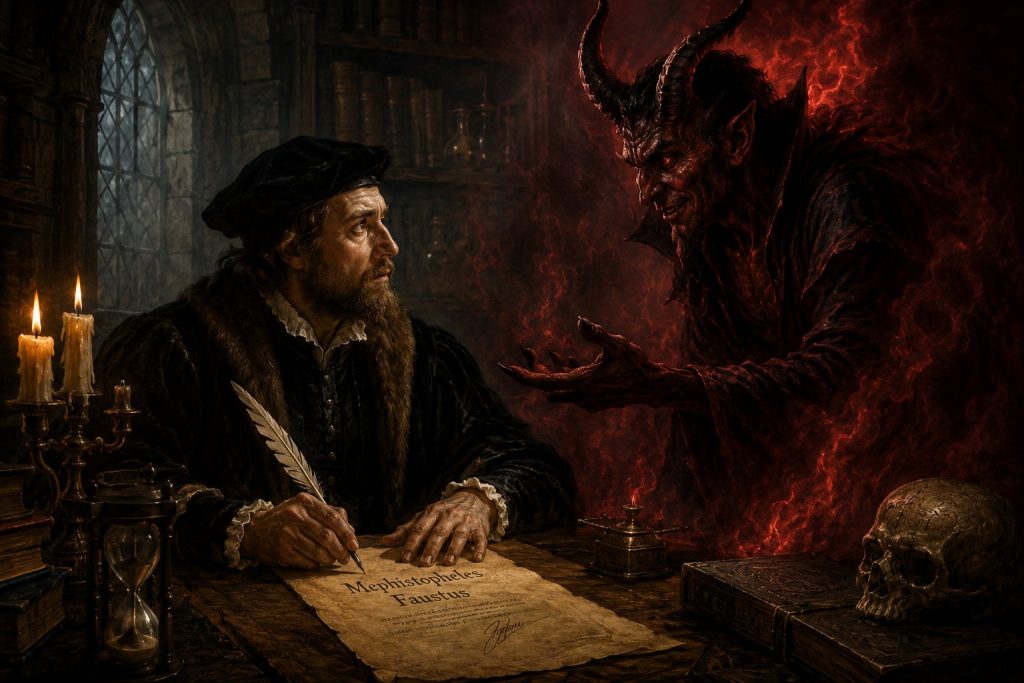
He enters into a pact with Mephistopheles, the servant of Lucifer. In exchange for twenty-four years of magical powers and knowledge, Faustus promises his soul to the Devil.
This moment represents more than a supernatural bargain. Philosophically, it symbolizes the triumph of desire over ethical duty. Faustus willingly abandons moral responsibility for personal gratification.
A Kantian Perspective: Duty Above Desire
The philosopher Immanuel Kant argued that morality should be guided by duty rather than inclination or personal desire. Human beings must act according to universal moral principles, not merely because something benefits them.
From a Kantian perspective, Faustus commits a grave moral error. He treats his soul and moral integrity as instruments for achieving power rather than respecting them as ends in themselves.
The Misuse of Knowledge and Power
Having acquired extraordinary powers, Faustus has the opportunity to achieve remarkable things. He could advance human understanding, alleviate suffering, or contribute to society.
Instead, he wastes his abilities on trivial entertainments. He performs tricks, mocks religious authorities, amuses kings, and satisfies temporary curiosities. The immense potential of his knowledge remains unrealized.
Aristotle and the Failure of Virtue
According to Aristotle, the purpose of human life is the cultivation of virtue and the achievement of eudaimonia—human flourishing through moral excellence.
Faustus possesses intelligence and capability but lacks practical wisdom (phronesis). His failure is not intellectual ignorance but moral weakness. He has knowledge without virtue, and therefore his life becomes an example of wasted potential.
The Inner Conflict: Conscience Versus Ambition
One of the most compelling aspects of Faustus’s character is his internal struggle. Throughout the play, he experiences moments of regret. He repeatedly considers repentance and seeks the possibility of divine forgiveness.
Yet every time he approaches redemption, pride and ambition pull him back. He becomes trapped between his conscience and his desires.
Existential Freedom and Responsibility
Existentialist thinkers such as Jean-Paul Sartre emphasize that human beings are free to choose, but they must also accept responsibility for those choices.
Faustus cannot blame fate, society, or supernatural forces for his downfall. The tragedy emerges from his own decisions. His freedom to choose ultimately becomes the source of his destruction.
The Final Hour: The Price of Unlimited Desire
As the twenty-four years come to an end, Faustus is overwhelmed by fear. The approaching midnight symbolizes the arrival of judgment. He desperately pleads for mercy, wishing for more time, another chance, any possibility of escape.
However, repentance delayed becomes repentance denied. The agreement cannot be undone. As the clock strikes twelve, devils arrive and carry his soul to eternal damnation.
The ending underscores a profound moral truth: actions have consequences, and some choices create irreversible outcomes.
The Clown and Faustus: Two Forms of Human Desire
Marlowe introduces comic characters who are also tempted to sell their souls. Yet their motivations differ greatly from Faustus’s.
The clown seeks immediate and ordinary satisfactions. Faustus, by contrast, sacrifices his soul for extraordinary power and limitless knowledge.
This contrast reveals an important philosophical insight: human desires vary in scale, but unchecked desire—whether trivial or grand—can lead individuals away from moral judgment.
Key Philosophical Positions Reflected in Doctor Faustus
- Moral Absolutism
Good and evil possess objective reality. Some actions remain wrong regardless of personal benefit. Faustus’s downfall demonstrates the consequences of violating moral law.
- Kantian Ethics
Duty and moral obligation must guide human action. Personal ambition cannot justify abandoning ethical principles.
- Aristotelian Virtue Ethics
Knowledge alone is insufficient. True excellence requires wisdom, moderation, and virtuous character.
- Existential Responsibility
Human beings are free to choose their paths, but they remain accountable for the consequences of those choices.
- Humanist Ambition
Renaissance humanism celebrated human potential and intellectual achievement. Faustus embodies this aspiration but also illustrates its dangers when detached from moral restraint.
Conclusion: The Lesson of Doctor Faustus
Doctor Faustus teaches that ambition and desire are not inherently wrong. Dreams inspire progress, creativity, and achievement. Yet when the pursuit of power causes individuals to forget the distinction between right and wrong, ambition becomes destructive.
Faustus sought infinite knowledge and extraordinary power, but he lost the very thing that gave his life meaning—his moral self. His tragedy reminds us that success without ethical responsibility is hollow, and that wisdom requires not only intelligence but also virtue.
In the end, Marlowe’s message remains timeless: human desires may be limitless, but moral integrity is priceless.


