


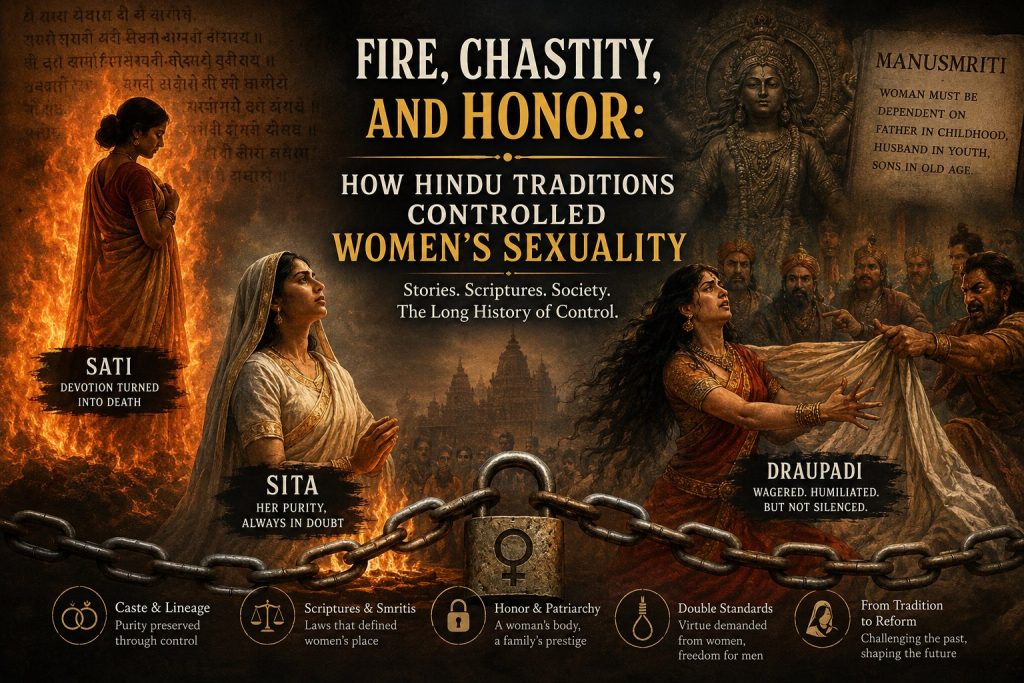
Across civilizations, one question has haunted patriarchal societies: who controls women’s bodies?
From ancient Athens to medieval Europe, from Confucian China to the Abrahamic world, the regulation of female sexuality became a cornerstone of social order. Religion often supplied the language, symbols, and moral authority that transformed social anxieties into sacred duties. Hindu society was no exception.
The story is complicated. Hinduism is not a single book, prophet, or church. It contains powerful goddesses, female sages, erotic literature, and philosophical traditions that celebrate both feminine power and human desire. Yet alongside these liberating strands emerged a social order that increasingly tied a woman’s worth to sexual purity, marital fidelity, and obedience to male authority.
The result was not merely a set of religious ideals. It was a system that made women’s sexuality a matter of family honor, caste survival, and social control.
The Politics of Chastity
One of the most striking features of many traditional Hindu social norms is the centrality of female chastity.
Male sexual transgressions were often treated as moral failings. Female sexual transgressions, however, could threaten entire family lineages.
Why?
The answer lies in the intersection of caste, inheritance, and patriarchy. In societies where property, ritual status, and lineage passed through male descendants, certainty of paternity became essential. Controlling women’s sexuality became a mechanism for preserving social hierarchy.
The ideal woman was therefore not simply virtuous. She was sexually exclusive, obedient, and devoted to her husband regardless of circumstance.
This ideal found its most powerful expression in the concept of pativrata—the wife whose devotion to her husband was absolute.
Over centuries, this ideal became one of the defining moral expectations placed upon Hindu women.
Sita and the Burden of Proof
No story illustrates this better than the ordeal of Sita in the Ramayana.
After being abducted by Ravana and rescued by Rama, Sita faces an extraordinary demand. Despite being the victim of kidnapping, she must prove her purity through an Agni Pariksha—a trial by fire.
The symbolism is revealing.
Ravana’s crime is not enough to establish Sita’s innocence. Her own body becomes evidence that must be publicly examined.
The burden of proof falls not on the abductor but on the woman.
Even after surviving the fire ordeal, later versions of the Ramayana depict continued public suspicion. As king, Rama ultimately abandons Sita because subjects question her chastity.
The message absorbed by generations was unmistakable: a woman’s honor could be doubted even when she had done nothing wrong.
In many patriarchal societies, sexual violence has often damaged a woman’s social standing more than the perpetrator’s. Sita’s story reflects precisely that logic.
Compare this with medieval Christian Europe, where rape victims frequently faced scrutiny regarding their virtue, or with certain interpretations of Islamic honor cultures where family reputation became linked to female sexual conduct. Across traditions, women repeatedly carried the burden of safeguarding communal honor.
Draupadi: When Women Become Property
The Mahabharata presents another uncomfortable truth.
In the infamous dice game, Yudhishthira gambles away his kingdom, his brothers, himself, and eventually Draupadi.
The horrifying question at the heart of the episode is simple: Can a husband wager his wife?
The fact that the royal court debates this issue rather than immediately condemning it reveals how deeply patriarchal assumptions had penetrated social thinking.
Draupadi is treated less as an autonomous individual than as an extension of male ownership.
When Dushasana attempts to strip her in public, the act is not merely physical humiliation. It is an attack on her dignity, sexuality, and personhood.
Yet Draupadi also exposes the hypocrisy of the men around her. She asks the question no one wants to answer: if Yudhishthira had already lost himself, by what right could he stake her?
Her challenge transforms the episode into one of the earliest literary critiques of patriarchal power.
The scene resonates with countless historical examples across cultures where women became bargaining chips in male political struggles—royal marriages in Europe, concubinage in imperial China, or tribal exchanges in many traditional societies.
Sati: The Ultimate Erasure of Female Sexuality
Perhaps no practice demonstrates the control of women’s sexuality more starkly than Sati.
Although never universally practiced and never mandated by the earliest Hindu scriptures, widow immolation became glorified in certain regions and periods.
A widow who entered her husband’s funeral pyre was celebrated as the embodiment of loyalty and devotion.
The underlying logic was revealing.
A woman’s sexual identity was considered inseparable from her husband. Once he died, her social purpose was believed to have ended.
Widow remarriage became stigmatized in many communities.
Widows were expected to live lives of austerity, renunciation, and social invisibility.
Their sexuality became something to suppress rather than acknowledge.
By contrast, widowers generally faced no equivalent expectation.
The double standard mirrors patterns found elsewhere. Medieval Christianity often idealized widowed women who remained celibate. Confucian China celebrated widows who never remarried. Across patriarchal civilizations, female sexuality after marriage was expected to remain permanently attached to one man—even after his death.
Sati represented the most extreme manifestation of that principle.
Manusmriti and the Architecture of Control
The stories of Sita and Draupadi gained social force because they existed alongside legal and moral texts that reinforced male authority.
Among the most influential was the Manusmriti.
The text famously states that a woman should remain under the protection—or control—of her father in childhood, husband in youth, and sons in old age.
Whether or not such prescriptions were universally followed, they reveal an ideal social order in which female autonomy was viewed with suspicion.
Control over movement, marriage, inheritance, and sexuality became interconnected.
The goal was not simply moral discipline.
It was the preservation of social hierarchy.
Women’s sexuality was regulated because caste boundaries depended upon it.
Marriage became the gatekeeper of social reproduction.
Female desire became a potential threat to the system.
The Contradiction at the Heart of Hinduism
Yet Hinduism also contains a profound contradiction.
The same civilization that demanded female chastity worshipped goddesses of immense power.
Durga destroys demons.
Kali terrifies death itself.
Shakti is understood as the cosmic energy that animates the universe.
In theological terms, the feminine is supreme.
In social practice, women were often subordinated.
This tension remains one of the most fascinating paradoxes in Hindu history.
A society could bow before the goddess in the temple while denying autonomy to women at home.
The contradiction is not unique to Hinduism. Christian Europe venerated the Virgin Mary while excluding women from church leadership. Islamic civilizations revered female saints while maintaining male guardianship systems. Religious symbolism often elevated women spiritually while restricting them socially.
Control Through Honor
The most effective systems of power rarely rely solely on force.
They operate through ideals.
In Hindu society, concepts such as pativrata, family honor, caste purity, and female modesty transformed social expectations into moral obligations.
Women frequently became the custodians of collective honor.
Their bodies symbolized the reputation of families.
Their sexuality symbolized the purity of lineages.
Their choices carried consequences far beyond themselves.
This is why stories like Sita’s, Draupadi’s, and the historical memory of Sati remain so powerful today.
They reveal how control over women’s sexuality was never merely about sex.
It was about power.
Power over inheritance.
Power over caste.
Power over social order.
And ultimately, power over women themselves.
Conclusion
The history of Hinduism and women’s sexuality cannot be reduced to a simple tale of oppression. Hindu traditions also contain resources for resistance, empowerment, and liberation. Female sages, goddess worship, Bhakti movements, and modern reformers all challenged patriarchal norms.
Yet it would be equally misleading to ignore how religious narratives and social customs were used to regulate women’s bodies and choices.
The stories of Sita, Draupadi, and Sati endure because they expose a recurring truth of human history: societies often seek to control women in order to preserve existing structures of power.
Hindu society developed its own distinctive methods of doing so. But the impulse itself was universal. The policing of women’s sexuality has rarely been about morality alone. More often, it has been about maintaining authority over who belongs, who inherits, who reproduces, and who gets to decide the rules.


