


From Gossip to Scripture
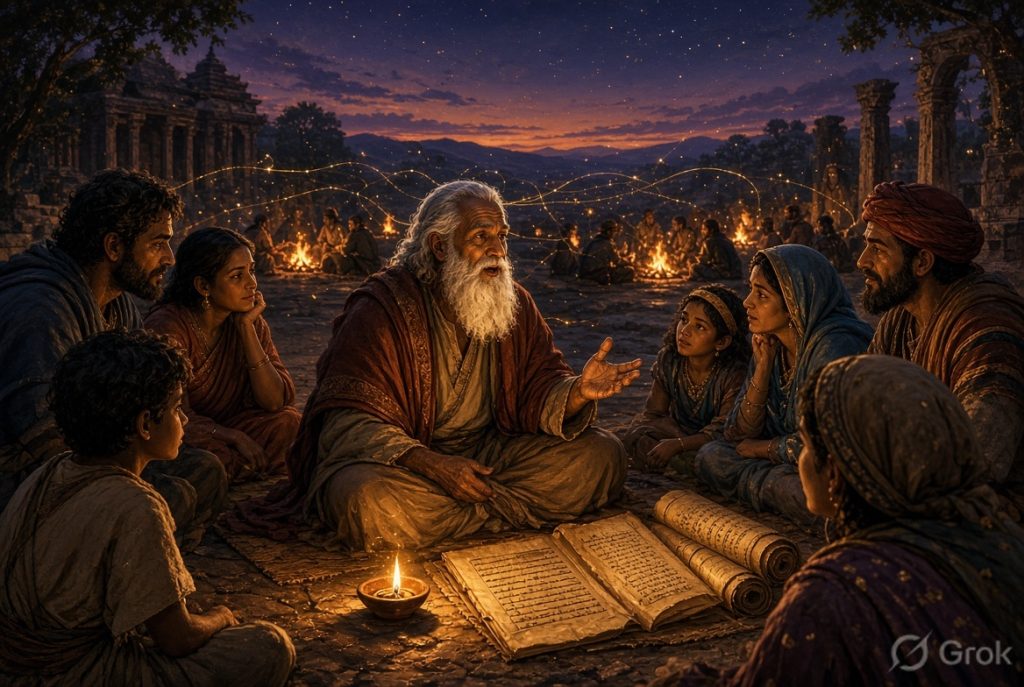
How Stories Went Viral Before the InternetLong before likes, shares, or algorithms, stories raced across continents through human voices. A remarkable event, a scandalous rumor, or a tale of gods and heroes would leap from mouth to ear in markets, along trade routes, around evening fires, and in temples. The most sticky versions multiplied; weaker ones faded. Over generations some of these circulating accounts hardened into epic poems and sacred texts. The process that turned marketplace gossip into scripture is one of humanity’s oldest information technologies—and it operated just as powerfully in ancient India as in the Mediterranean world.
The Human Instinct for Viral Stories
We are storytelling primates. Evolutionary thinkers such as Robin Dunbar suggest language itself evolved partly to support efficient “gossip”: tracking reputations, alliances, and distant events. In oral cultures this was the primary news network. Stories mutated with each retelling—the telephone-game effect—yet the versions that were emotionally charged, morally clarifying, or socially useful spread farthest. Rhythm, formulaic phrases, and dramatic structure helped bards and ordinary people remember and perform them accurately enough to keep the core alive while allowing local color to accumulate.
From Village Talk to Sacred Canon: The Gospel Example
In the first-century Mediterranean, reports about a Galilean teacher named Jesus moved with startling speed. After an exorcism in Capernaum, Mark records that “his fame spread everywhere throughout all the surrounding region of Galilee.” A Samaritan woman told her town about the stranger who knew her past; crowds came. These were classic gossip networks—positive, sensational, identity-shaping talk traveling through kinship and trade ties. For decades the material remained largely oral: units of sayings, miracle stories, and passion narratives performed and adapted for Jewish and then Gentile audiences. Only later were they collected, shaped, and written into the Gospels. Collaborative, multi-directional, and selective, the process turned circulating reports into scripture.
Parallel Paths in Ancient India: Ramayana, Mahabharata and the Puranas
The same dynamics produced two of the world’s largest and most influential narrative corpora on the Indian subcontinent. The Mahabharata did not spring fully formed from a single author’s pen. Tradition attributes it to the sage Vyasa, yet the epic grew over centuries through oral performance by professional bards (sutas) and storytellers. Core martial and dynastic material—centered on the conflict between the Pandavas and Kauravas—was expanded with philosophical dialogues (most famously the Bhagavad Gita), genealogies, sub-tales, and ethical debates. Reciters adapted episodes to their audiences, inserting local legends or emphasizing different moral lessons. What began as heroic and familial gossip on a grand scale became a vast encyclopaedia of dharma, politics, and devotion. By the time it reached roughly its present form (roughly between the 4th century BCE and 4th century CE in scholarly estimates), it had already functioned for generations as a living, performed tradition rather than a fixed book. Its sheer size—often called the longest epic poem—testifies to the cumulative power of oral virality: every compelling addition that audiences demanded was retained and transmitted.
The Puranas illustrate the process even more clearly. These texts—traditionally eighteen major ones—are mythological and encyclopaedic compilations dealing with creation, genealogies of gods and kings, cosmology, pilgrimage sites, and the deeds of Vishnu, Shiva, Devi, and other deities. Their origins lie in oral storytelling traditions that long predate the written versions. Professional narrators (pauranikas) recited and elaborated cycles of stories in temples, royal courts, and village gatherings. A popular episode about Krishna’s childhood, a vivid account of a cosmic battle, or a cautionary tale about a proud king could spread from one region to another, picking up regional variants and theological emphases along the way. Over centuries these floating narratives were compiled, redacted, and attributed to ancient sages, acquiring scriptural authority. Like the early Christian traditions, the Puranas remained porous: new material could still be absorbed because the culture valued living performance alongside written fixity.In both the Mahabharata and the Puranas, the journey from circulating tale to revered text followed familiar stages: oral units performed in social settings → selection for memorability and cultural usefulness → gradual compilation and attribution to authoritative figures → eventual recognition as sacred or classical literature. The stories that survived were those that helped communities negotiate ethics, identity, cosmology, and power.
The Accelerators Before Print and Beyond
Travelers, pilgrims, merchants, and wandering ascetics acted as the original content distributors. In India, temple festivals, royal patronage of bards, and the institution of public recitation amplified reach. In the Mediterranean, letters (such as Paul’s) and later manuscript copying networks performed similar work. When print arrived centuries later it supercharged the same underlying pattern—cheap pamphlets and vernacular scriptures spread Reformation ideas or popular legends with new speed—but the fundamental mechanism remained human networks selecting and reshaping stories.
What Hasn’t Changed
Modern virality is faster and leaves a more permanent digital trace, yet the psychology is continuous. Emotional resonance, social identity, and narrative elegance still determine what spreads. Stories still mutate as they move. And the ones that endure longest are often those communities eventually decide to treat as authoritative—whether as scripture, national epic, or cultural touchstone.From the gossip networks that carried news of a Galilean healer to the bardic performances that grew the Mahabharata and the Puranas, the path from fleeting talk to lasting scripture reveals a deep truth: humans have always been both the creators and the medium of viral culture. The internet did not invent the phenomenon. It merely gave our ancient storytelling instinct a new stage.


