


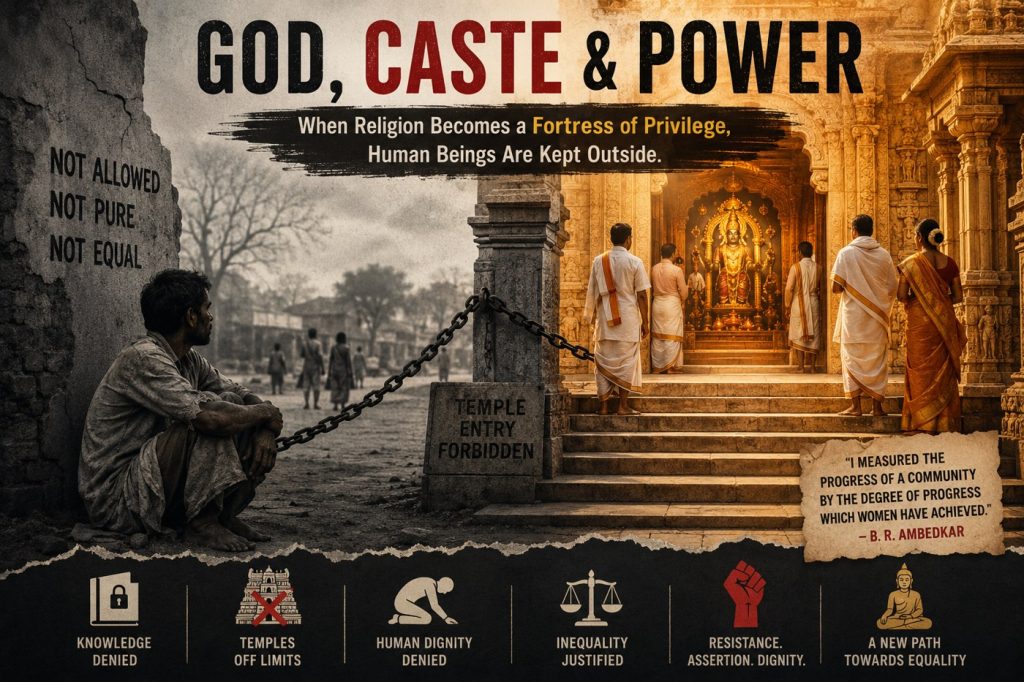
“If God is everywhere, why were Dalits kept outside the temple?”
This single question exposes one of the deepest contradictions in Indian society.
For centuries, millions of Dalits were told that God lived in stone idols, sacred rivers, Sanskrit chants, and temple rituals — yet they themselves were considered too “impure” to touch those very spaces.
Religion, which should have united people spiritually, often became a system that separated human beings by birth.
This is not just about faith. It is about power.
The history of caste in India reveals how the idea of God was not only spiritual but also political, social, and economic. Access to religion meant access to dignity, education, authority, and social legitimacy. Those who controlled religion often controlled society itself.
And nowhere is this more visible than in the historical marginalisation of Dalits within orthodox Hindu structures.
The Sociology of God: Who Gets to Define the Divine?
French sociologist Émile Durkheim argued that religion is not merely about worshipping God — it is society worshipping itself.
In simple words:
the structure of religion often mirrors the structure of society.
So if society is hierarchical, religion can become hierarchical too.
In caste society, spiritual authority was concentrated in the hands of upper castes, especially Brahmins. They became the interpreters of scripture, gatekeepers of rituals, and mediators between humans and God.
This created what sociologist Max Weber would call a system of “religious authority.”
The problem was not just belief in God.
The problem was:
- Who had the right to approach God?
- Who could read sacred texts?
- Who could become a priest?
- Who could enter temples?
- Who was considered “pure” enough for spirituality?
Dalits were denied nearly all of these rights.
Religion slowly transformed into a structure of social control.
Origins: Varna, Jati, and Scripture
The classical framework begins with varna (literally “color” or “attribute,” often interpreted as class or category), described in the Rig Veda’s Purusha Sukta (c. 1500–1200 BCE), which describes how comic being was created, resulting in creation of Varna: Brahmins from the mouth (priests/scholars), Kshatriyas from the arms (warriors/rulers), Vaishyas from the thighs (traders/farmers), and Shudras from the feet (laborers/servants).
Purush Sukta

Early Vedic society emphasized function and division of labor more than rigid heredity. The first three varnas were “twice-born” (dvija), eligible for Vedic study and initiation. Shudras served the others. Over time, this idealized model interacted with jati (birth groups, often occupational or kinship-based, numbering in the thousands). Jati became the practical, hereditary reality of “caste”.
Manusmriti (c. 200 BCE–200 CE) codified a stricter hierarchy, detailing duties, restrictions on Shudras (e.g., prohibitions on Vedic study, severe punishments for transgressions), rules on inter-varna mixing, and notions of purity/pollution. It presented this as dharma—cosmic and social order—tied to karma (actions across lives) and rebirth. This framework justified graded inequality as natural and divinely ordained, enabling upper varnas (especially Brahmins) to maintain authority over knowledge, rituals, and norms.
Purity and Pollution: The Theory That Crushed Millions
One of the strongest foundations of caste hierarchy was the idea of ritual purity and pollution.
According to Brahmanical orthodoxy:
- upper castes were considered spiritually pure,
- while Dalits were labelled “untouchable.”
This was not merely symbolic discrimination.
It shaped everyday life.
Dalits were:
- denied entry into temples,
- separated from upper-caste settlements,
- prohibited from using common wells,
- prevented from studying scriptures,
- and forced into degrading occupations.
Even their shadow, in some regions, was once considered polluting.
French anthropologist Louis Dumont explained caste as a hierarchy built around purity. In this system, inequality was not seen as injustice — it was presented as “divine order.”
That is what made caste so powerful.
It was not enforced only through violence.
It was enforced through morality and religion.
When God Needed a Middleman
One of the most elitist aspects of orthodox Hinduism historically was the monopolisation of spiritual access.
Religion became heavily ritualistic:
- Sanskrit chants,
- priestly mediation,
- complex ceremonies,
- birth-based authority.
The ordinary person could not directly access sacred knowledge.
And Dalits were almost completely excluded.
This created a dangerous equation:
Spiritual legitimacy = caste privilege.
If only certain castes could interpret God, then social inequality automatically appeared sacred.
German philosopher Karl Marx once called religion the “opium of the masses,” but in caste society religion also functioned as a technology of hierarchy.
It told oppressed communities:
- suffering was destiny,
- caste was karma,
- obedience was virtue.
The oppressed were not only economically marginalised — they were spiritually humiliated.
Ambedkar’s Explosive Question: Can Equality Exist Within Caste Hinduism?
No one challenged this structure more powerfully than Dr. B. R. Ambedkar.
Born into an “untouchable” Mahar caste, Ambedkar experienced caste humiliation firsthand despite being one of the most educated Indians of his time.
His critique was radical.
He argued that caste was not an accidental social problem. It was structurally embedded within orthodox Hinduism itself.
In Annihilation of Caste, Ambedkar attacked:
- scriptural authority,
- Brahmanical dominance,
- and the religious justification of inequality.
His argument was simple but devastating:
A religion that denies human equality cannot create social democracy.
Ambedkar believed political freedom without social equality was meaningless.
That is why, in 1956, he converted to Buddhism along with hundreds of thousands of followers.
It was not merely a religious conversion.
It was a declaration of human dignity.
Bhakti Saints: The Rebellion from Below
But the story of Hinduism is not one-dimensional.
Even within Hindu society, there were powerful anti-caste revolts.
The Bhakti movement became one of the biggest spiritual rebellions in Indian history.
Saints like:
- Ravidas,
- Kabir,
- Chokhamela,
- Nandanar,
challenged Brahmanical authority directly.
They rejected the idea that God belonged to upper castes.
Their message was revolutionary:
- devotion mattered more than birth,
- love mattered more than ritual,
- humanity mattered more than purity.
Kabir mocked religious hypocrisy openly.
Ravidas imagined a casteless utopia called Begumpura — a city without fear, hierarchy, or oppression.
For oppressed communities, Bhakti was not just spirituality.
It was resistance.
Temple Entry and the Politics of Dignity
The fight for temple entry was never merely about religion.
It was about equality.
When Dalits demanded entry into temples, they were demanding recognition as human beings.
Movements like:
- the Vaikom Satyagraha,
- Temple Entry movements,
- and anti-caste struggles across India,
challenged centuries of exclusion.
These protests exposed an uncomfortable truth:
If God is universal, exclusion cannot be sacred.
The Indian Constitution later outlawed untouchability under Article 17.
Yet caste discrimination still survives in many forms:
- social segregation,
- violence,
- discrimination in villages,
- exclusion from priesthood,
- and symbolic humiliation.
Modern India legally abolished untouchability.
Socially, the battle continues.
Why This Debate Still Matters Today
Many people today claim caste is “finished.”
Data says otherwise.
Dalits continue to face:
- disproportionate violence,
- educational discrimination,
- economic inequality,
- and social exclusion.
At the same time, a new Dalit consciousness has emerged through:
- literature,
- political assertion,
- digital activism,
- and cultural resistance.
Dalit writers, scholars, and activists are rewriting history from the perspective of the oppressed rather than the privileged.
And perhaps the most important shift is this:
Dalits are no longer asking dominant society for acceptance.
They are asserting dignity on their own terms.
The Real Question Is Not About God
The real question is:
Who controls the idea of God?
Because throughout history, religion has often been used in two completely opposite ways:
- to justify hierarchy,
- and to challenge it.
Caste oppression survived not simply because people believed in God, but because social power was wrapped in sacred language.
The struggle against caste, therefore, is not only political.
It is also intellectual, cultural, and spiritual.
And that is why the debate around Hinduism, caste, and Dalit marginalisation remains one of the most important conversations in modern India.
Because a society cannot truly become democratic while human dignity is still determined by birth.


