


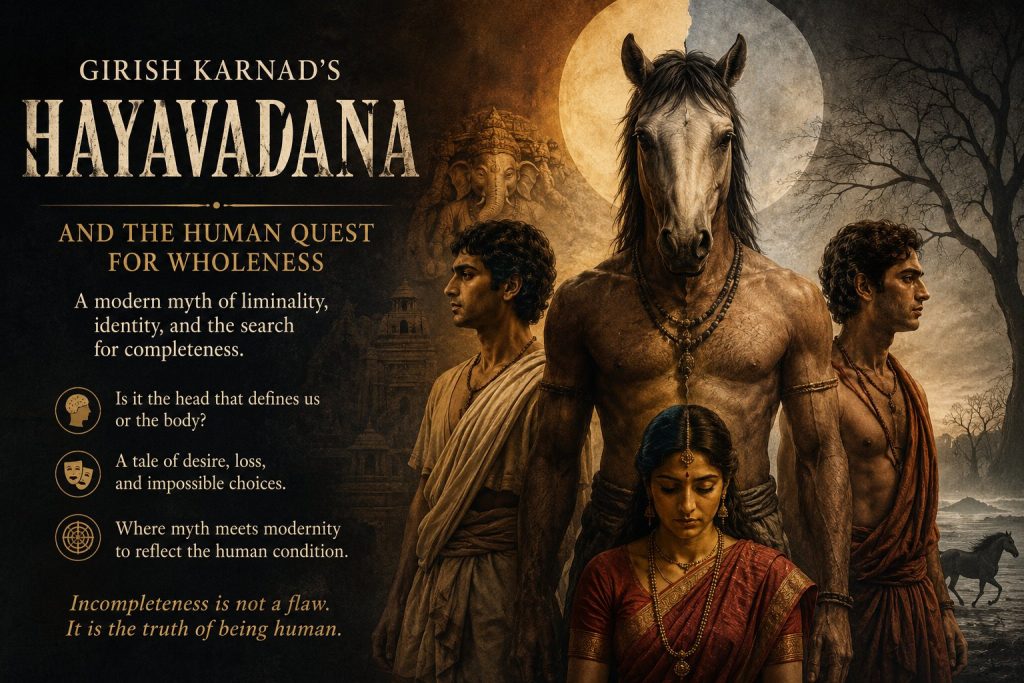
What does it mean to be complete?Hayavadana and the Human Quest for Wholeness navigates painfull reality of incopleness. Is it intelligence? Physical strength? Social status? Emotional fulfillment? Or is completeness merely an illusion that humans spend their entire lives chasing? These questions lie at the heart of Girish Karnad’s masterpiece Hayavadana, a play that continues to fascinate readers and audiences decades after its publication. Drawing inspiration from ancient Indian myths and legends, Karnad crafts a story that feels surprisingly modern—a story about identity, desire, and the painful reality of human incompleteness, and how it is linked to Hayavadana and human quest for wholeness.
A Strange Beginning: The God of Imperfection
The play opens with an image that immediately unsettles conventional ideas of perfection: Lord Ganesha. An elephant’s head on a human body. A broken tusk. A protruding belly. By ordinary standards, Ganesha appears imperfect. Yet he is worshipped as the remover of obstacles and the embodiment of wisdom and success, which strikingly ressonats to Hayavadana and the Quest for Wholeness
Karnad uses this paradox to introduce a profound question: if perfection itself appears imperfect, perhaps our understanding of completeness is fundamentally flawed. This idea becomes the foundation upon which the entire drama unfolds.
The Story of Three People and One Impossible Desire
At the center of Hayavadana are three characters:
- Devadatta, the intellectual Brahmin
- Kapila, the physically powerful and earthy friend
- Padmini, the woman drawn to qualities in both men
Padmini desires what many people secretly desire—a perfect combination of strengths. She admires Devadatta’s intellect but is equally attracted to Kapila’s vitality and physical presence. Her longing reflects a universal human impulse: the desire to possess everything without compromise. But myths have a way of exposing impossible dreams.
When a bizarre accident leads to the exchange of Devadatta’s and Kapila’s heads, the boundaries between mind and body collapse. Suddenly, Karnad transforms a simple love triangle into a philosophical puzzle, posing paradoxical relationship between Hayavadana and the Quest for Wholeness.
Who is the real husband? Does identity reside in the head or in the body? Can two incomplete individuals be merged to create a complete person? The answers prove far more complicated than anyone expects.
The Horse-Man Who Mirrors Humanity
Running parallel to the main story is the tale of Hayavadana—a man cursed with a horse’s head. Unlike the other characters, Hayavadana’s desire is straightforward: he simply wants to become fully human. His condition makes him a living symbol of liminality, a state of being “in-between.” Neither fully horse nor fully man, he exists on the threshold between identities. Ironically, while the human characters chase perfection through impossible combinations, Hayavadana seeks completeness through simplicity. Yet his journey ends with a startling twist: instead of becoming fully human, he transforms into a complete horse. The irony is unmistakable. The quest for wholeness rarely ends where we expect.
Why the Play Still Feels Modern
Although rooted in myth, Hayavadana speaks directly to contemporary anxieties. Modern life constantly pressures individuals to become ideal versions of themselves. We are expected to be intelligent, attractive, successful, emotionally balanced, socially admired, and professionally accomplished—all at once.
The result is often a fractured sense of self. Like Padmini, we want the best of every world. Like Devadatta and Kapila, we struggle between competing aspects of our identities. Like Hayavadana, we feel trapped between who we are and who we wish to become. The play beautifully portrays that these struggles are not new. They are deeply embedded in the human condition.
Beyond Identity: A Commentary on Society
The play is not merely philosophical. It also raises important social questions. By bringing together characters from different caste backgrounds and placing them in situations where identities become fluid and unstable, Karnad challenges rigid social hierarchies. If bodies can be exchanged and identities can shift, what happens to systems that rely on fixed categories? The play quietly undermines assumptions about purity, superiority, and social order. In doing so, it transforms myth into a powerful tool for social critique.
The Beauty of Being Incomplete
Perhaps the most enduring message of Hayavadana and the Human Quest for Wholeness is that incompleteness must not be considered as a flaw to be corrected but a condition to be understood. Every character in the play seeks wholeness. Every character fails. Yet it is through these failures that Karnad reveals a deeper truth: human beings are defined not by perfection but by contradiction. We are mixtures of desire and restraint, intellect and instinct, certainty and confusion.
The search for completeness may never end, but perhaps that search itself is what makes us human. In a world obsessed with perfection, Hayavadana offers a refreshing reminder: the fragmented, unfinished, and imperfect self is not a problem to solve. It is the reality of being alive. And perhaps that is enough.
Chandra, S. 2026


