


Introduction
For generations of Indians, the ancient code of social stratification known as the ‘caste system’ has defined their occupational resorts and formulation of conjugal bonds. Caste inherently has invaded all the domains of an individual’s life, partaking the sole agency of defining their economical, social and political status. Despite age long social reform efforts, deep-rooted prejudices and entitlement hold firm grounds amongst the so-called higher castes, while those on the lowest rungs still face marginalization, abhorrent discrimination and encounter horrendous instances of abominable violence in their routine lives. Caste which has been deeply engrained in Indian blood and soil has been an age long practice legitimizing discrimination and marginalization. Sociological understanding of caste attributes ‘Caste as an endogamous group having a relatively independent culture and structural existence.’ The caste system owns its derivation to the Varna system formulated in the Vedic times. While there’s incongruity over its origins, the caste system was solemnized in a legal treatise called Manusmriti, dating from about 1,000 B.C. The classification has since progressed to include some 3,000 castes and 25,000 sub castes. Ghurye precisely comprehends that any attempt to define caste is bound to fail because of the complexity of the phenomenon. The ambiguity related to the precise definition of caste has sill baffled a number of sociologists, economists, social-scientists and socio-political analytics.
Therein this article forays to revisit the caste system, understand and intimately analyze the social, economic and political spectrum of caste and finally ruminate more precisely on the caste reservation system of India along with its various dimensions and additions.
Ruminating upon the present situation
Seven decades back with the liberation of India from the colonial rule – the constitution of India outlawed the discriminative practices of untouchability and enshrined affirmative actions against it. But unfortunately, caste continues to play a decisive role in all the walks of life. The constitution provided provisions for reservation in government jobs and educational institutions for the Dalits – who now count more than 200 million in the population structure of the country. Since 1950– with the formulation of the Indian constitution, deliberation and meditation over the caste reservation system has taken place. In 1953 under Kaka Kalekar, OBC commission was set up followed by supreme court’s rule of not preceding the reservations more than 50% in 1963.in 1979 Mandal commission was set up and in 1989 V.P Singh government implemented Mandal commission’s implementations followed by deliberation on the same in 1992 and 2006. Recently in 2019 Union Cabinet conceded a bill that for the first time reserves 10% seats entirely based on financial status for Economically Weaker Sections (EWS). The existent reservation system is applicable only to the government jobs and public educational institutions. It is imperative to note that the opportunities in the government sector are shrinking as successive governments have whole-heartedly supported privatization of economy. It is unfortunate to record that astoundingly a third of Dalit population earn $2 a day and many are still denied safe drinking water and sanitation measures. In the extant jungle of reservations provided to a number of communities including SC, ST and OBC (other backward classes) – the system propounded to uplift these distressed classes have lost its significance. In the recent years the country has witnessed nearly a string of fierce protests by various communities demanding for reservation. In July 2015 Patidar youth started public demonstrations across Gujarat demanding OBC status for their community. The Jat reservation agitation was a series of violent protests in February 2016 by the Jat community, which “paralyzed” the State for 10 days. These occurrences further raise sheer apprehensions regarding the effectiveness of the extant reservation system, as the sections of the society who require the aid of the governmental structures are overshadowed by such violent protests. The contention encircling the reservation system is never-ending and therein, a proper review of the reservation system appears to be largely significant.
Political and economic dimensions of caste reservation system
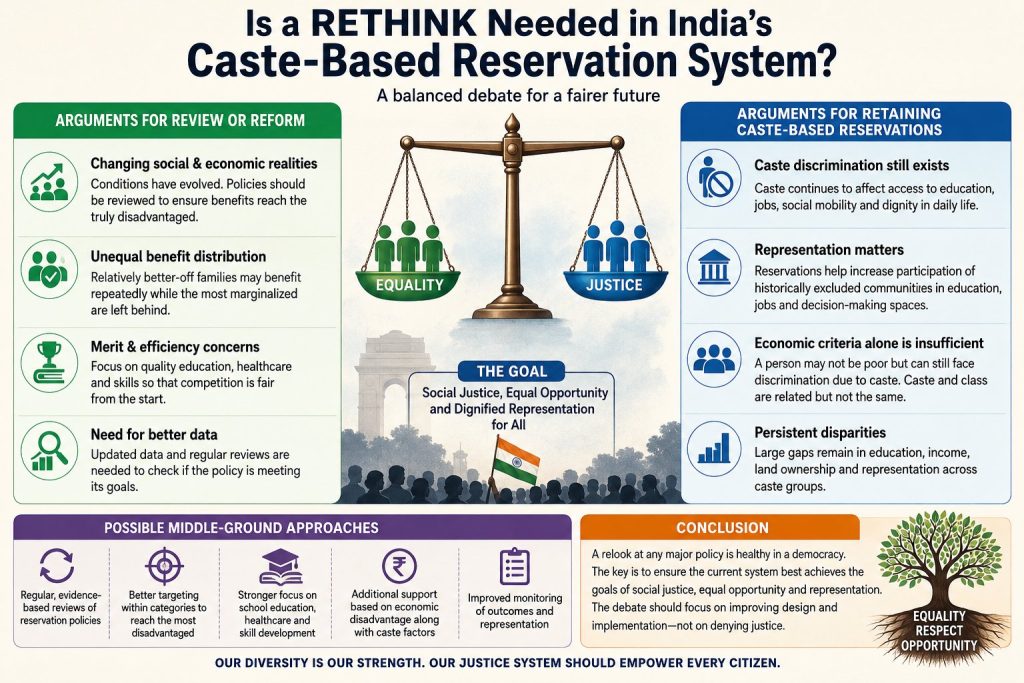
Political parties have every now and then, highlighted the fault lines of the caste system for political gain. The real issue gets merely diluted in rhetorics, as the political parties frame their agenda in accordance to the power structure. Basically, political parties seek to gain or retain their political clout by using caste system as a major plank. The subsequently ‘politicalization of caste’ has further made the scheduled castes more vulnerable. Recently, the Narendra Modi government has taken a decision of eliminating OBC reservation in the All-India-Quota seats for admission in medical college which opened a can of worms. In the lieu of this the Supreme Court evidently proclaimed that ‘reservations are not a fundamental right’ and therein has pressed the government to exclude the ‘creamy layer’ among the Scheduled castes (SCs) and Scheduled Tribes (STs) from reservation assistance. The fundamental grievance of the deprived castes (E/MBCs and Mahadalit’s) with the prevalent reservation mechanism is that they are not able to extract the benefit of reservation as numerically dominant and economically powerful OBCs and SCs are the ones who are majorly retrieving the reserved seats and larger reservation window.
Many scholars and activists argue that caste continues to affect social mobility, educational access, employment opportunities and social treatment in India and therefore, they consider reservations as a tool to address structural disadvantages, not merely poverty.
Conclusion and recommendations
There is a need of improving the socio-economic condition of Dalits and reservation therefore could be one of the several other means. Reservation could be use creatively as an instrument for uplifting the socio-economic and political status of these deprived classes and liberate them from the clutches of regressive caste-politics and marginalization. Caste can be integrated with the socio-economic status of individuals in order to determine their candidature for the reservation. Given the present situation and future scenario – where private players are likely to play major role in the economy, this insinuates that scope of reservation should be extended to the private sector as well. It is important to ponder that our envisioned future predominantly tied to goal post of achieving human development for everyone. Human development of everyone is principally associated to creation of condition and enabling factors that can facilitate individuals to realize their full potential. The envisioned future of India does not seem to support the continuance of existing reservation system given the fact that private sector will be generating greater number of jobs – in such a evolving scenario it is important to provide them with level-playing field in terms of quality education and training rather than mindlessly following the existing reservation system.
Chandra, S. 2026
References
- Chaudhary A. India’s caste System, October 25, 2019, Bloomberg https://www.bloomberg.com/quicktake/india-s-caste-system
- Kumar A., Both upper caste and quota creamy layer cite merit. But their goals are different, the print
- https://theprint.in/opinion/both-upper-caste-and-quota-creamy-layer-cite-merit-but-their- goals-are- different/470092/ [online]
- Ghurye, Govind Sadashiv. Caste and Race in India. India, Popular Prakashan, 1969.
- Ramchandran, N. 2018. Opinion | Time to review India’s reservation policies,https://www.livemint.com/Opinion/OMjluNQsw48JDqZqtzKnXL/Opinion–Time-to-review- Indias-reservation-policies.html


