


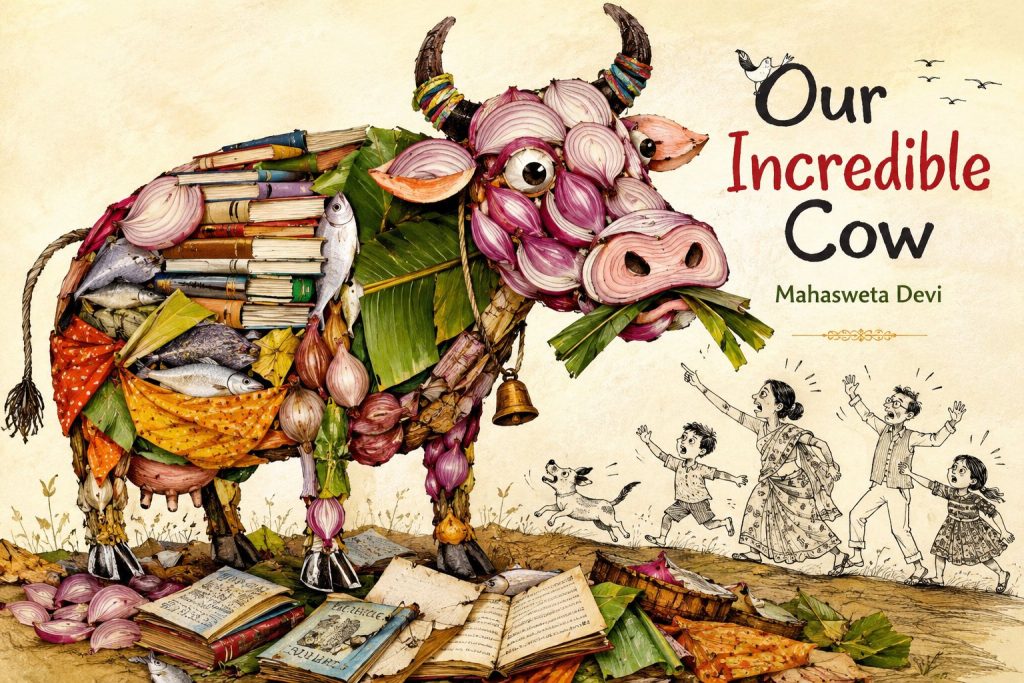
When we think of Mahasweta Devi, we often remember her as one of India’s most powerful literary voices for the marginalized and the oppressed. Throughout her vast body of work, she championed the concerns of those living at the margins of society—the subaltern, the voiceless, and the forgotten. Yet, even in her writing for children, Devi remained deeply committed to celebrating individuality, resistance, and the courage to challenge conventions. Her delightful children’s book Our Incredible Cow is a testament to this vision.
At the heart of the story is Nyadosh, a pet cow unlike any other. Far removed from the conventional image of the gentle, obedient, grass-chewing bovine, Nyadosh is mischievous, ravenous, and endlessly curious. She devours textbooks, chomps on frocks, and creates havoc wherever she goes. Her antics transform an ordinary household into a site of constant surprise and amusement, making the narrative both humorous and unforgettable.
What makes Our Incredible Cow particularly remarkable is its inventive visual storytelling. Nyadosh is illustrated as a constantly evolving collage composed of the very things she consumes—onions, fish, banana leaves, books, fabric, and recycled materials. Inspired by the assemblage portraits of the Renaissance artist Giuseppe Arcimboldo and the playful notion that “we are what we eat,” each depiction of Nyadosh becomes a visual record of her adventures. The illustrations are not static representations but shape-shifting constructions that change from page to page. Banana leaves are arranged into limbs, onions become facial features, and folded fabrics create movement and form.
This whimsical iconography does more than entertain. It invites young readers to transcend the limitations of stereotypical thinking. By presenting a cow that constantly changes shape, size, and appearance, the book encourages children to imagine beyond fixed categories and familiar assumptions. The gigantic, colourful images of Nyadosh are humorously contrasted with tiny black-and-white sketches of the family members who struggle—often unsuccessfully—to control their eccentric pet. The visual contrast reinforces the cow’s larger-than-life personality and her refusal to conform.
Beyond its humour, the story resonates strongly with Mahasweta Devi’s broader literary concerns. Nyadosh can be read as a symbolic embodiment of Devi’s idea of subaltern speakability. Traditionally, a cow is expected to be passive, predictable, and obedient. Nyadosh rejects these expectations. She is inquisitive, rebellious, and fearless in challenging authority. Her refusal to behave according to established norms mirrors the resistance of marginalized voices that Devi so often foregrounded in her adult fiction.
The narrative unfolds at a brisk pace, chronicling Nyadosh’s disruptive adventures throughout the neighbourhood and her household. Every episode is infused with laughter and wonder, yet beneath the humour lies a celebration of individuality and self-expression. Even when the story reaches its poignant conclusion with Nyadosh’s illness and death, her defining trait—curiosity—remains eternal. The cow’s physical presence may disappear, but her spirit of questioning and exploration endures.
Our Incredible Cow offers readers intimate glimpses into family life inspired by Mahasweta Devi’s own childhood experiences. Through everyday interactions, frustrations, and moments of affection, the story paints a warm portrait of familial relationships. In doing so, it reminds readers that individuality and belonging are not opposites; one can preserve a unique identity while remaining deeply connected to family and community.
Our Incredible Cow is much more than a humorous tale about a troublesome pet. It is a celebration of imagination, curiosity, and the courage to be different. Through its innovative visual design, engaging narrative, and subtle social commentary, the book introduces young readers to ideas of resistance and selfhood in a manner that is both accessible and entertaining. Like much of Mahasweta Devi’s work, it challenges us to look beyond appearances, question established norms, and appreciate the value of every unique voice—even if that voice belongs to a rebellious cow named Nyadosh.
In a world that often rewards conformity, Nyadosh’s adventures remind us that curiosity can be transformative, rebellion can be creative, and individuality deserves to be celebrated.


