


“O Muse! Sing in me, and through me tell the story of that man skilled in the ways of contending, a wanderer, harried for years on end…”
Few films announce their literary inspirations as boldly as O Brother, Where Art Thou?, the Coen Brothers’ delightfully eccentric 2000 masterpiece. From its opening moments, the film makes no secret of its connection to Homer’s Odyssey, inviting audiences on a journey that is at once mythic and unmistakably American.
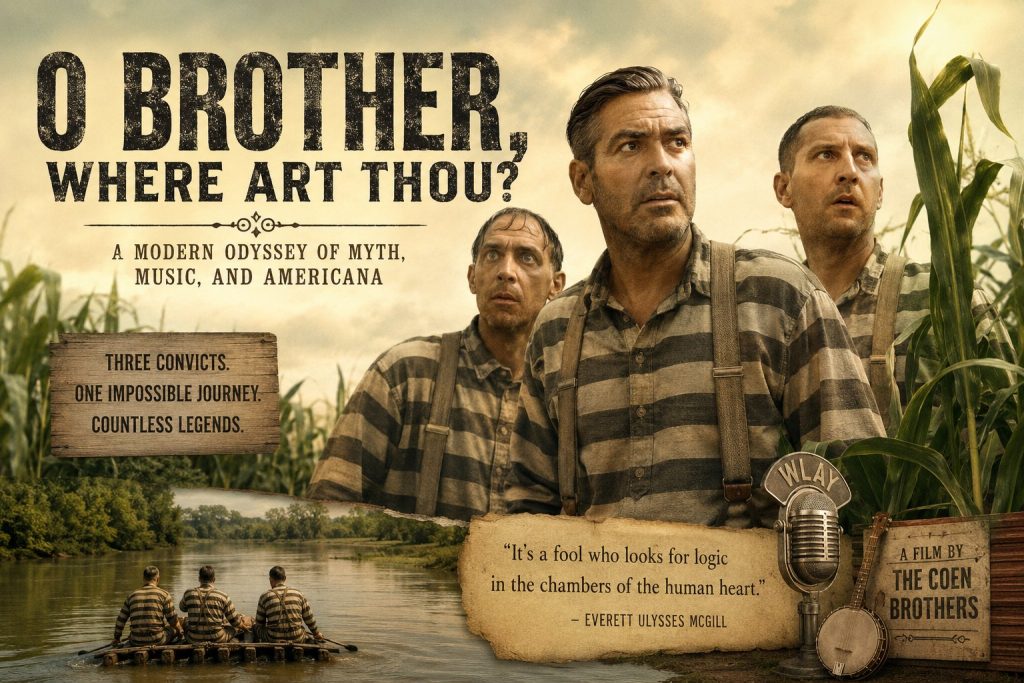
Set against the dusty landscapes, cornfields, backroads, and concert halls of Depression-era Mississippi, the film follows three escaped convicts—Everett Ulysses McGill, Pete, and Delmar—on a quest for a treasure that may or may not exist. What begins as a simple escape story gradually unfolds into a playful reimagining of Odysseus’ legendary voyage home, filtered through bluegrass music, political satire, and Southern folklore.
The genius of the Coen Brothers lies in their ability to weave ancient mythology into the fabric of American history without ever sacrificing entertainment. Throughout the film, viewers encounter familiar figures and episodes from The Odyssey in wonderfully unexpected forms. A blind railroad prophet recalls the seer Tiresias, whose predictions guide Odysseus through uncertainty. Three enchanting women washing clothes by the river become the seductive Sirens whose songs lure sailors to their doom. Big Dan Teague, the one-eyed Bible salesman, serves as a comic yet memorable version of the Cyclops Polyphemus. Even the nighttime encounter with the Ku Klux Klan echoes Odysseus’ descent into the realm of the dead, transforming a mythological episode into a sharp commentary on America’s troubled past.
Yet the film is far more than a simple adaptation. It thrives on absurdity. The Coens create a world where logic bends effortlessly to whimsy, where political campaigns resemble traveling carnivals, and where accidental musicians become cultural sensations overnight. This blend of the ridiculous and the profound gives the film its distinctive charm. Every strange encounter, every improbable coincidence, and every burst of music contributes to a universe that feels both fantastical and deeply authentic.
Music itself plays a central role in this modern epic. The bluegrass-infused soundtrack does more than provide atmosphere; it becomes a storytelling device, connecting the characters’ journey to the cultural heartbeat of the American South. Songs emerge organically from the narrative, transforming the film into a semi-musical adventure where myth and melody coexist seamlessly.
What makes O Brother, Where Art Thou? truly remarkable is its ability to merge disparate worlds. Greek mythology collides with American history. Political satire mingles with folklore. Magical realism intertwines with the harsh realities of the Great Depression. The result is a film that feels timeless despite being rooted in a specific place and era.
Beneath its humor and eccentricity lies a surprisingly thoughtful meditation on human nature. Everett’s memorable observation—“It’s a fool who looks for logic in the chambers of the human heart”—captures the film’s central philosophy. Human beings are irrational, contradictory, and endlessly unpredictable, and the Coens embrace that truth with wit and affection.
More than two decades after its release, O Brother, Where Art Thou? remains a singular cinematic achievement. It is a road movie, a musical, a comedy, a political satire, and a mythological retelling all at once. Most importantly, it is a celebration of storytelling itself—a modern odyssey that proves ancient tales can still find new life in the most unexpected places.
In the end, much like Homer’s epic, the journey matters far more than the destination. And what a wonderfully strange journey it is.
Chandra, S. 2026


