


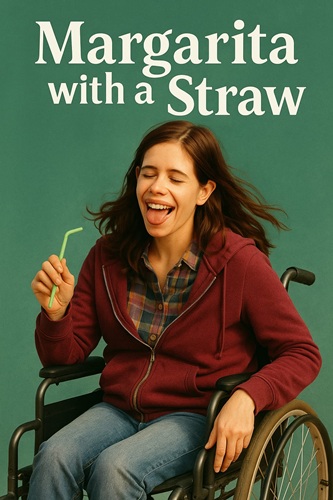
Halfway through the film in a climactic sequence the camera fervently shifts its focus from Laila’s (Kalki Koechlin) recent buoyant reception of her bisexual relationship with Khanum (Sayani Gupta) to Shubhangini’s (Revathy) abrupt realization of her disabled daughter’s sexual yearning. The scene is crammed with deep undertones of drama, conflict, reality, and a sense of unfeigned tension invading the relationship of Shubhangini and Laila. The cutaway shot offers a photomontage-like rendition of the relationship between the caregiver and the disabled subject. Shubhangini’s perception of Laila’s ‘innocence’ fades away as she skims through Laila’s laptop and finds the porn site tab open. The continuous shot allows the audience to view Shubhangini’s revulsion, the change in the dynamics, and the gradual rift which takes place between the two. The poignant realization of her daughter’s exposure to and engagement with the sexual cultures through porn sites disrupts the image of the de-sexualized disabled body which Shubhangini appears to actively internalize. In the very next sequence, Shubhangini barges into the washroom, violating Laila’s bodily privacy and in her discombobulated state confronts Laila. The over-the-shoulder shot features Shubhangini’s back while offering a glimpse of Laila in a disrupted state, it allows the audience member to stare at Laila with a similar autonomy through which Shubhangini gazes at her. The intrusion is no longer confined to Laila and Shubhangini but it appropriates a more collective character. The intrusion becomes an apparatus to inform the disabled subject about the authority that the state exercises over his/her/their body. Here, the audience is forced to perceive Laila with Shubhangini’s gaze, as a hyper-sexualized object deprived of any subject-hood, devoid of subjectivities and a coherent sense of sexual being. It becomes a cathartic moment, where the audience realizes the stereotype being latched on to Laila who reacts with an overwhelming scream followed by an agitated affirmation “how dare you?” The scream symbolically carries the ‘lack’ that Laila carries, this lack is not physical but rather cultural, social, and emotional. The lack of bodily integrity and privacy comes with a sense of sudden realization to Laila. This moment in the narrative presents Laila as a hollow base wherein sexuality is either imposed or stripped and the intensity of sexual affectation are rather altered by the forces of society. As the camera pans from Laila to Shubhangini, there is a transition from a sense of fulfillment to an overall atmosphere of fear, transgression, and doubt. Laila who quite of late tried to overcome her sense of self-doubt through the aid of her budding sexual and emotional dynamics with Khanum is yet again dragged into an abyss of vulnerability. The exchange is significant as it unpacks the anxiety that the abled-bodied caretaker experiences on the site of an overt encounter with the disabled subject’s sexuality. This exchange In Margarita with a Straw brings into the vanguard a quagmire of questions about the governance of disabled materiality; is it worth arguing that sexuality is predominantly perceived as a private affair but it has remained a major site of state (socio-cultural, political) control and intervention? How anxiety surrounding sexuality poses an inherent risk to individuals. How sexuality has remained an important domain of “Governmentality” for several centuries. How the state’s intervention in the sexual domain has continued to find strong support on the ground of construction and sustenance of socio-cultural order. How both social policy and law maintain significant hush in the context of the sexuality of disabled bodies. Furthermore how this silence itself coveys that sexuality in the context of a disabled subject encompasses a negative connotation, i.e. either it is forbidden or the state intentionally resists controlling, regulating, or managing the sexuality of the disabled subject. Therefore, this paper delves into understanding the contours of disability, self-discovery, and sexuality in Margarita with a Straw. This paper tries to understand the representational semiology of Margarita with a straw as a transnational narrative and how it has tackled the question of queerness and sexuality with a neoliberal lens. Concomitantly, this paper attempts to understand the predisposition of the conventional socio-political, familial and cultural state and the neo-liberal state towards the sexuality of the disabled subject for the fulfilment of their respective agendas. 1. The Queer Question, neoliberal inclusionism, and Margarita with a straw Cinema and cinematic representations garner a significant position within the modes of cultural production. Mainstream cinema as an artistic and creative agent of cultural production capitalizes on the voyeuristic pleasures of the audience by maintaining the gaze and by relentlessly preserving the norm and reiterating normative positions to retain its cultural dominance as a visual medium. As a consequence, it propagates the socially constructed binaries of “normal-abnormal”, “homosexual-heterosexual”, “self-other” “able-bodied” and “disabled corporeality.” In a way instead of detouring from the commonly held stigmas, it ends up ostracizing marginal identities, often re-imposing stigmas about those who are identified as “disabled” and “queer” (Foucault 1976; McRuer 2017). As this paper traces the history of Bollywood’s depiction of alternate non-hetero-normative sexualities, It observes that Bollywood has exploitatively materialized on two common (mis)conceptions; the representational trope of comedic relief (for instance; Kal Ho Na Ho, 2003; Dostana, 2008; Masti, 2004) or depiction of alternate non-normative sexualities with a pathologizing standpoint (e.g, Girlfriend, 2004; Men not allowed, 2006). However, Deepa Mehta’s Fire (1996) appoints lesbianism exceptionally as its central rhetoric and further tackles the subject matter with a renewed legitimacy. Thereof the film has become a key referent in the discourse surrounding the cinematic and representational politics of LGBTQ sexualities in the Indian cultural landscape. As Churnjeet Mahn and Diane Watt point out, lesbians can be recast “at the heart of Fire by filtering them through the lens of transnational protest, and by offering a close reading of the film’s play on religious and cultural symbolism.” Bypassing of hetero-normativity in Fire is queer, and several scholars argue that it triggered an imperative public discourse about non-normative female desire (Chakroboraty, 94). Fire ignited virulent protests from the right wing for its deliberate attempt to “malign” the cultural and ethical apparatus of India. Chakraborty and Ghosh opine that the release of Fire in 1996 in a way led to the ‘coming out of ‘cinematic queerness’ in Bollywood. Fire served as an imperative vehicle to firmly pose the queer question in the popular lexicon, which allowed an insurgence of films representing and (mis)representing alternate sexualities. There has been an emergence of queer films which potently interrogated traditional cinematic representation of masculinity-femininity, hetero-normative and non-heteronormative binaries (e.g; Mango Souffle, 2002; My Brother…..Nikhil, 2005; Bombay Talkies, 2013; Aligarh, 2015) alongside Indian cinema witnessed the formation of a discourse concretized around alternate sexualities shrouded in mal-readings and faltering identities that lie at the crossroads of “the erotic and the phobic” (eg; Kal Ho Na Ho, 2003; Masti, 2004). This ambivalence may be symptomatic of the Indian audience’s dilemma around surfacing sexualities and a struggle to come to terms with it. A schematic examination of films surrounding disability charts a similar trajectory of representational dynamics. Although there has been a scarce attempt to offer a non-normative stance towards disability in Hindi cinema (e.g, Koshish, 1972; Sparsh, 1980; Taare Zameen Par, 2007) however, none of these actively engages with the sexuality co-ordinate of the disabled subject as its central thematic concern. This lack of exploration of the sexuality-disability paradigm specifically within the Indian cinematic landscape quite fervidly highlights the rhetoric of ableism which desexualizes disabled bodies by making them appear as asexual beings. Julie Elman argues, borrowing from Rosemarie Garland Thomson that the gendered and sexual segment of ableism disallow autonomy and sexual agency to disabled bodies as “disability is a product of cultural rules about what bodies should be or do (Thomson, 57)” In this context, Margarita with a Straw emerges to be a remarkable film as it presents itself as one of the foremost mainstream Bollywood narratives tackling the intersections and the convergence of disability, sexuality, gender, and queerness. Moreover, the large-scale acceptance of Margarita With a straw by the Indian audience despite its conspicuous sexual matrix and non-normative narratorial context precipitates several interesting questions. It becomes important to question why Fire (1996) encountered backlash while Margarita with a straw (2014) which deals with a similar explicit portrayal of alternate sexuality received both critical and popular mandate. The film charts Laila’s journey from Delhi to New York and thereby The United States (the foreign land) instead of Delhi (the homeland) becomes the site of the exploration of homosexuality. The cultural landscape holds importance in Fire as opposed to Margarita with a straw; the homosexual relationship unwinds within the bounds of the familiar and familial milieu of the Indian middle-class household. The aspect of familiarity, recognition, and the process of identification with the two protagonists (Sita and Radha) and the milieu torment the cultural consciousness of the Indian audience. However in Margarita with a straw, this aspect of identification is intentionally betrayed, the unfolding of the sexual relationship between Khanum and Laila in a culturally isolated setting offers a sense of distance from the narrative and the characters. The movie thus ends up portraying homosexuality as a western import, “a residual vice” (Chakroboraty, 96) of the western influence on India which in turn dilutes the sense of contention. Furthermore, the deployment of characters that have a preeminent westernized appearance, for instance, Kalki Koechlin and William Moseley sever the process of identification. Herein, the sense of estrangement which pervades throughout the cinematic frame opens an imperative discourse about the “neoliberal inclusionism” which Margarita with a straw as a transnational narrative exercises. In Fire as the layers are slowly peeled back, the audience is exposed to a simmering cauldron of discontent within a typical middle-class Indian family. The narrative unlike Bose’s Margarita with a straw is quite precise in its portraiture of the economic limitations of the family. Fire is quite clearly centered on one specific culture-scape, Sita and Radha in their appearance, interaction, role, and representation fulfill the conservative cultural imagination of an Indian woman as opposed to Laila and Khanum. Thus, Fire remains outside the bounds of this neo-liberal state, though very much controlled by the familial and the cultural state. Margarita with a straw, however, offers an interesting site where the conventional familial-cultural state and the neo-liberal state collide to claim their agency over the sexuality of the disabled subject. Mitchell and Snyder in their work the Biopolitics of Disability; Neoliberalism, Ablenationalism, and Peripheral Embodiment comment upon the nature of neoliberal inclusionism; neoliberal inclusionism is primarily made available to newly visible public identities such as those labeled handicapped, cognitively impaired, intersexed, deaf/blind, or queer based on a formerly stigmatized group’s ability to approximate historically specific expectations of normalcy. Yet, in bestowing these forms of grudging recognition, neoliberal inclusionism tends to reify the value of normative modes of being developed concerning able-bodiedness, rationality, and hetero-normativity (Mitchell & Snyder, 19) Mitchell & Snyder’s argument eludes to the tactical inclusion of some forms of disabilities, or rather the flippant normalization of certain disabilities to pave a way for empowering hetero-normativity and abled-bodiedness by including the “other” within. The representational semantics of Margarita with a straw works in tandem with this agenda of neoliberal inclusionism. It ends up depicting the supremacy of the United States in terms of its infrastructure for disabled-bodied individuals; as one can palpably witness Laila moving on her own without any additional support on her automated wheelchair throughout the streets of New York. This picture is in stark contrast with the initial close-up shot in Delhi University, wherein Laila is put into a disconcerting position when her wheelchair is carried by four college staff members as the college neither has a lift nor a ramp for the wheelchair to move from one floor to another. The close-up shot focuses on the haptics of the uncomfortable position, the four men facing their backs towards the camera and their voice relegates to the background, for the audience Laila’s uneasiness becomes central. In New York, Laila is shown to be exposed to a host of new technologies which assist her with her speech impediments. She has access to almost all forms of public amenities; public transportation and swimming pools whereas in India her mobility is mostly confined to her house and her college, she has no access to public transportation and neither she appears to move around the city on her own. Mitchell & Snyder points out; “International disability-based claims of American exceptionalism operate by shaming developing countries for their neglectful treatment of disabled people (Mitchell & Snyder, 52).” This neoliberal mode of inclusion of the disabled materiality discards the disabled individuals or groups who lack a certain economic stature, intellectual positioning, and cultural apparatus which is necessary to increase the state’s profitability as it would turn them into prospective consumers. Thus, Laila is made a partaker in this neoliberal enterprise, where she becomes symptomatic of the empowered position of the disabled subject in the west as opposed to the Indian landscape. Additionally, the narrative imprints the impact of the cultural state and the neoliberal inclusion on the sexuality of the disabled subject. The narrative pins down the disapproval of Laila’s queerness in the cultural context of India as opposed to her sense of identity reconstruction and acceptance of self-hood in New York. 2. The cultural state, Eugenics Agenda & Reproductive futurism Disability as a substructure for exclusion has been innately premised on the notion of the “norm”, “normal”, “normality” or “normalcy.” Moreover, with the proliferation and deeper sedimentation of this idea of the “norm” and simultaneously the “other”, the “deviant”, and “the aberrant”, the disabled body becomes a site of deep anxiety for the ableist social consciousness. Furthermore, this anxiety manifests itself through a pool of corrective and coercive praxes. Eugenics as an apparatus to improve the genetic configuration of the human species through planned breeding catalyzes this ableist anxiety to correct, remodel, control, or curb the disabled subject. A symbiotic relationship exists between the eugenics agenda and the concerns of ableism (Davis, 4). Both configure the concept of a norm, particularly a normal body, and thereby as a product construct the idea of a “disabled body”. This combined enterprise which perceives disabled people as “evolutionary laggards” or “throwbacks”, develops a deep seeded apprehension about the sexuality of the disabled body. The sexuality of the disabled subject invokes a specter of terror, as it would result in the production of more “defective”, “unproductive”, and “abnormal” subjects which are in turn imagined as a threat to the ableist normalcy. This threat and anxiety can be anatomized into myriad stereotypical positions about disability and the body inhabiting this disability engendered by the social norm. The Eugenics agenda can simultaneously be ascribed to the queer subject, as queerness akin to disability becomes an aberration to the normative order. Lee Edelman as a part of deconstructionist Queer Theory foregrounds his understanding of queerness in purely oppositional terms. In Homographesis and No Future: Queer Theory and the Death Drive, he argues that queerness has been grasped as an opposition to the “norm” by the larger cultural register. ‘Queer’ is an umbrella term deployed for people who do not identify themselves as heterosexual or cis-gender though etymologically it means strange or peculiar. ‘Queerness’ thus connotes any sexual behavior, identity, or orientation that does not conform to the sexual norm. It can be primarily characterized as a category that tries to escape the praxes of the ableist state and fails to identify with the ‘norm’. In this escapade, the ‘Queer’ as a category defies the allegiance to the ‘reproductive ideal’. No Future accepts but transvalues the homophobic claims that since homosexuals are unable to produce a progeny, they lack any form of investment in the future. In this way, his searing polemic brings the discourse of ‘reproductive futurism’ to the vanguard of queer studies. In a culture hegemonized by the imperatives of ‘reproductive futurism’, Edelman argues that the child figure presents itself as the ‘perpetual horizon of every acknowledged politics (Edelman, 24).’ In No Future, Edelman deftly polemicizes the rhetoric of futurity through a political narrative and a social order that is, violently and unbendingly hetero-normative. This investment of the child figure with identifications and collective beliefs of the present is problematic for homosexuals, as it obliterates the recognition of those whose identities and relationship with the future is not mediated through reproduction. Edelman’s scathing evaluation of reproductive futurism further allows this paper to chart similarities between the treatment of homosexuality and disability as substructures of exclusion and as perceived radical categories of transgression from the “norm”. This continuum of disability and homosexuality as deviant markers of identities in opposition to the “norm”; heterosexuality and able-bodiedness is materialized as “compulsory abled-bodiedness” and “compulsory heterosexuality” in McRuer’s work Crip Theory cultural signs of Queerness and Disability. McRuer’s work is instrumental as it points out how disabled and queer people have commonalities erupting from comparable modes of oppression and how often one of the two subject positions informs the other. For instance, the disabled body and the queer body suffer compounded oppression and abjection from the abled-heterosexual body. The paradigm of compulsory able-bodiedness and compulsory heterosexuality becomes central to the representational semantics of Margarita with a Straw. The movie traces the psychosexual turmoil within the protagonist, Laila as she delves into navigating her sexuality. Margarita with a Straw capitalizes on sexual dissonance as the protagonist oscillates between the grey spaces of conflated homosexuality, socially superimposed de-sexuality, and ideal heterosexuality. This discord or dissonance is perpetuated due to the inability of the ableist familial and cultural state to accept the disabled as a sexual being. The narrative offers a kaleidoscopic view of Laila traveling from one cultural unit to another, but her sexual dissonance remains disconcertingly palpable as a consequence of the agendas of the familial-cultural state and the neoliberal state. The convergence of these two markers of identities is intensified to an extent where queerness appears to be a product of Laila’s disability. The announcement of bisexuality is conceived to be preposterous, almost making it the point of inflection in the narratorial structure. In a close-up shot, as Shubhangin bathes Laila – in a state of complete nakedness Laila confesses. The setting and the haptic equation between the two characters become central, as the caretaker is exposed to the anatomy of the disabled body; there is a sense of possession and autonomy that the caregiver figure appropriates. Herein, Laila’s declaration of her bisexuality defies the future trajectory that the abled-bodied caregiver as a representative of the ‘familial and cultural state’ envisages. The concept of reproductive futurism becomes important, as Shubhangini is not able to perceive Laila’s anatomy in the light of a reproductive future. Shubhangini who otherwise departs remarkably from the characterization of a conventional mother and caregiver figure in her approach towards Laila’s disability appears to perceive sexuality and disability as incongruent identities. For Shubhangini Laila’s future trajectory does not seem to inculcate any form of investment in the sexual cultures, which is initially established through her agitated response to the possibility of Laila’s relationship with Dhruv (her disabled friend) and later on through the porn site episode. The heightened sense of shock that shubhangini (Revathy) receives has myriad layers affixed to it; it is an active product of the ableist social construct which discourages access to sexual cultures to the disabled body; the homosexuality of Laila is perceived as a two-fold abrasion in addition to her disability and concomitantly the relationship with another disabled body (Khannum) amplifies the sense of insecurity. 3. Conclusion As a transnational narrative that tackles intersecting marginal identities; gender, class, queerness, and disability Margarita with a straw intrinsically emerges out to be a site of collision for different State forces to claim their agency over the disabled subject. Bose tries to situate the experience of a queer disabled subject in two different cultural scapes and subsequently emphasizes the politics of these two diverse spaces. The neoliberal state (The United States of America) appears to be an escape from the familial and cultural state which denies Laila sexual autonomy. In Delhi, within the arena of familial and cultural governance, Laila’s exploration of her sexuality assumes a more covert trajectory (evident in the initial masturbation and porn site scenes). The Neo-liberal state however allows Laila the autonomy of entering into non-normative and casual sexual relationships. Herein, bose’s narrative which otherwise departs from the ‘norm’ ends up reiterating the conventional tropes of the ‘occident’ and the ‘orient’, empowering the process of neo-liberal inclusionism which results in the formation of rigid hierarchies of disability. The narrative tries to offer a reconciliatory end to Laila’s journey of self-discovery, sexual exploration, and queerness. However, the suggestion of a ‘solo date in a café’ featuring Laila with a surface-level makeover results in the reduction of her character to a mere consumer. Consumption becomes the vehicle for attaining selfhood. The narrative in a way liberates Laila from the restraints imposed by the familial and the cultural state but towards the end makes her a captive of the neo-liberal state, reliant upon consumerism for identity re-construction. Works Cited • Addlakha, R., Price, J., & Heidari, S. (2017). Disability and sexuality: claiming sexual and reproductive rights. Reproductive Health Matters, 25(50), 4-9. • Creed, B. Horror And The Monstrous Feminine: An Imaginary Abjection. London Routledge, 1993. 1-15, 60-65 • Edelman, L. (1994). Homographesis: Essays in Gay Literary and Cultural Theory (1st ed.). • • Fine, M., & Asch, A. (2018). Disabled women: Sexism without the pedestal. In Women and Disability (pp. 6-22). Routledge. • Foucault, M. (1991). Governmentality. In G. Burchell, C. Gordon, & P. Miller (Eds.), The Foucault Effects: Studies in Governmentality (pp. 87-104). London: Harvester Wheatsheaf. • Garland-Thomson, R. (2020). Integrating disability, transforming feminist theory. In Feminist Theory Reader (pp. 181-191). Routledge. • Kristeva, J. Powers Of Horror: An Essay On Abjection. Columbia University Press, 1982. Pp 2-7 • La France, M. & Mayo, C. (1979). A review of nonverbal behaviors of women and men. Western Journal of Speech Communication, 43, pp. 96-107. • Margarita with a Straw. Directed by Shonali Bose, Viacom 18 Motions picture, 2014. • McRuer, R (2017): “The World-Making Potential of Contemporary Crip/Queer Literary and Cultural Production,” in The Cambridge Companion to Literature and Disability, Cambridge: University Press. • McRuer, R and A Mallow (2012): Sex and Disability, Duke University Press Books, Washington. • Shildrick, M. 2007. Contested Pleasures: The Sociopolitical • The economy of Disability and Sexuality, Sexuality Research & Social Policy Journal of NSRC, 4(1), pp. 53-66. • Titley, R. & Viney, W. 1969. Expression of aggression toward the physically handicapped. Perceptual and Motor Skills, 29(1), pp. 51-56.


