


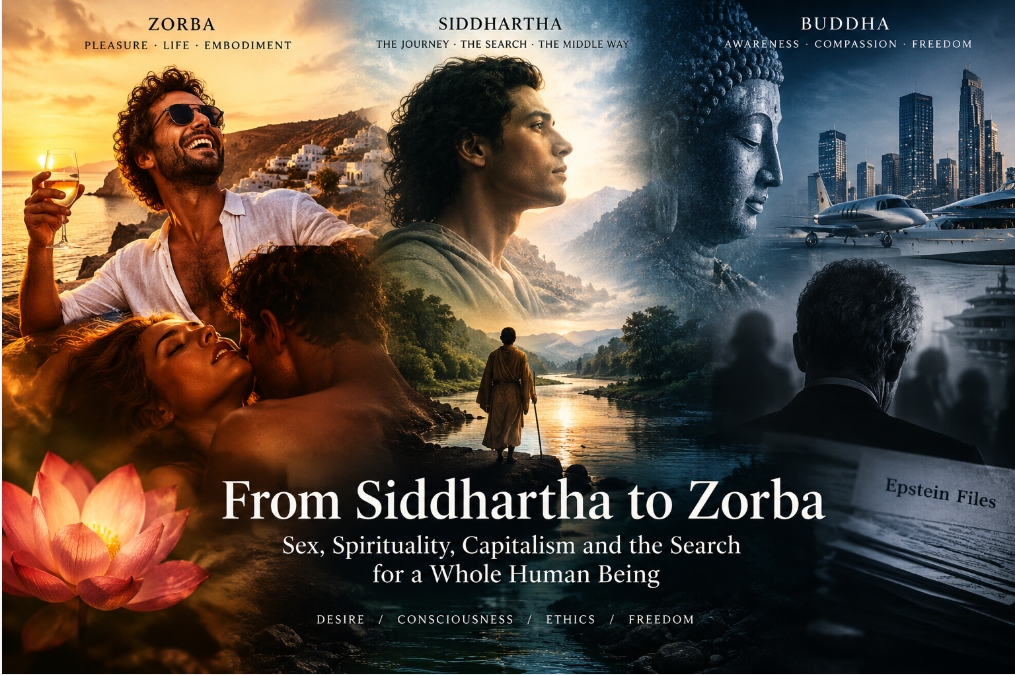
Most Americans remember Osho, Bhagwan Shree Rajneesh, as sex guru or the Rolls Royce Guru, who built a highly successful scandalous utopian community in central Oregon of the United States of America during the 1980s. Arguably, Osho can be prominently identified as the first global guru of the 20th century. His legacy can be still traced back to India and other parts of the globe. The greatest contribution of Osho however can be attributed to his conceptualisation of the ideal modern human, a combination of Zorba the Greek and Budha, Osho’s Zorba the Buddha Paradox.
Osho’s Zorba the Buddha paradox combines sensuality of Zorba with the awareness of Buddha. But the most notorious case of Epstein uncovers what happens when desire is liberated from sensuality, ego, ethics, power and responsibility. There is something timeless about Osho’s doctrine Zorba the Buddha: Zorba dances, and he is full of sensuality and full of life. Buddha resides exactly at the opposite pole as he continuously mediates. Zorba drinks, laughs, works, makes love and embraces the physical world fully. At the same time, Zorba remains a witness of his desire without becoming its prisoner.
Reflecting on the Jeffery Epstein case, this article navigates and subsequently analyses a darker philosophical question: what happens when Zorba is detached from consciousness? Osho poses a more provocative question: why does spirituality demand the destruction of sensuality? Why must the body be treated as the enemy of the soul to tread on a higher path of spirituality? Why is pleasure assumed to be the exact opposite of consciousness?
The case of Jeffery Epstein
Freedom without ethics is very much akin to the body without soul, and freedom devoid of ethics can become domination. Here, the Epstein files acquire a philosophically significant position. In January 2026, the Department of Justice (DOJ) revealed that the file contained nearly 3.5 million pages. These files do not contain one definitive story. But they explicitly indicate the hunger for secret lists, the hunger for unconscious consumption and the hunger for exploitation, rather than conscious sexual pleasure. The files indict that some girls as young as 14 were recruited for sexual acts in exchange for money. The unique business model developed by Jeffery Epstein not only recruited and exploited young girls including minors but also created an organised network of human trafficking and slavery.
Many high profile and powerful people, from Elon Musk to former prince Andrew Mountbatten, have been named in the Epstein files. Sexuality is an internal aspect of human existence, as it has significant influence over personality formation, interpersonal relationship, societal values and norms. The extant research insinuates that sexual development is the lifelong process. The Jeffery Epstein case however forces us to revisit a darker philosophical question: what happens when sexual processes are detached from consciousness?
The deepest question originating from the Epstein case has nothing to do with sex. It is all about power without friction or responsibility. Epstein developed a business model around wealthier people and extreme wealth can create private spaces where desire alone becomes a product itself.
Confusing desire with freedom
It is important to note that sex is the most vital form of energy, perhaps the only energy that drives humans or transforms humans. Osho argues that repression of sexuality is very much akin to wasting of life and time. Concomitantly, believing that freedom automatically appears with removal of repression is erroneous as well as a dangerous assumption because absence of prohibition does not mean the presence of consciousness. A person can be sexually liberated but physically enslaved. This is where the case of Epstein becomes compellingly relevant. The case demonstrates the relationship between sexuality and power. Epstein facilitated powerful people with unlimited freedom of consuming sexuality as the product.
But responsible sexuality involves agency, informed choice, recognition of another person as an individual entity and freedom from coercion. The Epstein case therefore cannot reasonably be confined to the parochial definition of unconventional sexual preferences. This can be precisely understood as freedom without consciousness.
Zorba Without Buddha
According to Osho, Zorba without Buddha is: pleasure without reflection, appetite without limit and freedom without responsibility. Imagine when the body itself becomes an object of consumption and other people because of the potential sources of pleasure. The inherent problem is not pleasure, rather instrumentalization of pleasure. It is erroneous to brand Zorba without Buddha as a villain. However, Zorba without Buddha becomes a more ordinary individual who experiences desires as self-satisfying, self-gratifying. An entitlement that I should have because I want it when combined with extraordinary wealth becomes dangerous. This is exactly what happened in the case of Epstein.
The capitalist version of Zorba has become more prevalent in post-modern culture. He does not necessarily dance in a Greek village, but he appears on social media. He commands significant purchasing power because of millions of his followers. He consumes food, entertainment, luxury and sex. The marketplace loves this version of Zorba because capitalism has discovered that desire is renewable. Satisfy one desire, another appears and this process is endless: a new car, a younger body, a new destination, a bigger house …………and so on.
In the post-modern society, Buddha becomes economically inconvenient as he asks to investigate carving. Capitalism continuously develops new business models to create new carvings. The contradiction is therefore profound as modern capitalists have started selling spiritually as well.
The Spiritualization of Desire
Perhaps capitalism has mastered the art of selling spirituality. An exceptionally large number of spiritual gurus have proliferated, and each one of them has created seemingly similar business models. The sell meditation, they sell yoga. They sell Adhyatm. They sell spirituality. Retreats are sold to create new luxury experiences. And more importantly, many spiritual gurus subscribe to the Epstein model.
Adhyatmik gurus often encourage us to reject social conditioning, but they simultaneously propel us to unprecedented commercial conditioning. They often tell us to discover authentic desires, but concomitantly expose us to curated desires. Thus, we are living in an exceptionally paradoxical situation.
Osho’s concept of Zorba the Buddha makes this contradiction even more profound. Zorba is permitted to enjoy everything, he can dance, he can drink and he can enjoy parties. But who decides what everything means for Zorba? The capitalist? The spiritual Guru? The Marketplace? The Algorithm? Or the culture? Concomitantly, Osho argues that Zorba should remain conscious of his desire. But what happens when billions of dollars are spent just to make us feel less satisfied with ourselves?
The Failure of Consciousness
Osho places consciousness at the center of transformation. Become aware. Observe. Meditate. Do not live mechanically.
Osho’s prescription is powerful but cases like the Epstein file insinuate that consciousness alone may not prove sufficient to transform individuals. A person can be intelligent, sophisticated, cultured and philosophically sound. But he may still act incongruently. Renowned philosophers and linguists like Noam Chomsky and several other high profile individuals’ names surfaced in the Epstein file, for instance. This insinuates that awareness does not automatically translate into concern for others.
Importantly, self-awareness and ethical awareness are integral components of consciousness. Osho’s concept, Zorba the Buddha, is paradoxical as desire often overpower consciousness. While Zorba represents embodiment, Buddha represents consciousness. But ethics can be considered a foundational aspect of society. Yet desire often supersedes ethics. Ironically, the very definition of ethics is ambiguous particularly in the context of sexual liberation. Ethical conduct becomes even more complicated when powerful individuals intend to fulfil their hedonic desires. Osho does not chart out a transformational path for Zorba to attain consciousness of Buddha.
Siddhartha is the missing link
Hermann Hesse’s 1922 novel Siddhartha uncovers compellingly why a young Brahmin walks away from privilege, rituals, sacred text, companionship, and everything that he has been taught to revere. What follows in Siddhartha’s life is not a gentle pilgrimage, a journey of stripping away every illusion: from the ascetic extreme of sensual excess.
The novel explores a journey of Sidhartha through rebellion, spirituality, wealth, desire, love, sufferings, loss and silence. Yet Siddhartha refuses to remain merely a story of an ancient Indian seeker. It becomes the story of anyone who perceives: why does it not feel like enough? The spiritual quest of Sidhartha for enlightenment begins during the time of Budha.
Dissatisfied with inherited religion and scriptures, Siddhartha says, “I cannot borrow somebody else’s enlightenment”. After renouncing all his privileges and home, Siddhartha embraces extreme asceticism and even meets Buddha, but refuses to become his disciple. This refusal is significant. Siddhartha refuses because he wants to perceive his own idiosyncratic enlightenment, it cannot be borrowed.
In a quest of his personal enlightenment, Siddhartha experiences that killing desires and carvings may not necessarily lead to enlightenment. While living the life of Samana (a group of ascetics who practice extreme forms of asceticism), Siddhartha learns that killing desires only help in torturing the body, and it does not lead to the state of pure consciousness and enlightenment.
Therefore, after leaving both Samanas and Buddha, Sidhartha enters into the world that he previously renounced. He falls in love with Kamala. Kamaswami introduces him to the world of business and commerce. He learns sexuality from Kamala and business from Kamaswami. He acquires wealth and status. He gambles, enjoys parties and lives a super luxurious life.
Siddhartha becomes increasingly absorbed in the material work, but suddenly he realises: having everything does not mean possessing meaning. And one morning, Siddhartha leaves his luxury life and continues his personal journey of meaning, consciousness and enlightenment. This time, Siddhartha meets Vasudeva, the ferryman.
Whilst living with Vasudeva, Siddhartha experiences silence, suffering and life, and the river becomes his ultimate Guru.
The Final Paradox
What Osho says is a borrowed form of enlightenment. Siddhartha experiences enlightenment and consciousness through various phases of the life. Siddhartha experiences lives of Buddha and Zorba, although in various phases. Osho’s Zorba the Budha paradox appears deceptively simple, but it is not feasible to fulfil idiosyncratic desires and remain conscious.
Enjoying life, celebrating sexuality with freedom, renouncing guilt, meditating, and concomitantly remaining conscious appears deceptively simple life philosophy, according to Osho’s Zorba-Budha paradox. But life experience is idiosyncratic. One cannot borrow consciousness and enlightenment from an Adhyatmik Guru, a philosopher or a thinker. One has to chart out a path of self-discovery just like Siddhartha.
D.Chandra, 2026
Citations
PBS News, 2026. A list of powerful men named in the Epstein files, from Elon Musk to former Prince Andrew: https://www.pbs.org/newshour/nation/a-list-of-powerful-men-named-in-the-epstein-files-from-elon-musk-to-former-prince-andrew
Urban, H.B., 2016. Zorba the Buddha: sex, spirituality, and capitalism in the global Osho movement. University of California Press.
https://www.reddit.com/r/awakened/comments/1jdbnng/osho_explains_how_to_transform_sexual_energy/
https://pmc.ncbi.nlm.nih.gov/articles/PMC12897641/
https://www.gutenberg.org/ebooks/2500
Hermann Hesse, Siddhartha.


