


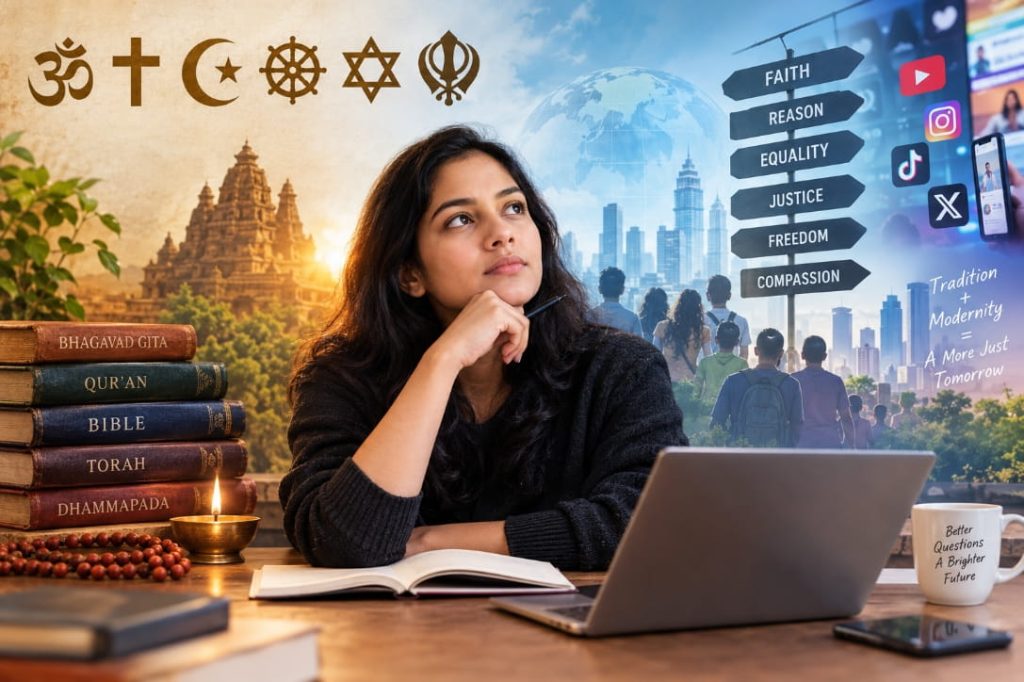
Are We Living in a Post-Meaning Society?
Every society inherits narratives through which individuals understand the world, distinguish right from wrong, and construct their identities. Religion, mythology, philosophy, and cultural traditions have historically provided these narratives, offering explanations of human existence, moral responsibility, suffering, and the relationship between individuals and the wider community. However, the growing influence of scientific rationality, individualism, globalisation, digital communication, and human rights discourse has transformed the ways in which people encounter and interpret religious traditions.
This transformation raises an important question: Have we entered a post-meaning society in which traditional sources of moral authority no longer provide universally accepted answers to the questions of how we should live?
The expression post-meaning society is best understood as a critical description rather than an established sociological category. It suggests a social condition in which inherited sources of meaning compete with multiple, often conflicting interpretations of truth, morality, identity, and the good life. In such a society, individuals are increasingly expected to negotiate their values rather than simply inherit them.
Religion remains an important source of meaning, but its authority is no longer experienced uniformly. For some, sacred scriptures and religious institutions continue to provide unquestionable moral guidance. Others approach religion symbolically, selectively, or critically, while some find meaning through secular humanism, scientific inquiry, or personal philosophies of life.
In India, this transformation can be examined through the relationship between religion and dharma. Dharma is a complex concept encompassing duty, moral order, right conduct, responsibility, and, in different philosophical traditions, the nature of reality and liberation. It cannot be reduced to religious obedience or a fixed collection of social rules. Its interpretation has varied across historical periods, philosophical schools, communities, and individual circumstances.
The central challenge for individuals in postmodern society is therefore not simply whether to follow religion or reject it. It is how to engage with inherited traditions while responding responsibly to contemporary questions concerning equality, freedom, justice, pluralism, and human dignity.
Postmodernism and the Changing Nature of Religious Authority
Postmodern thought challenges the assumption that one overarching narrative can adequately explain every aspect of human experience. Jean-François Lyotard (1984) famously described postmodernity in terms of scepticism towards grand narratives: comprehensive explanations that claim universal authority over knowledge, history, and social progress.
Applied to religion, this perspective invites individuals to examine how religious claims acquire legitimacy, how interpretations become authoritative, and why different communities understand the same moral questions differently.
This does not necessarily mean that postmodernism requires the rejection of religion or the denial of truth. Rather, it encourages attention to the historical circumstances, cultural assumptions, and institutional structures through which particular interpretations become dominant.
For example, a sacred text may contain teachings about compassion, justice, discipline, devotion, and social responsibility. Yet the practical application of those teachings can differ considerably between interpreters. A passage understood by one community as a timeless moral command may be interpreted by another as historically situated, metaphorical, or subject to contextual understanding.
Peter Berger’s work on religious pluralism and modernity also helps explain why the coexistence of different worldviews can weaken the assumption that one inherited interpretation must be accepted by everyone. When individuals encounter competing religious and secular perspectives, beliefs that once appeared self-evident may become subjects of reflection and debate.
However, the existence of multiple interpretations does not mean that every interpretation is equally defensible. Claims can still be assessed through historical evidence, logical consistency, ethical reasoning, and their consequences for human well-being.
The task of the individual, therefore, is neither blind conformity nor indiscriminate scepticism. It is the development of reflective judgement.
Religion and Dharma: Tradition, Duty and Ethical Responsibility
Religion is not merely a system of doctrines. It also involves rituals, collective identities, moral practices, relationships, and experiences of transcendence. Similarly, dharma cannot be understood adequately through a narrow definition of religious duty.
In Hindu philosophical traditions, dharma is associated with right conduct, responsibility, moral order, and the appropriate performance of duties. The Bhagavad Gita, for example, explores the relationship between action, responsibility, attachment, self-knowledge, and spiritual liberation. Its discussions of karma yoga emphasise disciplined action without excessive attachment to the fruits of action.
Nevertheless, the concept of dharma has been interpreted in different ways, and some historical interpretations have been connected to hierarchical social arrangements. Contemporary engagement with dharma must therefore distinguish between ethical principles that promote responsibility and interpretations that may perpetuate discrimination or deny individual dignity.
Dharma should not automatically be equated with whatever a social authority declares to be morally correct. Nor should every inherited practice be accepted simply because it is presented as traditional.
An individual might, for instance, be told that obedience to family expectations is a moral duty. Such expectations may foster care, solidarity, and intergenerational responsibility. However, when obedience requires accepting domestic violence, denying educational opportunities, coercing a marriage, or discriminating against another person, the moral legitimacy of that expectation requires scrutiny.
The important question is not merely, “Is this practice traditional?” It is also, “What ethical purpose does this practice serve, whom does it benefit, and whom might it harm?”
This approach allows individuals to engage with religious traditions without treating either tradition or modernity as inherently infallible.
Secularisation Does Not Necessarily Mean the Disappearance of Religion
Secularisation theory provides another framework for understanding the changing relationship between religion and contemporary society. Classical accounts of modernisation often anticipated that scientific progress, rationalisation, and institutional differentiation would progressively diminish the influence of religion.
However, the relationship between modernity and religion is more complex than a simple transition from faith to unbelief.
In some societies, participation in established religious institutions has declined, while religious beliefs and practices remain significant in private life, public culture, and political debate. In other contexts, religious movements have gained visibility through mass gatherings, television, digital platforms, and charismatic public figures.
José Casanova’s work on public religions demonstrates why modernisation should not automatically be understood as the complete withdrawal of religion from public life. Religion can continue to influence social movements, ethical debates, community formation, and public institutions, even within societies characterised by scientific advancement and democratic governance.
India illustrates this complexity. Religious traditions remain deeply connected to festivals, family relationships, charitable activities, public rituals, and collective identities. At the same time, constitutional commitments to equality, liberty, and freedom of conscience create an important framework for negotiating religious diversity.
The resulting challenge is not necessarily the elimination of religion from public life. It is the development of social arrangements in which religious participation can coexist with equal citizenship, individual freedom, and respect for people who hold different beliefs.
Individuals must consequently learn to distinguish between the personal significance of a religious conviction and its legitimacy as a rule imposed upon everyone.
A person may find profound meaning in a religious dietary practice, for example, without assuming that all citizens must follow the same practice. Similarly, an individual may organise personal life around a particular spiritual discipline while recognising the freedom of others to pursue different ways of living.
This distinction is central to a pluralistic society.
Digital Religion and the Transformation of Moral Socialisation
The internet has fundamentally changed how religious knowledge is produced, distributed, and consumed. Individuals can now access sacred texts, sermons, devotional music, religious debates, online prayer groups, and spiritual guidance without relying exclusively on family members, local religious institutions, or established scholars.
The Pew Research Center’s work on digital technology and religion provides a useful starting point for examining this transformation. Digital platforms enable religious participation across geographical boundaries while exposing users to a wider range of beliefs, practices, and interpretations.
However, greater access to religious information does not automatically produce deeper religious understanding.
Social media platforms often reward content that generates attention, emotional reactions, and repeated engagement. Consequently, complex theological questions may be reduced to short videos, dramatic claims, provocative statements, or simplified moral instructions. Religious personalities can acquire substantial influence because of their communication skills, popularity, or online visibility rather than the depth of their scholarship.
In India, the growing audiences of kathavachaks, spiritual speakers, devotional influencers, and religious preachers illustrate the changing relationship between religious authority and popular culture. Their discourses can introduce audiences to devotional traditions, encourage charitable activities, and provide emotional support. They may also simplify complex texts, reinforce stereotypes, or present contested interpretations as unquestionable truths.
It would be misleading to assume that digital religious influence is inherently harmful. Equally, popularity should not be treated as evidence of moral or spiritual authority.
Social learning theory, associated particularly with Albert Bandura (1977), helps explain why this distinction matters. Individuals learn not only through direct instruction but also by observing the behaviour of influential models. When young people repeatedly encounter religious figures who demonstrate compassion, generosity, and respect, these behaviours may become important moral examples. When influential figures normalise hostility, humiliation, prejudice, or intolerance, similar behaviours may also be legitimised.
The critical issue is therefore not simply what religious personalities say, but also what their conduct models and what their audiences learn to regard as acceptable.
Individuals navigating digital religion should ask several questions:
- Does the speaker provide the original textual or historical context for a religious claim?
- Is the interpretation supported by credible scholarship or merely asserted with confidence?
- Does the message encourage compassion, reflection, and responsible conduct, or does it depend on fear, humiliation, and hostility?
- Does the speaker acknowledge the dignity of people from different religious communities?
- Are financial interests, commercial promotions, and institutional affiliations sufficiently transparent?
These questions do not require the rejection of spiritual teachers. They encourage a more responsible relationship between religious authority and personal judgement.
The Problem of Moral Policing: Who Has the Right to Define Dharma?
One of the most significant tensions in contemporary religious life concerns the difference between ethical guidance and moral policing.
Ethical guidance encourages individuals to reflect on their actions, understand their responsibilities, and cultivate virtues. Moral policing, by contrast, attempts to regulate the behaviour of others through coercion, intimidation, public humiliation, or the imposition of contested moral codes.
The distinction is especially important when questions of gender, relationships, dress, marriage, dietary practices, or interreligious interaction become subjects of public controversy.
Michel Foucault’s analysis of power provides a useful theoretical lens. His work demonstrates that power operates not only through formal institutions and explicit laws but also through everyday practices, social expectations, surveillance, and the production of norms. Individuals may begin to regulate their own behaviour because they anticipate criticism, exclusion, or punishment.
Religious and cultural expectations can contribute to social solidarity and a shared sense of responsibility. Yet they may also become mechanisms of control when particular groups claim the exclusive authority to define acceptable behaviour.
For example, a religious teaching about modesty may be understood by some as a personal spiritual commitment. When it is used to shame women, restrict their education, or deny them freedom of movement, the issue extends beyond personal faith to the exercise of social power.
Similarly, concern for the ethical conduct of young people does not justify treating their autonomy as irrelevant or assuming that disagreement with elders necessarily reflects moral failure.
The concept of dharma becomes more ethically meaningful when it encourages individuals to consider the responsibilities accompanying power. Parents, teachers, religious leaders, and community representatives have responsibilities not only to transmit values but also to protect dignity, acknowledge disagreement, and avoid the misuse of authority.
A society committed to ethical living must therefore distinguish between encouraging responsible conduct and coercively enforcing conformity.
Gender Justice and the Critical Interpretation of Sacred Texts
The relationship between religion and gender equality remains one of the most important areas of contemporary ethical debate.
Religious traditions contain diverse narratives and interpretations concerning women’s roles, family responsibilities, leadership, sexuality, and social participation. Some interpretations have supported women’s education, dignity, spiritual agency, and participation in public life. Others have been used to justify unequal access to property, institutional authority, education, and personal freedom.
The challenge is not adequately addressed by declaring all religious traditions either inherently oppressive or inherently emancipatory.
A more productive approach distinguishes between the historical context of a text, its subsequent interpretation, the authority claimed by particular interpreters, and the contemporary consequences of applying a teaching in a specific way.
Feminist approaches to religious interpretation have demonstrated the importance of examining whose experiences have historically been represented, whose voices have been marginalised, and how social hierarchies influence the interpretation of sacred narratives.
This does not require individuals to discard religious identity. Many believers seek to reinterpret their traditions in ways that uphold both spiritual commitments and gender justice.
The same principle applies to dharma. If dharma involves moral responsibility, then its contemporary interpretation must confront questions concerning consent, equal dignity, freedom from violence, and the fair distribution of opportunities.
Tradition can provide valuable ethical resources, but its social applications should remain open to critical examination, particularly when they affect people who have historically possessed less power.
Religious Pluralism: Living With Different Truth Claims
Religious pluralism presents a distinctive challenge because religious traditions do not always make compatible claims about God, salvation, liberation, revelation, or the nature of ultimate reality.
Some traditions understand their teachings as uniquely authoritative. Others recognise multiple spiritual paths or emphasise practices that do not depend on belief in a single divine authority. Even within a particular tradition, believers may disagree about the meaning and implications of foundational teachings.
In a multicultural society, individuals must negotiate these differences without assuming that coexistence requires complete theological agreement.
John Rawls’s political philosophy offers a useful distinction between comprehensive moral or religious doctrines and the principles necessary for fair cooperation among citizens. People can disagree about ultimate questions while supporting common political arrangements that protect liberty, equality, and the basic rights of others.
This approach is especially relevant in India, where religious diversity forms part of the country’s social and cultural landscape.
An individual may remain deeply committed to Hinduism, Islam, Christianity, Sikhism, Buddhism, Jainism, or another religious or philosophical tradition while recognising that fellow citizens are entitled to different convictions.
Respecting another person’s freedom of conscience does not require abandoning one’s own beliefs. Nor does religious tolerance require remaining silent when another person is subjected to discrimination or violence.
Instead, pluralism requires a distinction between conviction and coercion. Individuals may defend their religious beliefs, explain their traditions, and disagree with competing interpretations. However, disagreement does not justify denying another person’s dignity, safety, or equal standing in society.
A contemporary understanding of dharma can contribute to this discussion when it encourages self-discipline, responsibility, compassion, and restraint in the exercise of power.
Scientific Rationality, Critical Thinking and Spiritual Experience
Modern societies are shaped by scientific and technological developments that have transformed understandings of health, the natural world, communication, and human behaviour.
These developments sometimes produce tensions with religious claims, especially when a spiritual assertion is presented as an empirically verifiable fact without adequate evidence.
Nevertheless, science and religion do not always operate in precisely the same domain. Scientific inquiry investigates questions through observation, evidence, experimentation, and revisable explanations. Religious and philosophical traditions may also address questions of meaning, moral obligation, suffering, and the purposes people assign to their lives.
Conflicts arise when claims from one domain are treated as substitutes for the methods appropriate to another.
For example, spiritual practices may provide comfort during illness, but this does not establish that a ritual can replace evidence-based medical treatment. Similarly, an individual may derive personal meaning from a religious narrative without treating every interpretation of that narrative as a scientific explanation.
Critical thinking enables individuals to recognise these distinctions.
It involves asking whether a claim is supported by evidence, whether alternative explanations exist, whether an authority has relevant expertise, and whether a conclusion follows logically from the available information.
Critical inquiry need not be hostile to faith. For many individuals, it is a means of developing a more reflective and responsible religious commitment.
The objective is not to eliminate uncertainty from human existence. It is to avoid allowing uncertainty to become a justification for manipulation, misinformation, or unaccountable authority.
Moral Development: From Obedience to Ethical Judgement
Lawrence Kohlberg’s theory of moral development offers another perspective on how individuals negotiate religious authority and personal responsibility. His framework describes different forms of moral reasoning, including reasoning influenced by punishment and reward, social expectations, and broader principles of justice.
Although the theory has important limitations and has been criticised for its emphasis on particular models of moral reasoning, it provides a useful starting point for distinguishing obedience from reflection.
A person may follow a moral rule because they fear punishment, want social approval, or regard a religious authority as beyond question. Another person may follow the same rule after considering its ethical purpose and consequences.
The outward behaviour may be identical, but the reasoning underlying it differs.
Consider the principle of truthfulness. An individual might tell the truth because a religious authority commands it, because dishonesty could bring punishment, or because honesty is necessary for trust and mutual respect. Reflective moral reasoning allows the person to understand the value that the rule seeks to protect.
However, independent judgement should not be confused with the assumption that personal preference is always morally correct. Ethical reasoning also requires attention to other people’s interests, the consequences of one’s actions, fairness, and the limits of individual freedom.
The goal is not to replace every inherited rule with a personal opinion. It is to develop the capacity to understand, question, and responsibly apply moral principles.
Religious education can contribute to this development when it encourages interpretation, dialogue, historical understanding, and ethical reflection rather than relying exclusively on memorisation and unquestioning compliance.
How Should Individuals Navigate Religion and Dharma in Postmodern Society?
Navigating religion in contemporary society requires a balance between meaningful commitment and intellectual openness. The following principles offer a practical framework.
- Understand the tradition before accepting or rejecting it.
Sacred texts should be approached with attention to historical context, literary form, translation, philosophical interpretation, and the diversity of views within a tradition. A short online quotation rarely captures the full complexity of a religious teaching.
- Distinguish spiritual principles from inherited social practices.
Not every custom presented as religious is necessarily a direct or universally accepted requirement of a sacred text. Individuals should examine how particular practices developed, whose interests they serve, and whether they remain ethically defensible.
- Evaluate religious authority critically.
Respect for spiritual teachers does not require surrendering independent judgement. Their interpretations and conduct should be assessed in light of relevant knowledge, transparency, consistency, and their treatment of other people.
- Use human dignity as an essential ethical consideration.
Religious practices and moral expectations should be examined for their implications for equality, consent, freedom from violence, and the dignity of vulnerable individuals. Tradition should not be used as an automatic justification for abuse or discrimination.
- Practise religious pluralism without abandoning personal conviction.
Individuals can remain committed to their faith while respecting the right of others to hold different beliefs. Dialogue and peaceful disagreement are compatible with serious religious commitment.
- Develop digital and religious literacy.
Before sharing religious content, verify its source and context. Distinguish established scholarship from unsupported claims, emotionally manipulative content, and commercial promotion. Be particularly cautious when content encourages hostility towards a religious or social group.
- Balance personal autonomy with social responsibility.
Freedom does not mean indifference to the needs of others. A meaningful ethical life involves recognising both individual rights and responsibilities towards family members, communities, and society.
- Remain open to learning and revision.
People’s understanding of religion and morality can change through education, experience, dialogue, and reflection. Revising an interpretation does not necessarily mean abandoning a tradition; it may reflect a deeper engagement with its ethical possibilities.
Together, these principles encourage a form of religious engagement that is reflective rather than passive, compassionate rather than coercive, and intellectually open without being ethically indifferent.
Conclusion: Beyond Blind Faith and Uncritical Rejection
The relationship between religion, dharma, and postmodern society cannot be reduced to a simple conflict between tradition and modernity. Religious traditions are internally diverse, historically dynamic, and interpreted through changing social conditions. Modern societies, in turn, remain shaped by questions of meaning, identity, belonging, and moral responsibility that scientific and technological progress cannot automatically resolve.
The emergence of digital religious authorities, the changing influence of traditional institutions, and the growing visibility of competing moral claims have made the individual’s role in interpreting religion increasingly significant.
The question is no longer simply whether people should obey religious authorities or reject inherited traditions. It is how they can distinguish ethical wisdom from social prejudice, spiritual guidance from coercive control, and meaningful conviction from unexamined conformity.
Dharma offers a potentially valuable framework for this discussion when understood as an ongoing concern with responsible action, moral reflection, and the relationship between personal conduct and the wider social order. Its contemporary significance depends, however, on careful interpretation rather than the assumption that every inherited social rule expresses an unquestionable moral truth.
Similarly, religious traditions can continue to provide meaning, community, and ethical resources when their interpretation remains attentive to historical context, human dignity, and the realities of pluralistic life.
A postmodern society does not necessarily have to become a society without meaning. It may instead be a society in which the sources of meaning are more diverse, contested, and subject to individual reflection.
The task is to transform this diversity into an opportunity for deeper understanding rather than a justification for moral confusion or hostility.
Ultimately, navigating religion and dharma in the contemporary world requires neither blind faith nor automatic rejection. It requires the willingness to question responsibly, believe reflectively, respect difference, and act with compassion.
The enduring value of religion and dharma may lie not in their capacity to eliminate every moral disagreement, but in their capacity to encourage individuals to live more thoughtfully, justly, and responsibly amid uncertainty.
References
Bandura, A. (1977). Social Learning Theory. Prentice Hall.
Berger, P. L. (Ed.). (1999). The Desecularization of the World: Resurgent Religion and World Politics. William B. Eerdmans Publishing Company.
Casanova, J. (1994). Public Religions in the Modern World. University of Chicago Press.
Chrostowski, M. 2023a. “Anwendung von Künstlicher Intelligenz im Religionsunterricht: Möglichkeiten, Grenzen und Brennpunkte [Application of Artificial Intelligence in Religious Education: Possibilities, Limitations and Focal Points].” Religionspädagogische Beiträge 46 (1): 79–95. doi:10.20377/rpb-267.
Foucault, M. (1977). Discipline and Punish: The Birth of the Prison. Translated by Alan Sheridan. Pantheon Books.
Harari, Y. N. (2018). 21 Lessons for the 21st Century. Jonathan Cape.
Kohlberg, L. (1981). Essays on Moral Development, Volume I: The Philosophy of Moral Development. Harper & Row.
Lyotard, J.-F. (1984). The Postmodern Condition: A Report on Knowledge. Translated by Geoff Bennington and Brian Massumi. University of Minnesota Press.
Rawls, J. (1993). Political Liberalism. Columbia University Press.


