


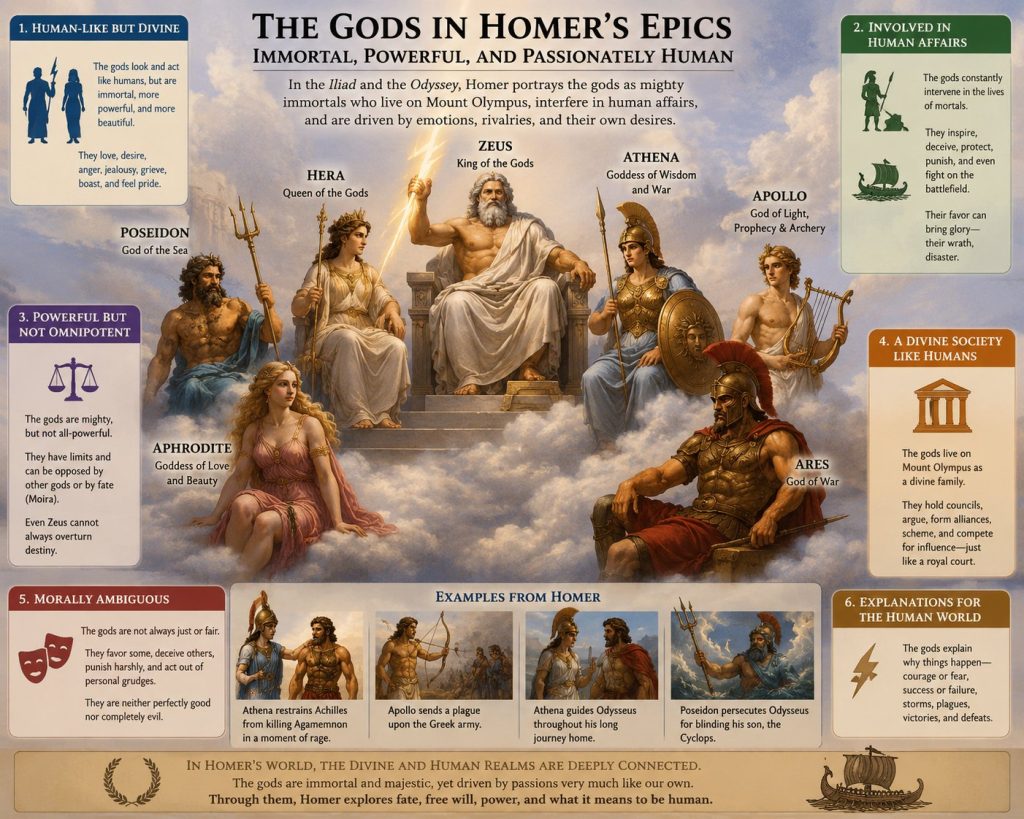
Representation of Gods by Homer
Though they are immortal, more powerful, and more beautiful, they experience, love and desire, anger and jealousy, pride and vanity and grief and amusement just like human. Depiction of the gods in the ancient Greek literature is seemingly preoccupied with noteworthy inconsistencies. For example, the Greek mythology overwhelmingly portrays the gods as the most essential and influential characters and they continuously collaborate as well as fight with titans, demigods, human and the other creatures in order to fulfill their personal goals and aspirations. It is rather interesting to observe that Greek classical literature uses similes such as fickle, rogue and narcissistic to create image and persona of gods, which is even paradoxical to the imagination of the god. Emblemizing the goods with human like traits and their lack of commitment and responsibility to mortals also creates an antagonistic picture of godly justice that is seemingly humanistic and individualistic. Homer could be justly described as father of ancient Greek literature. However, his idiosyncratic portrayal of the gods also represents transition in the Greek literature: from the era of oral tradition to written. Homer identifies and presents vivid aspects of gods such as fickleness of human being, super human being and controller and exhibitor of miraculous actions. Interestingly, inconsistent portrayal of gods indeed helps in assimilating diverse perspectives of Greek culture through the literature.
Representation of mortal passion and vulnerabilities in Immortal
Homer has been successful in presenting “Gods” as individual entities with a human face; and made a community out of them by giving the readers minute insights about their birth, conjugal relationships, kingship ties and their personality traits. Homer has substantiated this humanness of the gods in the form of most strikingly mundane details. He has therefore, presented a vivid picture of “anthropomorphic” deities who along with the splendour, power and might exhibits human weaknesses such as greed, hatred, envy, jealousy and uncontrolled anger. Iliad therein exemplifies that Homeric gods are capable of exhibiting both commendable and despicable human traits. In book 14, the infamous scene of Zeus’ seduction by Hera exposes the vulnerability of gods in front of sexual impulses and whims. Here the mighty, formidable and invincible king of Gods – Zeus, appears to be helpless in front of his own sexual desires. Homer has projected Zeus as a immortal who is extremely defenceless to feminine charm and in book 14 he completely gives up to the amorous call of Hera. Similarly in book 1 and 18, Thetis enters into the sight as a doleful, unfortunate and ill fated mother who is perhaps the only goddess being intensively struck by corporeal grieves and agony. Homer’s narrative presents Immortal goddess Thetis as a tragic mother who is touched by all human sorrows, sufferings and pain. Homer has further tried to ascertain that even after having a life of eternity, Immortals are possessed by mortal passions, desires, impulses and grieves which makes their vulnerability par with that of mortals.
Another prominent attribute coupled with the representation of gods in the Iliad is there subservience to fate and the plans of destiny. In book 16, even having immense might and power Zeus wasn’t able to save the life of his beloved son Sarpedon. “I am in two minds” these words quite eminently reveal the acute dilemma of Zeus. Further the words of ox-eyed lady Hera “are you proposing to reprieve from the pains of death a mortal man whose destiny has long been settled?”(L; 440) explains that even the mighty immortals are susceptible to the plans of destiny.
Divine Intervention
It is imperative to notice that the entire narrative revolves around the central themes which are the “will of Zeus” and the “wrath/anger of Achilles”, which depicts the importance of divine will and the significance of divine intervention for the progression of the plot. The narrative opens with the plague inflicted upon the Achaeans by the mighty Archer-god Apollo. A question has been evidently posed by the narrator “which of the gods was it that made them quarrel?” which clearly signifies the course of human lives being administered by the gods.
The poet of the Iliad interprets the world by taking the passions of the gods to be the determining factors of what happens on the human level. This is quite autonomous of the respective moral qualities of these passions. Hera’s and Athena’s disenchantment over the victory of Aphrodite in the Judgment of Paris determines the whole conduct of both goddesses in the Iliad. This is all the more astounding as their beauty contest on Mount Ida is only mentioned in book 24 and yet it is able to mould their conduct towards the Trojans throughout the narrative. Aphrodite on the other end keeps on supporting Paris whose act of “blind folly” at the judgment of Mount Ida declared her victorious. This can clearly be seen in Aphrodite’s epiphany before Helen in the shape of a familiar old wool-spinner in Book III, who tries to sexually entice Helen towards the son of Priam – Paris.
Within this scaffold of divine appearance and intervention the gods do not even shrink from deceit. Athena, with the consent of Zeus in Book IV entices Pandarus, who has joined the Trojans as an ally, to shoot the disastrous shot in the direction of Menelaus in order to break the truce between both the parties.
Interplay of divine will and human impulse projected by Homer acquires a considerable stage in the narrative. However, in addition to the interplay a stark contrast to the peaceful life on Mount Olympus and the constant gory, blood-bathed, gruesome and horrendous Battle of Troy has been projected quite evidently. In Book 1, a stark contrast has been posed between the rift between Agamemnon and Achilles and the quarrel between Hera and Zeus. Formerly, Nestor fails at reconciliation. However, in the case of the later, Hephaestus is able to make peace between Zeus and Hera. The author has tried to portray that how the conflict between immortals ends up in merrymaking whereas the conflict between mortals leads to battles and wars.
Through the epic, the Iliad, Homer unfolds a set of capricious moral codes that guide relationship between the gods and humans. Gods by Homer not may not merely be viewed as religious figures but as literary characters who embody forces such as war, wisdom, desire, and fate
Chandra, S. 2026
References
- Kullmann, Wolfgang. “Gods and Men in the Iliad and the Odyssey.” Harvard Studies in Classical Philology, vol. 89, 1985, pp. 1–23. JSTOR, jstor.org/stable/311265. Accessed 28 Jan. 2021.
- Jones, Nathanael (2017) “The Justice of the Gods in Homer and the Early Greek Plays,” Journal of Interdisciplinary Undergraduate, Research: Vol. 9 , Article 1.
- Petersen, Walter. “Divinities and Divine Intervention in the ‘Iliad.’” The Classical Journal, vol. 35, no. 1, 1939, pp. 2–16. JSTOR, jstor.org/stable/3291227. Accessed 28 Jan. 2021.
- Jebb R. “the epic poetry” Primer of Greek literature, Part 1, the early literature; to 475 BC.1877, pg14-22.
- The Iliad translated by E.V Rieu (1950) revised and updated by Peter Jones with D.C.H.Rieu


