


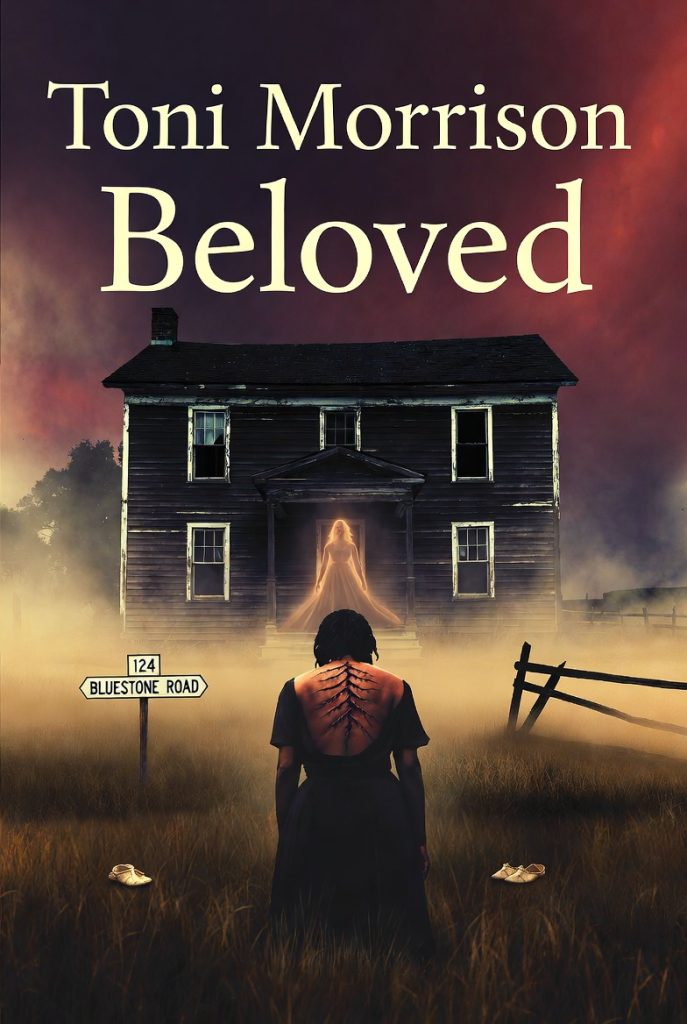
Toni Morrison’s ‘Beloved’ is a self-conscious assessment of the possibilities and restraints of the story-making process mutually for the individual and for the Afro-Americans as a community in its entirety. As one delves to understand the complexities affixed with slave narratives and the myopic historical understanding of slavery presented by the mainstream forces – the exercise of revisiting, reliving, re-exploring and “rememory” becomes extremely potent. As Cynthia S. Hamilton in her essay “Revisions, Rememories and Exorcisms: Toni Morrison and slave narrative” presents an imperative argument, vital to understand the discursive measures adopted by Morrison to revive and rekindle the horrors of slavery with an organic honesty, portraying the dreadfulness of the practice of slavery in very mundane aspects of existence. Hamilton argues that the fundamental concern of the narrative is the need to transform facts of unspeakable and appalling horror into a life-giving story (Hamilton, pp 429-445). Thus, Morrison deploys “rememory” as a poignant instrument in order to present the interiority of the individuals who are grappling with the violence, oppression and sheer dehumanization. In this way she makes a successful attempt to ascribe the actual quality of human memory and consciousness to the narrative. This sense of rememory experienced by individual characters is replete with certain kinds of inconsistencies, irregularities and incoherence which present the narrative enveloped in the form of an actual human memory – erroneous and imprecise. However, the scattered pieces of the memory of all the characters in cohesion form a logical portrait, and thus the narrative appears to work on two different tiers; individual and collective. Inherently Beloved makes an attempt to carve out collective consciousness of slavery through individual lived experience of the black community. This paper therefore sincerely delves to understand the functioning of the narrative appropriating the role of an Individual memory of slavery and community consciousness of slavery as an oppressive institution and concomitantly aims to underscore the significance of the term “rememory” with respect to remembering and forgetting in Morrison’s ‘Beloved’.
Quite early in the narrative Sethe experiences pangs of abrupt memories – like teleportation Sethe goes back into past which at times is a conscious effort and at times it can be completely unconscious. In another argument Elizabeth Palmer addresses the rememories as uncanny occurrences – moments that are not so familiar because they have been long kept concealed, tucked away and their triggered manifestation, haunts Sethe (Palmer, N.D).
“the welcoming cool of unchiseled headstones; the one she selected to lean against on tiptoe, her knees wide open as any grave. Pink as a fingernail it was, and sprinkled with glittering chips.”
Here, through the austere description of the physical and tactile sensations, the distressing psychological impact of the sexual intercourse in which Sethe indulges in order to get “Beloved” engraved on her dead daughter’s grave quite astoundingly reveals the lack of ownership of black women over their bodies. In line with the above arguments, the theme of violation is central to the discourse of rememory along with the main narrative.
“And suddenly there was sweet home rolling , rolling , rolling out before her eyes, and although there was not a leaf on that farm that did not make her want to scream, it rolled itself out before her in shameless beauty.”
Here, Sethe experiences sudden paroxysms of the memories from Sweet Home, however quite strikingly instead of the trauma, the abhorrent infringement casted out on her body, the snatching away of her agency as a mother – all she remembers is the beauty of the plantation which fills her with shame. Thus, Rememory here acts as a coping mechanism where Sethe’s remembrance of the Sweet Home with a sense of community represses her trauma of the sexual assault. Madhumita Purkayastha quite meticulously observes the malleability of “rememory” as a narrative strategy and as an instrument of subversive representation.
“All I can remember of her is how she loved the burned bottom of bread. Can you beat that? Eight children and that’s all I remember.”
“That’s all you let yourself remember.”
Herein, this conversation between Baby Suggs and Sethe heightens the intensity of Rememory as a mechanism of coping trauma. Pukayastha in her essay labels it as ‘willful amnesia’ which is a refuge taken by the black women who have been denied their motherhood by the institution of slavery. Baby Suggs deliberately forgets her children who have been sold under the practice of slave trade in order to break away from utter misery. Sethe adopts this willful amnesia when she’s encountered with the question about her mother. This has been referred to as “defensive exclusion” as per John Bowlby who defines it as a “form of subjugation in which certain information of significance to the individual being systematically excluded from further processing.”
Morrison’s idea of rememory therefore encompasses a plethora of personal, psychological, emotive and simultaneously communitarian aspects. It’s not just a mere attempt to trace slave history with a sociological perspective; rather it delves deeper to construct a collective consciousness based on the psychological and deeply individual experiences of its members. The abhorrent dishonors, ignominy and trauma attached with the lives of former slaves dampen their selfhood and thus hinder them to accept their past. Morrison with these deeply personal yet concomitantly communitarian experience makes an attempt to reconstruct accounts of authentic history written from the margins with the voice of the marginalized and in this entire process the mechanism of “rememory” plays an integral role.
Chandra, S. 2006
REFERENCES AND CITATIONS
- Caesar, Terry Paul. “Slavery and Motherhood in Toni Morrison’s ‘Beloved.’” Revista de Letras, vol. 34, UNESP Universidade Estadual Paulista Julio de Mesquita Filho, 1994, pp. 111–20, http://www.jstor.org/stable/27666617.
- Hamilton, Cynthia S. “Revisions, Rememories and Exorcisms: Toni Morrison and the Slave Narrative.” Journal of American Studies, vol. 30, no. 3, Cambridge University Press, 1996, pp. 429–45, http://www.jstor.org/stable/27556178.
- Krumholz, Linda. “The Ghosts of Slavery: Historical Recovery in Toni Morrison’s Beloved.” African American Review, vol. 26, no. 3, [Indiana State University, Saint Louis University, African American Review, African American Review (St. Louis University)], 1992, pp. 395–408, https://doi.org/10.2307/3041912.


