


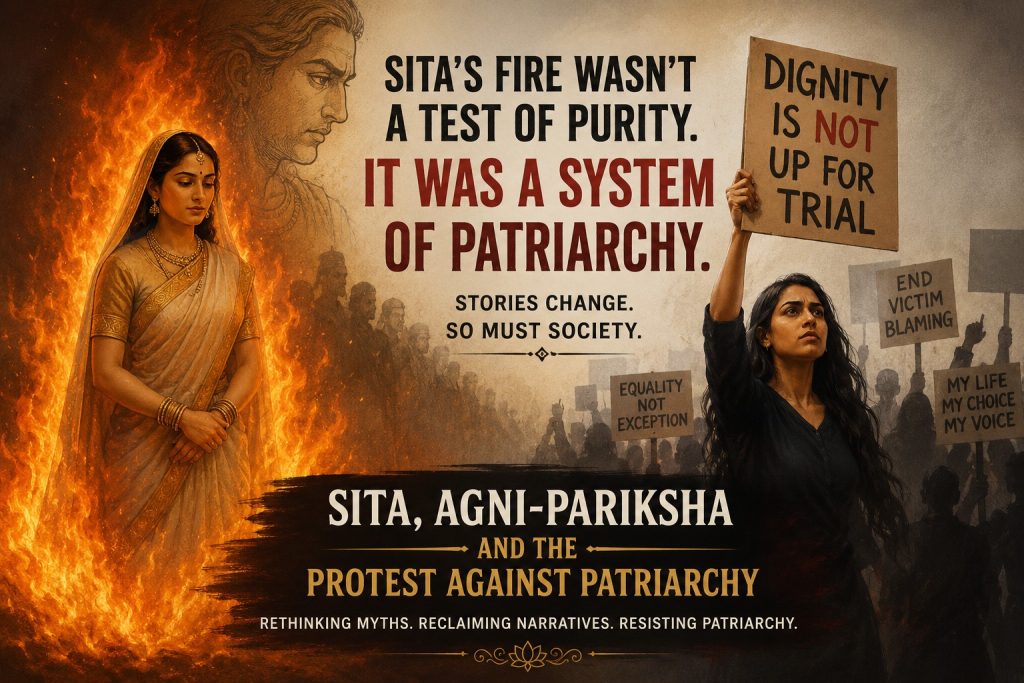
For centuries, the story has been told as a tale of devotion. A queen returns after captivity. A husband demands proof. A fire becomes the judge. Purity is established. Order is restored. But what if we have been reading the wrong story? What if the Agni-pariksha was never really about Sita’s virtue? What if Sita and Patriarchy are deeply interconnected.What if it was about society’s anxiety over a woman who had lived beyond male control?
Viewed through a contemporary lens, the episode exposes one of the oldest patriarchal instincts in human history: the demand that women continually prove their worth, morality, and loyalty while men remain unquestioned. The flames surrounding Sita were symbolic. But Sita’s story remains relevant in conversations about equality and justice today.
Who Was Sita?
Sita has been adorned with various names such as Vaidehee, Siya, Jaanaki, Bhoomija, Janakatanaya, Janakanandini, Raamapriya and many others. However, she is popularly hailed as daughter of Mithila (Mithila ki beti) or daughter of earth (Bhumi). Sita has been portrayed as the central women protagonist in the epic ‘Ramayana’ but she also occupies the status of Hindu goddess. Ramayana as an epic has continued to influence everyday life of people in India as well as abroad. Ganghi used Sita’s reference to persuade women to join the freedom struggle against British rule in India. Sita continues to occupy center stage in the women’s folk songs in various languages including Maithili, Marathi and Bengali. However, folktales and folk songs, only depicts agony and valor surrounding Sita’s life have remained deeply ingrained in the culture and traditions of Mithila. She has been also popularly recognized as the tallest cultural icon of Mithila.
According to popular versions of Ramayana such as Ramcharitmanas and Valmiki Ramayana, a baby girl was found by King Janaka in a field at the tip of a plow while the king was performing the vedic ritual to overcome the situation of famine prevailing over the kingdom. She was named Sita as literary meaning of the Sanskrit word Sita is furrow. The birth of Sita is associated with prosperity, fecundity or fertility because her fortune discovery by King Janaka ended the deep spell of famine, and brought fortune and prosperity to Mithila Kingdom. In a similar vein of argument renowned author of Hindi and Maithili literature, Nagarjuna, says that people of Mithila are descendents of Sita Mata (mother Sita) because her fortune arrival ended drought, brought prosperity and good luck to Mithila.
Understanding Sita from cultural and societal lenses
Story or legacy of Sita cannot be entirely viewed from a mythological perspective. It needs to be interpreted from cultural and societal lenses for the greater cause of women empowerment. It is important to consider that neither the king Janka nor his brother Kushadhwaj has a son. Mithila used to be a matriarchal society under the rule of King Janak. Women enjoyed complete freedom in terms of receiving education, participating in debate, discussion and receiving training on warfare. Sita grew up in a completely unique environment and received education from renowned rishi such as rishi Gautam. Many contemporary scholars consider Sita to be a great warrior. Gradually the nobility and fame of Sita as a desirable princess spread in other kingdoms as well. Even Rishi Vishwamitra along with his disciples Rama and Lakshman came to pay a visit to the Janak court so that archer prince Rama could participate in Sita’s swayamvar organized by the king Janaka. King Janaka had announced that whoever wanted to marry sita had to lift Shiva Danush and string it. According to Valmiki Ramayana, many great warriors including Ravana could not even move Shiva Danish (Pinaka) in Sita’s swayamvar. According to legend, Shiva himself gave his Pinaka (Danush) to Devartha, the ancestor of King Janka. But it was routine practice for Sita to lift divine Shiva Danush with her left hand and clean the places beneath. Finally, Ram fulfilled the condition of Swayambar and married Sita.
The Agnipariksha
After returning to Ayodhya with his wife Sita, the situation unfolded antagonistically as Rama had to go on exile for fourteen years just to fulfill a promise made by his father, King Dasaratha. Sita could live a lavish life in Ayodhya but she decided to accompany her husband to fulfill her duty of chaste wife. In their last year of exile, Sita was abducted by Ravana, King of Lanka. Sita demonstrated great resolve and faith in Rama during her captivity in Ravana’s Lanka. By forming an army of monkey with the help of monkey god Hanuman, Rama killed Ravana and rescued Sita but she had to undergo through a fire test (Agnipariksha) to prove her chastity, and she came out unscathed from the fire test, and proved her chastity.
After returning to Ayodhya, Rama became the king and Sita crowned price but whispering began from the subject about chastity of Sita because she had been abducted by Ravana and was kept under confinement for a prolonged period before she was finally rescued by Rama. Almost all versions of Ramayana narrated that Rama was endowed with divine qualities in human form. He was endowed with quality of best man (Narrotama or purushottama). Rama abandoned Sita just to set best precedence or example of Rajadharma. Rama said When Sita came victorious from the agnipariksha, “My Lord! Agni! This Sita is pure enough to purify three worlds. She is as chaste as snow. Even as a good man can never abandon his fame, so, Sita cannot be abandoned by me. If there is one thing I am afraid of, it is the censure of the world of men”. Finally, crowned queen Sita had to leave Ayodhya and she found refuge in sage Vilmiki’s ashram, establishing a lucid link between Sita and Patriarchy.
Sita and Patriarchy
In sage Vilmiki’s ashram, she gave birth to and raised her twin sons Lava and Kusha. Sita is also endowed with divine quality as well as ideal quality of women. As a divine intervention, her birth ended drought in Mithila. Moreover, she set highest example of an ideal daughter, dutiful wife and ideal mother. Sita was daughter of King Janka but she never sought king Janaka’s help when she was abandoned by lord Rama. As a single mother, she not only raised her twin sons but also provided them best education. Her sons, Lava and Kusha became great warriors and Sita played instrumental role in this regard. Even Rama and his brothers were defeated by his sons Lava and Kusha. However, this also led to revelation of their identity and secrete that Sita was alive. Ironically, she was again asked to prove her chastity once and for all by performing another trial by fire but Sita refused to go through the humiliation of another trial, and asked her mother the earth to take her back into the womb if she indeed had been true to Rama throughout her life. Some feminist authors have appropriated Sita‘s suffering that women endure in a patriarchal society. Sita’s suffering and agony indeed provide glimpse how women became subjects of unjust demands, narratives and victim of societal strictures. Sita’s status suddenly transformed from a popular queen or loving wife of Rama to nobody but she preserved her own identity as well as identity of her own Sons and also sustained legacy of Rama. Rama was descendent of illustrious Iksvaku dynasty and Sita nurtured legacy of this illustrious dynasty through her Sons, Lava and Kusha.
Majority of historians and scholars overwhelmingly accept that Vedic period did not show discriminatory attitudes towards women but it was the epic age that nurtured and promoted subjugation of women. Discovery of Sita in a field also demonstrates that because of girl child she might have been abandoned by patriarchal society but her upbringing by King Janka highlights feminist perspective to the epic Ramayana. Ramayana is also a most important religious text and it has continued to influence, inspire and determine societal norms and traditions but with a patriarchal overtone. Irony is that even in Mithila, the land of Sita, her sorrow; plight and destiny have continued to find voice and sentiment in women folk songs and folktales but her fight and tussle against patriarchal society have found little expression in popular societal and cultural sentiments. Sita occupies a status of goddess in both culture and society but contemporary society does not endorse that girl child should have Sita’s destiny because she suffered immense pain and agony. Therefore, even people of Mithila demonstrate uneasiness and hesitancy to emulate their girl child with Sita. Her narrative of single mother, empowered women, and refusal to be cowed down by patriarchal norms, has found little expression in popular societal and cultural norms.
Feminst scholar such as Madhu Kishwar’s (2001) argues that Sita’s refusal to undergo through the second agni pariksha as a protest against injustice inflicted by the patriarchal society. Feminist scholars consider that Sita is a perfect example that can help in promoting understanding about patriarchal norms and inequality regime. Thus, Sita and Patriarchy are deeply interconnected.
Chandra, D. 2026
REFERENCES
National Museum, New Delhi [online] https://artsandculture.google.com/story/GgWxERU0uwd8lw
Hazarika, Munmi. “Gender Roles and Representation of Feminine Identity in Ramayana: A Critical Study.”International Journal of English Language, Literature and Humanities, Vol. II, 2014, pp. 295-301.
Kishwar, Madhu. 2001. “Yes to Sita, No to Ram: The Continuing Hold of Sita on Popular
Imagination in India.” In Questioning Ramayanas: A South Asian Tradition, edited
by Paula Richman, 285–308. Berkeley: University of California Press.
Luthra, R. 2014. Clearing Sacred Ground: Women-Centered Interpretations
of the Indian Epics, Feminist Formations, Vol. 26 No. 2.
Saklani, D.P. 2018. Valmiki Ramayana and the Case of Sita in Historical Context, Spring Magazine on English Literature, Vol. IV, No. 1,
Sengupta, R. 1972. “Ravana Carrying Away Sita, Terracota From Koushambi.” Journal of the Andhra Historical Research Society, Vol- XXXII.
Variyar, S. 2018. Saving Sita: The Ramayana and Gender Narratives in Postcolonial Hindu Nationalism.


