


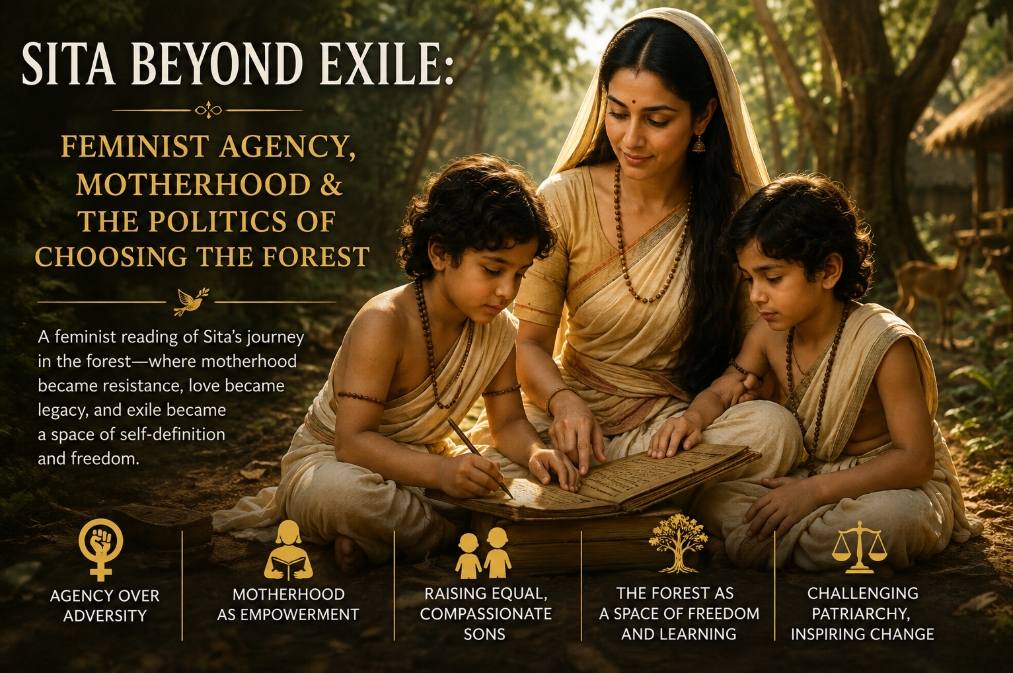
What if Sita’s most radical act was not following Rama into the forest—but choosing what came after? How Sita Beyond Exile offers a completely new and interesting perspective of feminism?
For centuries, Sita has been remembered through familiar images: the devoted wife, the woman who followed her husband into exile, the embodiment of endurance, and the figure subjected to one of the most painful tests of feminine virtue in the Ramayana. Yet there is another Sita waiting in the forest.
She is not simply abandoned.
She is not merely suffering.
She cannot be simply seen as a mother making choices.
Sita Beyond Exile
In the forest, far from Ayodhya’s palace, its expectations, and its relentless gaze, Sita can be read as a woman reclaiming a measure of agency within a world structured by patriarchal authority. Through the upbringing of her sons, Lava and Kusha, the forest becomes more than a place of exile. It becomes a space of resistance, education, self-definition, and alternative social imagination.
Reading Sita through contemporary feminist theories does not require turning her into a twenty-first-century feminist activist. Rather, feminist theory gives us a language to examine questions that her story has raised for generations: Who gets to define a woman’s worth? What happens when a woman refuses to be reduced to her relationship with a man? And can motherhood itself become a site of resistance?
Sita’s forest offers powerful ways to ask these questions.
The Forest as a Space Beyond Patriarchal Surveillance
Ayodhya represents more than a geographical location. It is a social order. The kingdom operates through reputation, duty, lineage, public judgment, and prescribed gender roles. Within such a system, a woman’s identity can become inseparable from the honor of her family and husband.
The forest disrupts that structure.
Away from the palace and its public gaze, Sita occupies a radically different environment. She is no longer primarily defined as queen or wife. She becomes caregiver, teacher, decision-maker, and protector.
This transformation can be illuminated through feminist theories of space and power.
Feminist thinkers have repeatedly examined how social spaces are gendered: who is allowed to occupy them, who controls them, and who is watched within them. Patriarchal power does not operate only through laws or explicit commands. It can also operate through expectations, surveillance, shame, and the internalization of socially approved behavior.
The forest, in this reading, becomes a space outside—or at least at the margins of—that surveillance. And the margins can be surprisingly powerful. In the absence of the palace, Sita creates another kind of home.
From Abandoned Woman to Author of Her Own Story
One of the most compelling feminist concepts for reading Sita is agency. Agency does not necessarily mean complete freedom. A person can exercise agency even within severely restricted circumstances. Feminist scholarship has long emphasized this distinction because women living under patriarchal systems are rarely either completely powerless or completely liberated.
Sita’s circumstances are undeniably constrained. Yet within those constraints, she can still nurture, teach, decide, and shape the future. Her relationship with Lava and Kusha is therefore significant. She does not merely preserve her sons until they can return to the structures of royal power. She educates them.
She gives them knowledge.
She gives them resilience.
She gives them a moral vocabulary.
And, most importantly, she can be understood as teaching them to imagine strength differently.
Strength need not mean domination.
Authority need not mean violence.
Leadership need not require the silencing of others.
This is where Sita’s motherhood becomes politically interesting.
Motherhood as Resistance
Feminist theory has often questioned the assumption that motherhood is naturally conservative or inherently tied to patriarchal values. Motherhood can reproduce social structures—but it can also challenge them.
The distinction lies in what kind of world the mother prepares her children to inhabit.
Sita’s education of Lava and Kusha can be interpreted as an alternative curriculum for the next generation. The forest becomes their classroom, but its lessons extend far beyond survival.
They learn from nature.
They learn responsibility.
They learn compassion.
They learn courage.
They encounter a world in which cooperation matters as much as individual power.
Through them, Sita’s influence moves beyond her own life.
This is a crucial feminist insight: resistance does not always look like confrontation.
Sometimes resistance is generational.
Sometimes it happens in a household.
Sometimes it takes the form of raising children who refuse to reproduce the inequalities their parents inherited.
Teaching Sons to See Women as Equals
Perhaps the most radical dimension of this interpretation lies in the question of what Sita teaches her sons about women.
In patriarchal societies, gender inequality is not sustained only by men exercising power over women. It is also reproduced through the education of children—through stories, customs, expectations, inheritance, authority, and everyday behavior.
A feminist reading therefore asks: What happens when a mother raises sons who have learned to respect women as complete human beings rather than as symbols of family honor?
Lava and Kusha can be imagined as inheritors of a different moral framework.
They can learn that compassion is not weakness.
That listening is not submission.
That care is not exclusively feminine.
That courage does not belong exclusively to men.
And that leadership without empathy can become another form of domination. Here, Sita’s motherhood becomes a form of social reproduction in reverse. Instead of reproducing the old order unchanged, she has the possibility of reproducing different values.
The forest therefore becomes the place where another future is rehearsed and reshaped.
Intersectionality: Sita Is More Than a “Woman”
Another useful feminist framework is intersectionality, associated most prominently with scholar Kimberlé Crenshaw. Intersectionality reminds us that identity and power cannot be understood through gender alone. Social position is shaped by overlapping structures such as class, status, family, political authority, sexuality, and cultural expectations.
Sita occupies a complicated position.
She is a woman.
She is a wife.
She is a mother.
She is a daughter.
She is connected to royalty.
She is also a woman whose social identity is repeatedly interpreted through her relationship to others.
This complexity matters. Sita is neither simply an oppressed woman nor an uncomplicated symbol of female empowerment. Her story contains contradictions. She possesses extraordinary moral significance while existing within a patriarchal social structure.
She is revered while being subjected to judgment. She is powerful as a cultural figure while repeatedly being denied control over the circumstances surrounding her. That contradiction is precisely what makes her such a compelling subject for feminist analysis.
The Male Gaze and the Politics of Female Virtue
Another lens comes from feminist literary criticism: the male gaze. Although the concept was developed in the context of modern visual culture, its broader question can be applied carefully to traditional narratives:
Who gets to look at a woman, judge her, define her, and determine what counts as acceptable femininity?
Sita’s story repeatedly places her under judgment. Her body, sexuality, loyalty, purity, marriage, and behavior become matters of public concern. Her worth is not treated as entirely her own. It is evaluated.
This is one of patriarchy’s most enduring mechanisms: transforming women’s private lives into public tests of morality.
Seen against this backdrop, the forest carries symbolic weight. There, Sita’s life is less about proving herself to society and more about living according to her own immediate responsibilities.
The question changes from: “What will the kingdom think of Sita?” to: “What kind of life will Sita create for herself and her children?”
That shift is profound.
The Emotional Labor of Building Another World
Feminist scholarship has also drawn attention to care work and emotional labor—the often-invisible work involved in sustaining families and communities.
Sita’s work in the forest can be read through this lens. Food, safety, education, emotional support, moral instruction, and daily survival do not simply happen. Someone must create them.
By placing Sita at the center of her children’s upbringing, the narrative can be reread as a story about the intellectual and emotional dimensions of caregiving.
She is not merely keeping Lava and Kusha alive. She is shaping who they will become.And this distinction matters.
Patriarchal narratives have often treated caregiving as a woman’s natural duty rather than as skilled, consequential labor. A feminist reading makes that labor visible.
Teaching is power.
Care is power.
The ability to shape a child’s understanding of justice, dignity, and responsibility is power.
Sita’s influence therefore extends far beyond the boundaries of her physical surroundings.
From Survival to Self-Definition
There is another important distinction: survival is not the same as freedom.
Sita’s forest life should not be romanticized as though exile were inherently liberating. Exile involves loss, isolation, and profound injustice. To describe the forest only as an empowering escape risks erasing the violence of the circumstances that brought her there.
The more interesting interpretation lies in the tension.
Sita does not necessarily choose the circumstances imposed upon her.
But she can still influence what those circumstances become.
That is a subtle but powerful form of agency.
She transforms a site of exclusion into a site of education.
A place of abandonment becomes a home.
A period of uncertainty becomes a formative chapter in her sons’ lives.
And a woman who has been pushed away from the center of political power becomes the moral center of another world.
Sita and Feminist Ethics of Care
This perspective connects naturally with the ethics of care, a feminist philosophical tradition associated with thinkers such as Carol Gilligan and Nel Noddings.
Care ethics challenges moral frameworks that place excessive emphasis on abstract rules, hierarchy, autonomy, or individual competition. It highlights relationships, empathy, responsibility, and attentiveness to human needs.
Sita’s forest life lends itself to such a reading.
Her strength is relational.
She builds rather than conquers.
She teaches rather than commands.
She protects without needing to dominate.
This does not mean that feminine strength must always be gentle. Nor should women be confined to the role of caregivers.
Rather, Sita’s story allows us to ask a larger question:
What if care itself is a form of political intelligence?
A society built only around power can produce rulers.
A society built around empathy can produce communities.
Sita’s forest offers a vision of strength in which these values are not opposites.
Raising the Next Generation as an Act of Rebellion
Every generation inherits a world it did not create.
But every generation also has the possibility of changing it.
This is where Sita’s relationship with Lava and Kusha acquires its greatest symbolic force.
She cannot simply erase the structures that wounded her.
She cannot rewrite every rule of Ayodhya.
But she can influence the people who will encounter those structures next.
Her sons become carriers of another possibility.
They grow up with a mother whose life contradicts the assumption that women are dependent, passive, or incapable of surviving beyond male protection.
They encounter a woman who teaches them.
A woman who protects them.
A woman who embodies knowledge.
A woman who survives.
That image alone can destabilize patriarchal assumptions.
Because sometimes the most revolutionary lesson a child can receive is simply this:
A woman can build a world.
Beyond the “Perfect Woman”: Reclaiming Sita’s Complexity
Modern discussions of Sita sometimes fall into another trap.
In attempting to reclaim her as a feminist icon, we can accidentally replace one restrictive image with another.
The “ideal wife” becomes the “ideal feminist.”
But Sita does not need to be perfect to be powerful.
She does not need to behave according to contemporary feminist expectations.
She does not need to reject every traditional value.
Her significance lies partly in the contradictions of her story.
She can embody devotion and resistance.
Love and self-respect.
Motherhood and independence.
Vulnerability and strength.
Tradition and transformation.
A genuinely feminist reading should preserve those tensions rather than flatten them.
Sita becomes more interesting—not less—when we allow her to remain complicated.
The Forest Was Never Just a Place
Perhaps the most enduring way to understand Sita’s forest is not as an escape from civilization, but as a challenge to the idea that civilization has only one form.
Ayodhya represents one model of social order. The forest offers another. One is structured around kingdom, reputation, hierarchy, and public expectations. The other can be imagined through intimacy, learning, care, resilience, and shared responsibility.
The contrast invites a provocative question: What if the wilderness was not where Sita lost her place in society, but where she discovered the possibility of creating a different one?
Her story then becomes significantly larger than exile. It becomes a story about what people do after the structures that once defined them have been taken away.
Who are we when the title disappears? Who are we when the crowd stops watching? Who are we when the roles assigned to us no longer make sense? For Sita, the answer can be found in what she builds.
Sita’s Legacy: A Different Definition of Power
Sita’s power does not have to resemble the power of a king. It does not require a throne. It does not depend upon military victory. It does not announce itself through conquest. Her power can be understood as the power to define, nurture, educate, endure, and influence.
Through Lava and Kusha, her values travel beyond the forest. Through the stories told about her, her image continues to evolve. And through feminist theory, we can ask new questions of an ancient narrative.
Sita’s forest life reminds us that agency can emerge in unexpected places. That motherhood can become a site of intellectual and social transformation. That care can challenge hierarchy. That stepping outside the center can sometimes reveal how the center operates.
Most importantly, her story challenges the idea that a woman’s greatest achievement is being accepted by the world that once rejected her.
Perhaps it is something else. Perhaps it is the courage to create a world in which her children—and those who come after them—do not have to inherit the same limitations.
That is why Sita’s forest still matters. Not because it was a perfect feminist utopia. But because within a story shaped by duty, patriarchy, exile, and public judgment, we can still find a woman whose influence extends beyond the boundaries imposed upon her.
The palace may have defined Sita as a wife. The forest allowed us to see her as a mother, teacher, survivor, and maker of meaning. And perhaps the most radical inheritance she leaves behind is not a kingdom.
It is a question: What kind of world would we create if we stopped teaching the next generation to inherit our inequalities—and started teaching them to imagine something better?


