


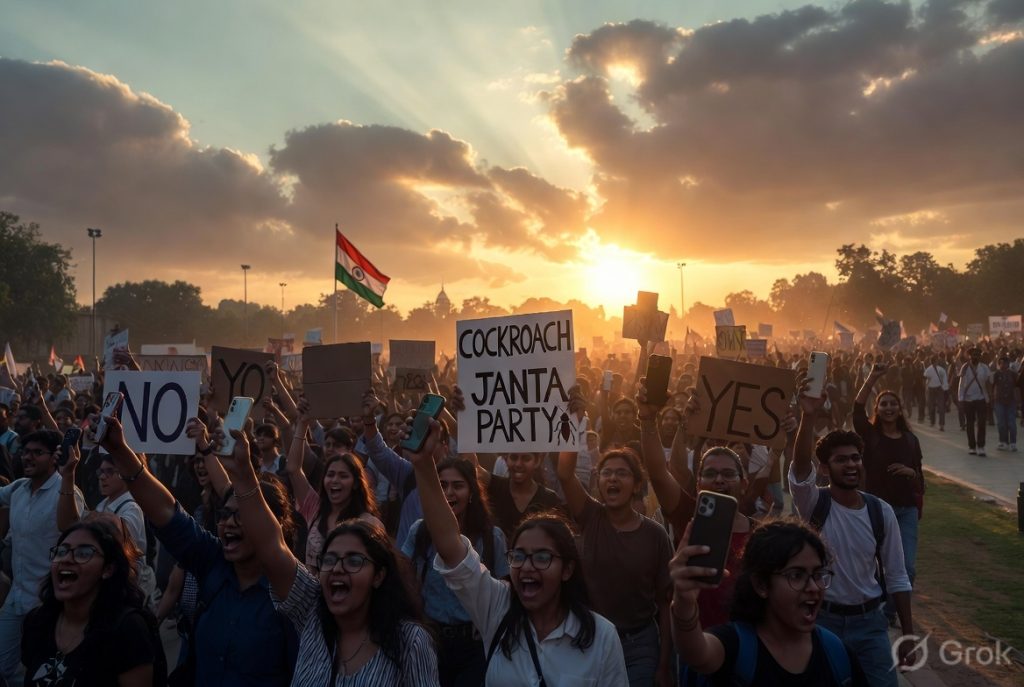
Dissent has never merely been about raising one’s voice against power. It has always been about finding a language that power cannot easily contain. Traditionally, protests in India have relied on slogans, marches, speeches, and symbolic acts of civil disobedience. Today, however, a new generation is reshaping this vocabulary. India’s Gen Z is not simply protesting differently—they are fundamentally changing what dissent looks, sounds, and feels like. This article explores The New Grammar of Dissent.
Unlike previous generations, Gen Z has grown up in an ecosystem dominated by smartphones, social media, digital culture, and visual storytelling. Consequently, their resistance is no longer confined to streets or university campuses. It unfolds simultaneously across Instagram reels, memes, short videos, digital art, podcasts, stand-up comedy, and online communities. The protest itself has become multimodal, blending humour, irony, satire, pop culture, and political commentary into a language that is both accessible and difficult to censor.
From Silent Scrolling to Viral Resistance
Protests of previous generations and mainstream political parties remain entrenched in marches, long sit-ins and fiery speeches. But Gen Z completely changed this basic grammar of protests, as they protest with memes, Instagram Lives, short-form videos, and unapologetic humor. When the Chief Justice of India reportedly likened unemployed youths to “cockroaches,” Gen Z didn’t cower—they reclaimed the insult. The Cockroach Janta Party (CJP) turned it into a badge of honor: resilient, countless, and impossible to eradicate. This satirical advantage made this movement instantly relatable and shareable, spreading like wildfire across platforms where traditional political rhetoric often falls flat.
They didn’t wait for mainstream media or established opposition parties to lead. Armed with smartphones, they documented police actions in real-time, live-streamed crackdowns, and created viral moments—like a young woman fearlessly standing before a police van—that captured national imagination. This is the new grammar: decentralized, leaderless (or multi-leadered), digitally native, and culturally fluent in the language of the internet.
How Gen Z Changed Narrative of Dissent
The concept of dissent has always implied two simultaneous realities. First, it acknowledges the existence of structures of power that marginalize certain voices. Second, it signifies resistance against these very structures. As structuralist thinkers argue, power functions through systems of relationships, hierarchies, and narratives. Dissent emerges precisely in the cracks of these systems, exposing what dominant institutions attempt to normalize.
What Gen Z has achieved is not merely occupying these cracks but expanding them through new communicative practices.
Rather than relying solely on formal political discourse, they translate complex political issues into cultural conversations. A meme questioning censorship may travel faster than a newspaper editorial. A thirty-second reel explaining constitutional rights can reach millions who would never read an academic article. Satirical illustrations, viral hashtags, and remix culture have become instruments of political participation.
This transformation echoes what graphic narratives have long demonstrated about dissent. Art Spiegelman’s Maus illustrates how personal memory, historical trauma, and political conflict coexist within multiple voices rather than a single authoritative narrative. The graphic novel refuses simplistic binaries and instead creates a polyphonic space where conflicting experiences coexist. Similarly, Joe Sacco’s Palestine rejects detached journalism by inserting the observer into the story itself, exposing how mainstream narratives often silence ordinary lives.
These works remind us that dissent is not merely about opposing authority—it is about reclaiming representation. India’s Gen Z is extending this logic into the digital age. Today’s protests rarely depend upon one spokesperson or one ideological centre. Instead, countless creators, artists, students, comedians, journalists, and anonymous internet users collectively produce narratives that challenge dominant political discourse. The authority once monopolized by traditional media is increasingly negotiated through decentralized digital participation.
Humour occupies a particularly significant place in this new grammar of dissent. Political satire has always existed, but Gen Z weaponizes humour differently. Irony, absurdity, parody, and meme culture transform fear into ridicule. The strategy resembles Armando Iannucci’s The Death of Stalin, where comedy does not trivialize authoritarianism but exposes its inherent absurdity. By laughing at power, satire strips it of the aura of inevitability that authoritarian systems seek to cultivate.
Memes therefore become more than entertainment. They become acts of political interpretation. Visual communication further strengthens this transformation. Images, comics, infographics, and short-form videos communicate emotional truths that lengthy policy discussions often fail to capture. Hillary Chute argues that graphic narratives combine textual and visual forms to represent histories that are otherwise difficult to articulate. Gen Z employs the same multimodal strategy online, compressing complex political realities into visual formats that are instantly shareable yet emotionally resonant. The result is a democratization of political storytelling.
Democratization of Political Storytelling
Every smartphone transforms into a publishing house. Every user becomes a political documentarian or activist. Every protest acquires multiple simultaneous narrators. Dissent no longer belongs exclusively to domains of political parties, intellectuals, or mainstream journalists. It is collectively authored.
This decentralization movement also alters the relationship between protest and identity. Contemporary movements are increasingly intersectional, connecting concerns surrounding gender, caste, climate change, mental health, employment, education, digital surveillance, and constitutional rights. Rather than treating these struggles as isolated issues, Gen Z understands them as interconnected structures of power.
The language reflects this interconnectedness. English seamlessly blends with Hindi, regional languages, internet slang, emojis, GIFs, and global pop-cultural references. A protest placard today might quote Ambedkar alongside Taylor Swift lyrics or combine constitutional values with viral internet humour. This linguistic hybridity reflects the lived reality of a generation that navigates both local identities and global digital cultures.
This transformation is not without limitations. Digital activism often faces criticism for performative engagement, algorithmic manipulation, misinformation, and fleeting attention spans. Viral visibility does not always translate into sustained political change. Yet dismissing online resistance as “slacktivism” overlooks how contemporary public discourse itself has shifted. Political legitimacy today is increasingly negotiated across digital spaces before it reaches traditional institutions.
The most significant contribution of Gen Z, therefore, is not inventing dissent but reinventing its language. Where previous generations marched with slogans, Gen Z marches with stories, visuals, satire, algorithms, and collective creativity. Their politics is participatory rather than hierarchical, visual rather than purely textual, and networked rather than centralized.
Every generation inherits the right to dissent. Few redefine how that dissent is spoken.
India’s Gen Z is doing precisely that—transforming resistance from a singular voice into a living, multilingual, visual conversation that continues to reshape the democratic imagination itself. The most remarkable contribution of this movement is reinventing Gandhian way of peaceful protest and creating a mass movement.
D.Chandra
References
Cutler, Robert M. “Soviet Dissent Under Khrushchev: An Analytical Study.” Comparative Politics, vol. 13, no. 1, 1980, pp. 15–35. JSTOR, https://doi.org/10.2307/421761. Accessed 4 May 2024.
Kuromiya, Hiroaki. “Stalin and His Era.” The Historical Journal, vol. 50, no. 3, 2007, pp. 711–24. JSTOR, http://www.jstor.org/stable/20175118. Accessed 4 May 2024.
McCloud, Scott, 1960-. Understanding Comics: the Invisible Art. New York: Harper Perennial, 1994.
Rotenstreich, Nathan. “On Lévi-Strauss’ Concept of Structure.” The Review of Metaphysics, vol. 25, no. 3, 1972, pp. 489–526. JSTOR, http://www.jstor.org/stable/20126058. Accessed 2 May 2024.
Sacco, Joe. Palestine. Jonathan Cape, 2003.
Spiegelman, Art. 1994. “Little Orphan Annie’s Eyeballs.” The Nation.
https://www.nytimes.com/2026/07/23/world/asia/rhiya-ahir-mumbai-india-student-protests-genz.html


