


In 1784, the German philosopher Immanuel Kant defined the Enlightenment as “man’s leaving his self-caused immaturity,” wherein earlier epochs had been disabled by the incapacity to “use one’s intelligence without the supervision of another,” Kant asserts the motto of the Enlightenment: “Dare to Know! : Have the courage to use your own intelligence!” The eighteenth century Enlightenment is established as a movement led by the intellectuals who “dared to Know” (Englewoods, p.62). They were immensely inspired by the accomplishments of the Scientific Revolution, and their understanding of the word “Reason” predominantly entailed the advocation of the application of the scientific method to understand and discern the greater aspects of living. All institutions and all mechanisms of thought were subject to the rational, scientific way of thinking, therein a tenuous attempt was made to attain freedom from the shackles of past, worthless traditions and foreground one’s way of living in the new ways of thinking. Sir Isaac Newton’s discoveries of the natural laws regulating the world of nature became an ideal for the larger society. Reason, natural law, hope, progress— these were common words in the heady atmosphere of the eighteenth century.
The intellectual inspiration for the Enlightenment primarily emanated from figures like Sir Isaac Newton and John Locke. Newton was actively singled out for praise as the “greatest and rarest genius that ever rose for the ornament and instruction of the species.” One English poet affirmed: “Nature and Nature’s Laws lay hid in Night; God said, ‘Let Newton be,’ and all was Light” (Higgith, 2013). Enthralled by the grand design of the Newtonian world-machine, the intellectuals of the Age of Enlightenment were persuaded that by emulating Newton’s rules of reasoning they could discern the natural laws that directed politics, economics, justice, religion, and the arts. The world and everything in it were like a giant machine. The Newtonian model of thinking endorsed an idea of progress premised on rationality and the exceptionality of the human faculty of thinking, thus entrusting human mind with the utmost importance and supremacy. Swift’s satire in Gulliver’s Travels is premised on this very Newtonian eulogization of the human faculty of rationality. By assuming the form of a travelogue, Swift intends to posit his satire on the human hubris which reaches its pinnacle during the Age of Enlightenment. Therein, this paper deeply delves in investigating Swift’s subject of satire in Book III and IV of Gulliver’s Travels. This paper concomitantly attempts to underscore Swift’s deep-seeded criticism for the intellectual tradition of the Age of Reason which placed utmost importance in the institution of scientific explorations which took place at the cost of common welfare through the potent example of Laputa and the Academy of Lagado. Further, this paper emphasizes Swift’s criticism of slavery, human cruelty on other organisms and colonialism which were justified under the intellectual tradition of the Age of Enlightenment which appreciated the fulfillment of the White man’s curiosity at the cost of the “othered entities”.
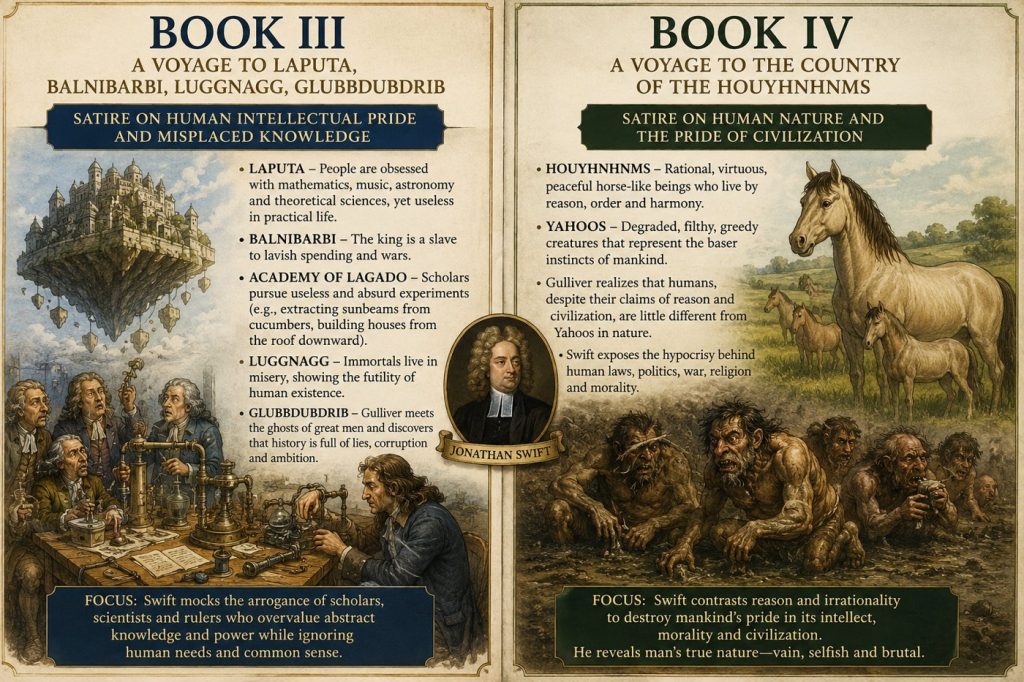
In myriad ways the entirety of Gulliver’s Travels is a potent satire on the scientific explorations of the Royal Society and the larger human hubris which was immensely evident in the Age of Enlightenment, in its presentation as a travel narrative, reporting on extraordinary sights and experiences of faraway lands in a calm, detached and whenever possible, in a quantitative fashion. The Royal Society often encouraged travelers to formulate such records and reports on information gathered in circumstances that varied across formal experiment, mathematical proof, astronomical observation, field work, library work, happenstance and even hearsay. Curiosities and natural monstrosities concurrently took place alongside Newton’s experimentations. “Jonathan Swift’s” satire in the entirety of Gulliver’s Travels but more specifically in Book III and IV are dedicated to this monstrocious nature of human curiosity, he adopts ‘Satire’ as a charged vehicle to comment upon the monstrosity of human hubris in the name of reason and rationality. A Glossary of Literary Terms by “M.H Abrams and Geoffrey Galt Harpham” establishes “satire” as “the literary art of diminishing or derogating a subject by making it ridiculous and evoking toward it attitudes of amusement, contempt, scorn, or indignation (Abrams & Harpham; pp352).” It becomes imperative to understand that the satirist of the 18th century perceived and moreover justified the employment of satire as a ‘corrective of human vices and folly (352).’ Alexander Pope adduces that “those who are ashamed of nothing else are so of being ridiculous.” Pope justifies Satire by framing its objective; “its frequent claim has been to ridicule the failing rather than the individual and to limit the ridicule to corrigible faults, excluding those for which a person is not responsible (355).” Swift uses indirect satire through the faculty of his gullible protagonist – Gulliver. By creating a character that is a white English surgeon set on a voyage to discover faraway lands, Swift is intrinsically posing a satirical attack on the Englishmen’s impulse to decipher all the mysteries of life and satiate his curiosity through the faculty of science and travel. Herein, the choice of Gulliver’s profession in England and his innate liking for travel is not coincidental rather carefully devised and charted by Swift. Gulliver’s inherent gullibility becomes symptomatic of the Englishmen’s pursuit of mastering all the disciplines (politics, administration, economy) through the sole faculty of science. He covertly criticizes the common place perception of “progress” popularized by the scientific experiments, explorations and leading figures affixed to it in the eighteenth century. Book III actively interrogates and poses haunting questions pertaining to the proclamation of the all-pervasive nature of science, and the possibility of mastering all disciplines integral for the human society solely through scientific rumination. The most momentous section of the book from the history of science perspective is Gulliver’s visit to the floating island of Laputa, where the inhabitants are enamoured by mathematical calculations, measuring, quantifying, experimenting and being overwhelmed by astronomical prediction at all times;
“Their heads were all reclined either to the right, or the left; one of their eyes turned inward, and the other directly up to the Zenith. Their outward garments were adorned with the figures of suns, moon, and stars (pp; 135).” The predilection of the Laputians towards astronomical explorations is quite evidently mentioned and established in these initial lines from chapter 3 of book III. In chapter III of book III, Gulliver ornamentally elaborates the flying island; his description is replete with scientific jargons and perplexing terminologies. However, the island floats due to the much known phenomenon of magnetic levitation; the use of a highly jargonized description to describe a relatable simple phenomenon of magnetic levitation by Gulliver reflects his inherent inclination towards the Laputians. Herein, the Laputians are symbolic of the Newtonian philosophy and Gulliver embodies the impulse of the larger British society in the 18th century, who are heavily influenced by the complex philosophies and rules charted out by scientists. The grand Academy of Lagado further concretizes as the most direct form of satire posed on the scientific explorations undertaken by the Royal Academy of Science. The description of the varied experimentations and the amount of human capital invested on it reveals the innate idiosyncrasies of obsessive scientific experimentations which took place in the 18th century. “he had been eight years upon a project for extracting sunbeams out of cucumbers”; “His employment from his first coming into the Academy was an operation to reduce human excrement to its original food”; “I saw another at work to calcine ice into gunpowder (pp; 153)” all these preposterous experiments are means of commenting upon the fanaticism which the scientists appropriated during the Age of Enlightenment, following Newton’s example.
Furthermore, through the example of the Lindalinians – Swift unearths the tyranny of Science, reason and rationality and concurrently the notions of modernity over the masses. Those who deny adhering to the modernist ideas pertaining to science and discovery appropriate a redundant position in the fabric of the society. Herein, Swift’s natural predilection towards the “ancients” as opposed to the “moderns” is revealed. Lord Munodi becomes Swift’s object of deflating the idea of progression and advancement, and proffers an interesting insight as to how ancient ways can turn out to be more benefitting in opposition to the hubristic pseudo-progressive experiments of the present.
“About fourty years ago, certain persons went upto Laputa either upon business or diversion, and later five months continuance came back with a very little smattering in mathematics, but full of volatile spirits acquired in that airy region. That these persons upon their return began to dislike the management of everything below, and fell into schemes of putting all arts, sciences, languages and mechanics upon a new foot (pp; 151).”
In the above passage the use of the word “schemes” explicates the inherent idea of indoctrination of the people, the innate fascination affixed with the idea of modernity and the concomitant mindless emulation of the popular ideas devoid of detecting its suitability. It becomes imperative to observe that Swift has been previously involved with charged debates about the ‘Ancients’ v/s the ‘Moderns.’ Swift’s The Battle of Books published in 1704, a deceptively simple mock-heroic account of a battle which erupts amongst the books in the King’s library at St. James’s palace. The battle is fundamentally a satirical allegory on an intellectual debate which plagued England since 1692, referred to as the “Battle of the Ancient and the Moderns.” Theoretically, this debate concerning the relative significance of the intellectual achievements of the antiquity, as compared to the “progress” that had been made in numerous fields pertaining to the human knowledge since the Renaissance (Levine; pp 297). Therefore, Swift constantly questioned the notion of “progress” and relentlessly involved himself in interrogating the moral, social, individual and political efficacy which the notion of scientific advancement offered in the Age of Enlightenment. Swift here supplants Munodi as an embodiment of authenticity, of the ancient and reliable patterns of living and thinking. Therein, Book III constantly tackles the ideas of pseudo-progression, through the faculty of Laputa and Lagado. Tending to be a devious satire on the Royal Academy of Science, The Academy of Lagado presents itself as a space which portrays the various divarications and convolutions of science and administration. Swift poses the idea that unilateral adulation of one discipline does not offer any advantages on the part of administration, as evident in the case of the metropolis of Lagado.
Swift was satirizing the ubiquity of Newtonian philosophy in the polite society of 1720s London, but he was not being ‘anti-experimental philosophy’ or discrediting the faculties of science and reason completely. Most perceptibly, in Laputa, Swift criticizes a world of mathematical and philosophical endeavors that does little or nothing to better people’s lives, precisely those of the subjects in the colony of Balnibarbi, located beneath the floating Laputa. Swift’s satire is directed towards the excessive involvement of the scientists with the approval of the political authorities in conducting preposterous experiments which do not show any resolve for the practical needs or requirements of the populace instead deploys a large body of productive human resource in unpractical investigations. Lynall adduces that Swift’s satire eventhough directed towards the faculties of science clearly carried political undercurrents. He further states that Newton became one of the chief targets of Swift’s sharp satire not entirely due to his association with the larger aspects of scientific explorations in 18th century but partially because of his influential and much remunerated position as Master of the Mint and his ambiguous association with the Whigs. Swift despised political tyranny and corruption, he once claimed that he had a “perfect hatred of tyranny and oppression.” Thus his satire collectively targeted the coveted nexus of the experimental philosophy and the political authorities to extract mutual benefits in material and abstract terms. Through the binary between Laputa and Balnibarbi, Swift covertly commented upon the power relations between Britain and Ireland; or generally the hegemon and the sub-ordinate. Swift suggests that how the hegemonic force inflicts and imposes its culture, ideas, and thoughts upon the sub-ordinate. The imposition of the laputian ways of thinking, scientific explorations and quantitative calculations onto the metropolis of Lagado reflects the idea of the sublimation of the culture of the colonized territory by the infiltration of the colonizer.
While working on Gulliver’s Travels, Jonathan Swift was occupied in a passionate and prolific literary battle for Irish economic liberty. Critics have long detected the effect of Swift’s Irish commitment in Book III where the charged Satire against England’s tyranny seems evident. However, a very diminutive attention has been given to this visible ambiguity that the parallel between the Irish-English situation and the Yahoo-Houyhnhnm dynamics adds to the already intricate interpretation of Book IV. Kelly notes that the term Swift utilizes to explicate the oppression in both Ireland and Houyhnhnmland is “slavery”; this however is not a matter of coincidence, as Swift was conscious of the complicated moral and philosophical questions augmented by the “emotional designation of slavery (Kelly; pp 846)”
The misery of the Irish populace in the early eighteenth century created a huge impact over Swift; the hopeless passivity of the people in the desolate land made it appear as if both the psyche and the corporeal frame of the Irish were enslaved. Swift consistently vacillates as to whether the Irish have assumed servility due to some defect within their character or whether their deplorable condition is the product of a calculated policy which has reduced them to brutishness. Similar questions could be asked about the servitude of Yahoos and their degeneration. There’s an uncanny similarity between the degenerative situation of the Irish and the Yahoos. Gulliver appears to be a dismantling figure that penetrates into this dynamics of slave and the master. His presence stimulates another set of questions which Kelly suggests in her essay titled Swift’s Explorations of Slavery in Houyhnhnmla and Ireland. She questions that does Gulliver’s acceptance of his similitude with the Yahoos is the only plausible possibility under the given circumstances? This echo largely as a question which Swift intends to ask from the Irish people, given the condition of Ireland in the 18th century. Further, the dynamics between the Yahoos and the Houyhnhnms appears to be a tantalizing subversion of the universal slave-master relation. It subverts the potent dynamics of the ‘colonizer’ and the ‘colonized’, as Gulliver, the white European ends up attaining the position of servitude. With this jarring imagery of Gulliver becoming the slave of the horse race, Swift dismantles the traditional relationship matrix and puts the predominantly white reader in a disconcerting position. Further, the Yahoos not only stimulate the sense of identity crisis for the Irish people but to the larger colonized races, mastered by the Englishmen. It breeds a sense of mutual retrospection of the brutal ramifications of colonialism particularly in the very last segment of Book IV. Gulliver’s lack of conformity to his own culture, geographical territory, lifestyle patterns suggest the consequences of colonial infiltration into the native character of the colonized entity. The subversion, plates the very same question with a sense of striking poignancy to the English readers;
“Yet my memory and imaginations were perpetually filled with the virtues and ideas of those exalted Houyhnhnms (pp; 242).”“Having not been used to the touch of that odious animal for many years, I fell in a swoon for almost an hour (pp; 242).” These lines depicts Gulliver’s indoctrinated self, his innate detestation of his own family depicts the overbearing sense of infiltration which he garnered while he was colonized by the race of the Houynhnms.
Therein, Book IV of Gulliver Travel’s insinuates the various systems of discrimination and oppression designed and sustained by human hubris. In Book IV through the gritty subversion of the dynamics between the animal and the master/ slave and master, Swift exposes the ramifications of this central enterprise of keeping human at the centre of all machineries, as the master of all organisms. He covertly critiques the faculty of colonialism, the institution of slavery and puts into the vanguard the pressing issue of the human as the master of all species followed by its disastrous consequences. The subversion of the master and the slave matrix further amplifies the sense of satire and criticism, the inversion potently brings out the idiosyncrasies affixed with humanity and the excessive pride which human garners over their capacity to think. The fetishism fastened with the European man taming the wild beast in faraway lands further receives an inverted treatment, as the white man becomes the slave of the very animal he assaults in the hegemonic order.
Chandra, S. 2025
References
- Alkemeyer, Bryan. “The Natural History of the Houyhnhnms: Noble Horses in <em>Gulliver’s Travels</Em>.” The Eighteenth Century, vol. 57, no. 1, 2016, pp. 23–37, https://www.jstor.org/stable/eighcent.57.1.23. Accessed 15 Apr. 2022.
- Kelly, Ann Cline. “Swift’s Explorations of Slavery in Houyhnhnmland and Ireland.” PMLA, vol. 91, no. 5, 1976, pp. 846–55, https://doi.org/10.2307/461560. Accessed 24 Apr. 2022.
- LATIMER, BONNIE. The Review of English Studies, vol. 64, no. 267, 2013, pp. 895–97, http://www.jstor.org/stable/24541032. Accessed 24 Apr. 2022.
- Levine, J. Humanism and History: Origin of Modern English Historiography, Ithaca: Cornell university Press, 1987, pp 297.
- Patey, Douglas Lane. “Swift’s Satire on ‘Science’ and the Structure of Gulliver’s Travels.” ELH, vol. 58, no. 4, 1991, pp. 809–39, https://doi.org/10.2307/2873283. Accessed 15 Apr. 2022
- Seidel, Michael. “Gulliver’s Travels and the Contracts of Fiction.” The Cambridge Companion to the Eighteenth-Century Novel, edited by John Richetti, Cambridge University Press, Cambridge, 1996, pp. 72–89. Cambridge Companions to Literature.
- Swift, Jonathan. “Gulliver’s Travels.” Edited by Landa L., 2013


