


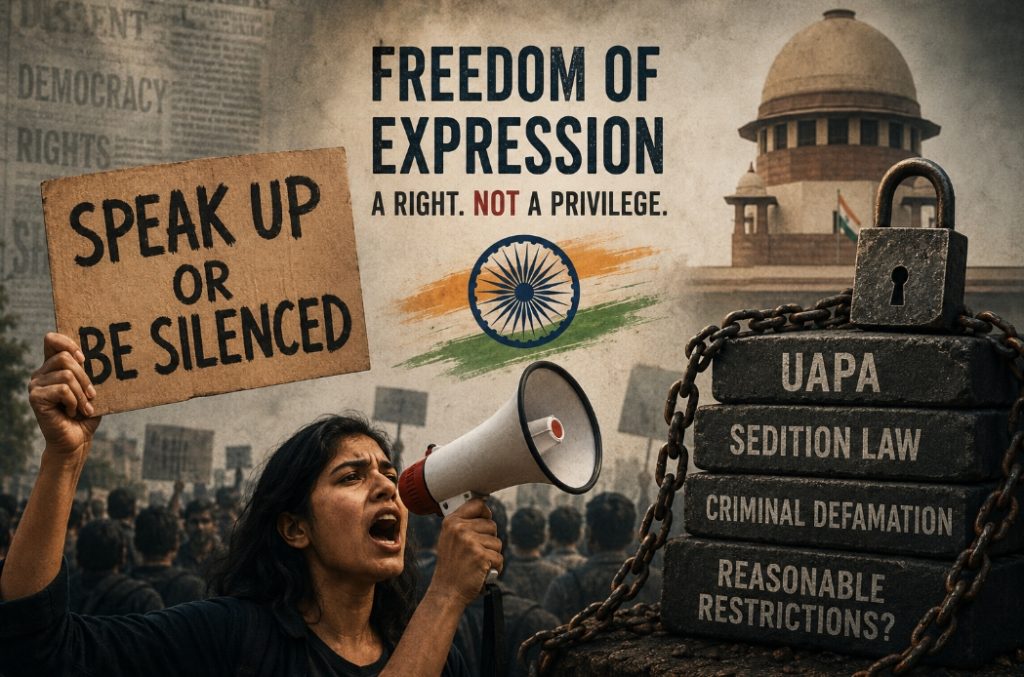
“The freedom to express oneself is not merely a constitutional privilege; it is the lifeblood of democracy.”
Article 19 of the Universal Declaration of Human Rights declares that every individual has the right to freedom of opinion and expression. This includes the freedom to seek, receive, and share information and ideas through any medium, regardless of borders. The principle is simple yet profound: human beings cannot fully develop as free individuals if they are denied the right to think, speak, question, and disagree.
More than seven decades after the adoption of the UDHR, freedom of expression remains the cornerstone of every democratic society. Political philosopher and human rights scholar John Howie described it as an indispensable foundation of democracy. Without it, governments cease to be accountable, public debate withers, and citizens become subjects rather than participants.
India, often celebrated as the world’s largest democracy, constitutionally guarantees freedom of speech and expression under Article 19(1)(a). As a signatory to the International Covenant on Civil and Political Rights (ICCPR), the country has also committed itself to protecting civil and political liberties. Yet an uncomfortable question increasingly confronts the nation: How healthy is a democracy when criticism of the government is routinely treated as a threat to the state?
The Shrinking Space for Free Speech in India
Over the past decade, a growing number of incidents have raised concerns about the shrinking space for dissent in India.
During the farmers’ protests of 2021, hundreds of protesters were arrested. Some were charged under the Unlawful Activities (Prevention) Act (UAPA), India’s principal anti-terror law, while authorities reportedly initiated proceedings to withdraw passports of several activists. What began as a democratic protest against agricultural reforms quickly became a test of how much dissent the state was willing to tolerate.
The arrest of climate activist Disha Ravi became another defining moment. The 22-year-old was detained for sharing an online “toolkit” supporting the farmers’ movement. Authorities accused her of criminal conspiracy and promoting social disharmony. For many observers, the case symbolized a troubling reality: social media activism itself appeared to be under suspicion.
The pattern did not end there.
Ali Khan Mahmudabad, an associate professor at Ashoka University, faced criminal charges over a social media post criticizing what he viewed as the government’s role in fostering social polarization. His comments questioned whether public praise for Muslim military officers would translate into equal concern for victims of mob violence and discrimination.
Journalists have also found themselves in the crosshairs.
Pawan Jaiswal, a reporter from Uttar Pradesh, exposed the poor quality of meals being served to schoolchildren under a government welfare scheme. Instead of being commended for investigative reporting, he was charged with cheating and criminal conspiracy. The message seemed unmistakable: exposing administrative failures could invite legal consequences.
Even universities have not escaped scrutiny. Educational institutions have reportedly faced pressure over screenings of documentaries critical of Prime Minister Narendra Modi’s handling of the 2002 Gujarat riots. Such actions raise deeper concerns about academic freedom and the ability of students to engage with competing interpretations of history.
When Protest Becomes “Terrorism”
Perhaps the most worrying trend is the growing tendency to criminalize protest.
In 2020, activists Natasa Narwal and Devangana Kalita were arrested during protests against the Citizenship Amendment Act (CAA). Authorities linked them to terrorism-related charges under UAPA. When granting bail, the Delhi High Court strongly criticized the state’s attempt to blur the distinction between lawful dissent and terrorist activity.
The court’s observation touched upon a fundamental democratic principle: disagreement with government policy is not equivalent to a threat against the nation.
Yet increasingly, activists, students, writers, journalists, filmmakers, and academics have found themselves facing criminal proceedings for expressing unpopular views. Such developments create a chilling effect, discouraging citizens from speaking freely even when their criticism falls squarely within democratic norms.

The Problem of Vague Laws
Defenders of government action often point to Article 19(2) of the Constitution, which permits “reasonable restrictions” on free speech in the interests of sovereignty, public order, morality, national security, and other legitimate concerns.
The principle itself is not controversial. No democratic society permits unrestricted speech that incites violence or threatens public safety.
The problem lies elsewhere.
Terms such as “public order,” “morality,” or threats to national interests can be interpreted broadly, creating opportunities for misuse. The absence of precise legal definitions often allows authorities to stretch the boundaries of what constitutes a legitimate restriction.
The controversy surrounding sedition law illustrates this challenge.
Section 124A of the Indian Penal Code historically criminalized words or actions that brought “hatred,” “contempt,” or “disaffection” toward the government. The language was so expansive that ordinary criticism could potentially fall within its scope. Although the constitutionality and future of sedition law remain under judicial and legislative scrutiny, its legacy demonstrates how vague legal provisions can become tools against dissent.
When laws lack clarity, citizens begin to self-censor. Fear replaces debate. Silence replaces criticism.
And democracy suffers.
Why Free Speech Matters Beyond Politics
The consequences of restricting free expression extend far beyond political discourse.
John Stuart Mill’s famous “marketplace of ideas” theory argues that societies progress when competing ideas are allowed to confront one another in the open. Even unpopular or controversial opinions serve a purpose: they challenge prevailing assumptions, expose weaknesses in dominant viewpoints, and stimulate intellectual growth.
A society that suppresses dissent risks losing more than political freedom. It risks losing innovation, creativity, scientific inquiry, and social progress.
Economic development, technological advancement, and cultural flourishing all depend upon an environment where individuals can question authority, challenge orthodoxies, and propose alternatives without fear of punishment.
History repeatedly demonstrates that societies prosper not when citizens remain silent, but when they speak freely.
The Road Ahead
India’s constitutional commitment to free speech remains one of the strongest pillars of its democratic framework. Yet constitutional guarantees alone are insufficient if laws are interpreted expansively or applied selectively.
The urgent challenge before policymakers is not whether speech can be restricted—it can and sometimes should be. The challenge is ensuring that restrictions remain truly reasonable, narrowly defined, and consistent with democratic principles.
Clearer definitions under Article 19(2), stronger safeguards against misuse of anti-terror legislation, and reforms to laws historically used against dissent would be important steps toward restoring confidence in democratic institutions.
The real test of a democracy is not how it treats those who agree with the government. It is how it treats those who disagree.
If criticism is increasingly viewed as disloyalty, and dissent as criminality, the question is no longer whether freedom of expression and Free Speech in India is under pressure. The question is whether democracy itself can thrive without it.
Team SChandraLiterature
References
ALJAZEERA, 2021. BJP deploys its majoritarian tactics against India’s farmers [Online] https://www.aljazeera.com/opinions/2021/2/13/bjp-deploys-its-majoritarian-tactics-against-indias-farmers
Basu, S. and Sen, S., 2024. Silenced voices: Unravelling India’s dissent crisis through historical and contemporary analysis of free speech and suppression. Information & Communications Technology Law, 33(1), pp.42-65.
BBC, 2021. India activist Disha Ravi arrested over farmers’ protest ‘toolkit [online] https://www.bbc.com/news/world-asia-india-56060232
Drishti IAS, 2025. Reaffirming Free Speech in a Constitutional Democracy. [online] https://www.drishtiias.com/daily-updates/daily-news-editorials/reaffirming-free-speech-in-a-constitutional-democracy
Gupta, S. 2024. Silencing Voices: An In-Depth Analysis Of Freedom Of Speech And Expression On Social Media Platform In Context Of India’s IT Act, Indian Journal of Law and Legal Research
ISSN: 2582-8878 [online] https://www.ijllr.com/post/silencing-voices-an-in-depth-analysis-of-freedom-of-speech-and-expression-on-social-media-platform
Howie, E., 2018. Protecting the human right to freedom of expression in international law. International journal of speech-language pathology, 20(1), pp.12-15.
India Today, 2019. Use and misuse of Sedition law: Section 124A of IPC [online] https://www.indiatoday.in/education-today/gk-current-affairs/story/use-and-misuse-of-sedition-law-section-124a-of-ipc-divd-1607533-2019-10-09
NDTV, 2022. Journalist Who Exposed Roti-Salt Meal In UP School Dies Of Cancer [online] https://www.ndtv.com/india-news/pawan-jaiswal-journalist-who-exposed-roti-salt-meal-in-up-school-dies-of-cancer-2948360
Pandey, G. and Day, A. 2026. No bail for Indian activists after five years in jail without trial, BBC [online] https://www.bbc.com/news/articles/cd0ye2z33x9o
Rashid, O. 2019. Journalist who exposed salt-roti meal in school booked by UP govt. The Hindu [online] https://www.thehindu.com/news/national/other-states/journalist-who-exposed-salt-roti-meal-in-school-booked-by-up-govt/article29320560.ece
Siagian, R., Siahaan, L. and Hamzah, M.I., 2023. Human rights in the digital era: online privacy, freedom of speech, and personal data protection. Journal of Digital Learning and Distance Education, 2(4), pp.548-558.
Shukla, S. 2020. Freedom of speech and expression – Article 19(1)(a), Law Column [online] https://lawcolumn.in/freedom-of-speech-and-expression-article-191a/
The Guardian, 2023. India invokes emergency laws to ban BBC Modi documentary [online] https://www.theguardian.com/world/2023/jan/23/india-emergency-laws-to-ban-bbc-narendra-modi-documentary
The Hindu, 2024. ‘Writers, journalists, social activists being jailed for merely criticising Indian government’ [online] https://www.thehindu.com/news/national/writers-journalists-social-activists-being-jailed-for-merely-criticising-indian-government/article68007391.ece
https://cpj.org/2026/02/indian-journalist-ravi-nair-sentenced-to-1-year-in-adani-defamation-case/
Yadav, N. 2025. Bail for Indian professor arrested for comments on India-Pakistan conflict, BBC [online] https://www.bbc.com/news/articles/c93llyrrze7o
https://thewire.in/rights/india-134-free-speech-violations-2024-free-speech-collective


