


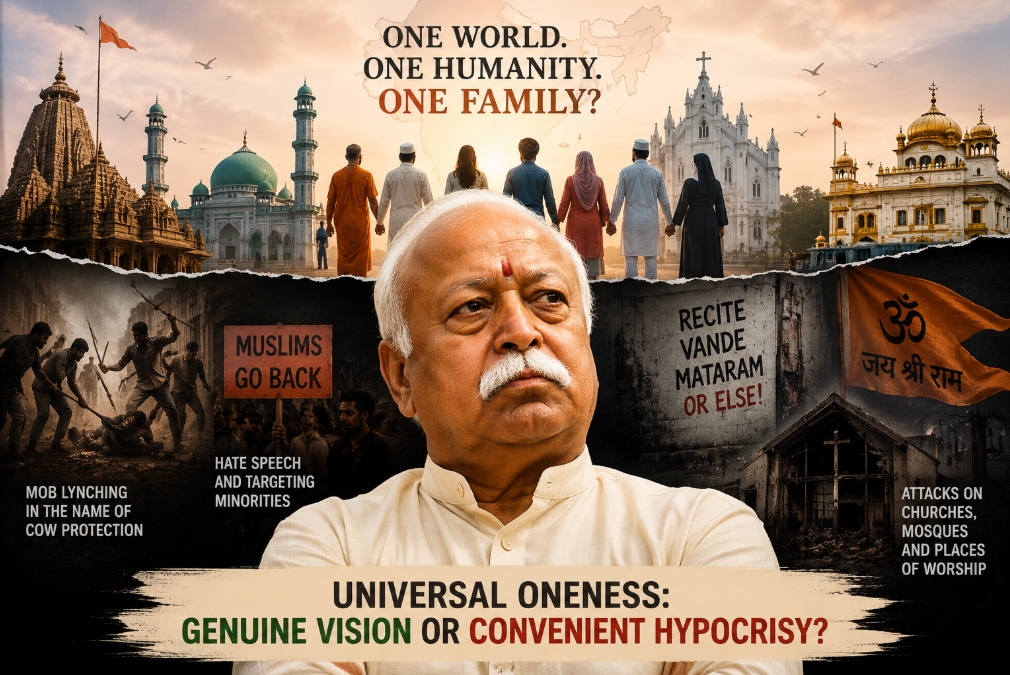
There is something undeniably powerful or hypocrisy about the language of Bhagwat’s Universal Oneness
At the recent “Universal Oneness Celebration” in New York, RSS chief Mohan Bhagwat spoke of unity in diversity and argued that India’s civilisational mission is to make the world recognise the unity underlying human diversity. More strikingly, when asked about Muslims, he said that a Hindu who believes Muslims should be driven out of India cannot remain a Hindu.
These are words worth welcoming.
But words of universal brotherhood inevitably invite a simple question: what happens to the philosophy when it encounters power, prejudice and violence on the ground?
That is where Bhagwat’s message faces its most serious test.
The problem is not the speech. It is the distance between the speech and the lived experience.
For years, India has witnessed episodes of mob violence against Muslims, attacks connected to cow-vigilante politics, intimidation over religious practices, and assaults on Christian communities and places of worship. Reports have also documented the involvement or alleged involvement of organisations associated with the wider Hindu nationalist ecosystem, including the VHP and Bajrang Dal, in attacks on minorities. The U.S. State Department, for example, has documented incidents involving Bajrang Dal and VHP activists and attacks on Christian congregations and religious personnel.
The question, therefore, is not whether Bhagwat can deliver an eloquent speech about humanity being one.
The question is whether the moral universe described in that speech is reflected in the conduct of the ecosystem over which he exercises ideological influence.
That distinction matters.
An organisation cannot claim the moral credit of moderation while asking society to judge its leaders only by their most conciliatory speeches. Nor can critics fairly attribute every crime committed by an individual activist to the RSS without evidence.
The real issue lies between those two extremes:
What responsibility does a movement have for the political and social culture created in its name?
Universalism cannot have a religious qualifying clause
Bhagwat’s argument is rooted in the idea that diversity is natural while unity is fundamental. The RSS itself describes this as the relationship between diversity and oneness.
But genuine universalism has a demanding implication.
It cannot mean:
You are welcome as long as you accept our definition of national identity.
It cannot mean that a Muslim is accepted merely as a culturally assimilated Hindu, or that a Christian is tolerated provided Christianity remains invisible in public life.
And it certainly cannot mean that minorities must repeatedly demonstrate their patriotism to satisfy the majority.
This is where controversies surrounding demands that Muslims recite Vande Mataram become symbolically important. The issue is not whether Vande Mataram is an important part of India’s national history—it unquestionably is. The issue is whether patriotism becomes a test that one religious community is required to perform in a prescribed manner.
A confident civilisation does not need coerced displays of loyalty.
Patriotism freely expressed is fraternity. Patriotism demanded as proof of belonging is conformity.
That distinction should matter to anyone who genuinely believes in Vasudhaiva Kutumbakam—the world as one family.
The mosque and the church are part of the test
If the world is one family, then the mosque cannot be treated as an intrusion into the cultural landscape of India.
The church cannot be treated as an alien institution.
The synagogue, gurdwara, Buddhist monastery and temple cannot be ranked according to the religious identity of their worshippers.
A family does not ask one of its members to erase their identity before granting them belonging.
Yet India has repeatedly seen disputes over places of worship, allegations of forced conversion, intimidation of Christians, and attacks on churches and Christian gatherings. Contemporary reporting has also recorded a rise in hate speech targeting Christians and continuing hostility toward Muslims.
The answer cannot simply be that these acts were committed by “fringe elements.”
At some point, every movement must ask why its supposed fringes repeatedly find an ideological vocabulary in which minorities can be portrayed as threats, outsiders or objects of suspicion.
Calling someone a fringe element may explain who committed an act.
It does not necessarily explain the soil in which that act grew.
Lynching is where philosophy meets flesh and blood
There is no more brutal contradiction to universal oneness than the mob deciding who deserves to live.
India’s history of mob lynchings, particularly violence involving Muslims in the name of cow protection or allegations of beef consumption, has produced a profound question about the meaning of citizenship. Reports by human-rights organisations and other observers have documented such violence and the broader climate of anti-minority hate.
Imagine telling the family of a lynching victim that humanity is one.
They would be entitled to ask:
Where was that oneness when the mob arrived?
Imagine telling a Muslim citizen that Hinduism has room for him while he watches men like him beaten in the name of protecting a cow.
Imagine telling a Christian that India welcomes every faith while a church is attacked because someone suspects its congregation of conversion.
At that point, philosophy becomes more than a speech.
It becomes a demand for accountability.
Bhagwat deserves to be judged by the standard he himself has set
There is a temptation among critics to dismiss Bhagwat’s recent remarks as public-relations exercises, particularly because the RSS is seeking a larger international profile and because his American tour has attracted controversy. Critics have argued that the organisation’s rhetoric of unity conflicts with its historical and contemporary record; the RSS rejects such characterisations and describes itself as a Hindu-centred cultural movement.
But perhaps the more intellectually serious response is neither automatic dismissal nor unquestioning applause.
Take Bhagwat at his word—and then hold him to it.
If Muslims are genuinely an inseparable part of India, then say so not merely in New York but wherever Muslims are being demonised.
If diversity is India’s strength, defend diversity when it is politically inconvenient.
If every faith deserves respect, condemn attacks on mosques and churches with the same moral clarity with which attacks on temples would be condemned.
If Hinduism rejects the exclusion of Muslims, then the RSS leadership should make it unmistakably clear that anyone who intimidates a Muslim in the name of Hindu civilisation is betraying, rather than defending, that civilisation.
And if the RSS considers VHP, Bajrang Dal and other organisations part of a broader cultural family, then moral leadership requires more than distancing itself from individual acts of violence. It requires confronting the rhetoric that makes such hostility possible.
The burden of proof is now on the philosophy
There is nothing inherently contradictory about being proud of India’s Hindu civilisational heritage while defending religious pluralism.
There is nothing contradictory about believing that Hindu philosophy has something profound to contribute to the idea of human unity.
There is, however, a profound contradiction if “oneness” ultimately demands that minorities surrender equal cultural and religious dignity in exchange for acceptance.
That is not universalism.
That is assimilation.
And assimilation dressed up as fraternity remains assimilation.
Bhagwat has now articulated a remarkably ambitious proposition: that India’s destiny is to demonstrate the unity underlying human diversity.
If he genuinely believes that, India should welcome the proposition—and demand that it be applied without exception.
Not only to the obedient Muslim.
Not only to the Christian who keeps quiet.
Not only to the minority that never challenges the majority.
But to every Indian, regardless of religion, language, caste or belief.
The ultimate test of Vasudhaiva Kutumbakam is not whether a leader can proclaim that the world is one family on a stage in New York.
The test is whether the stranger standing next to us in an Indian street is treated as family when nobody is watching.
Universal oneness begins where majoritarian power ends.
Until that principle is visible in the lives of India’s minorities—not merely in speeches—the question of whether Bhagwat’s universalism is genuine conviction or political hypocrisy will remain unanswered.
And perhaps that is the question he should welcome most.
Because if the philosophy is genuine, scrutiny should strengthen it.
If it is hypocrisy, scrutiny will expose it.


