


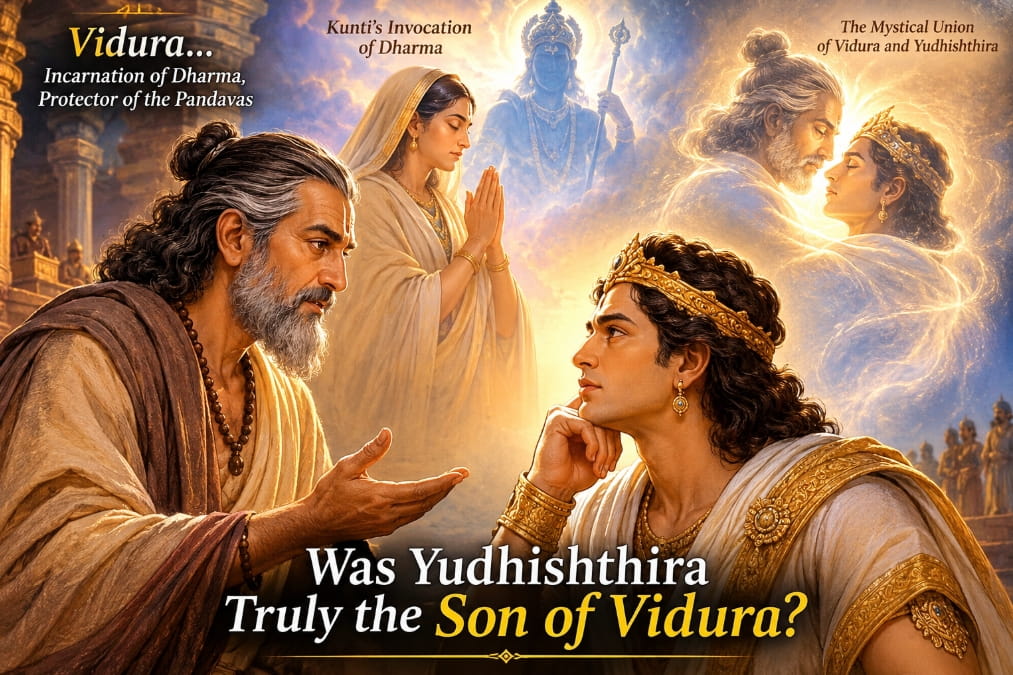
Was Yudhishthira the Son of Vidura? An Untold Mystery of the Mahabharata
An exploration of Vidura’s relationship with the Pandavas, his identity as an incarnation of Dharma (Yama), and the intriguing possibility that Yudhishthira’s biological father was Vidura rather than the god Dharma.
Introduction: A Question Hidden in the Mahabharata
Among the many mysteries of the Mahabharata, few are as intriguing as the question of Yudhishthira’s parentage.
According to the conventional narrative, Yudhishthira was born to Kunti through her invocation of Dharma, also known as Yama, the god of righteousness and death. He was therefore called Dharmaputra—the son of Dharma. This divine parentage explains his extraordinary commitment to truth, justice, morality and righteous conduct.
Yet another character in the epic invites a fascinating reconsideration of this story: Vidura.
Vidura was not merely a wise minister of the Kuru kingdom. He was an incarnation of Dharma himself. He possessed an extraordinary understanding of righteousness, was deeply attached to the Pandavas, and shared a particularly intimate intellectual and spiritual relationship with Yudhishthira.
There is also an important genealogical detail. Vidura was the younger half-brother of Dhritarashtra and Pandu. In the complex world of Kuru succession, where the practice of niyoga played a significant role, this relationship raises interesting questions about the possible human dimension of Yudhishthira’s birth.
Could Vidura have been Yudhishthira’s biological father, with the divine story of Dharma’s intervention preserving a deeper symbolic or theological truth?
The proposition is intriguing. However, to examine it fairly, we must distinguish between what the Mahabharata explicitly narrates, what its symbolism suggests, and what can be inferred through comparative interpretation.
- Vidura: The Man Who Was Dharma Incarnate
To understand the possibility of Vidura’s paternity, we must first understand who Vidura really was.
Vidura was born to Vyasa and a maidservant of the royal household. His birth was the consequence of an unusual episode in the Kuru dynasty’s succession history. When the widows of Vichitravirya were approached by Vyasa to produce heirs, the maidservant was also sent to him. Unlike Ambika and Ambalika, she received Vyasa without fear or hesitation. Vidura was born from this union.
Although Vidura was raised in the Kuru royal household and became one of its most respected ministers, his maternal birth placed him outside the conventional privileges of Kshatriya royalty. The epic describes him as born of a Shudra woman, while some translations and traditional accounts use the designation of a maidservant or servant woman. His social position therefore differed from that of his royal brothers, Dhritarashtra and Pandu.
But Vidura’s spiritual identity was extraordinary. The Mahabharata explains that Vidura was an incarnation of Dharma, the divine embodiment of righteousness. This incarnation came about because of a curse pronounced by the sage Mandavya.
Mandavya had been unjustly punished for an offence committed during childhood. When he questioned Dharma about the reason for his suffering, Dharma explained that Mandavya had once injured an insect in his childhood. Mandavya considered the punishment disproportionate and cursed Dharma to be born in the world of human beings.
Consequently, Dharma took birth as Vidura. This is not merely a later popular belief. It is explicitly explained in the Ashramavasika Parva, when Vyasa reveals Vidura’s divine identity to Dhritarashtra.
The revelation becomes particularly interesting when Vyasa discusses Vidura’s relationship with Yudhishthira. He explains that Vidura was Dharma himself and that Dharma was also the divine source of Yudhishthira’s birth. The two identities ultimately converge when Vidura enters Yudhishthira’s body through his yogic power.
The passage is significant because the epic does not merely describe Vidura as a devotee of Dharma. It identifies him with Dharma itself.
- Vidura’s Extraordinary Attachment to the Pandavas
Vidura’s relationship with the Pandavas was unlike that of an ordinary royal minister.
Although he occupied a subordinate position in the Kuru court, his affection for the children of Pandu was profound. He repeatedly tried to protect them from Duryodhana’s jealousy and hostility.
The most famous example is the conspiracy involving the Lakshagriha, or house of lac, at Varanavata.
Duryodhana and his associates planned to burn Kunti and her sons alive. Vidura understood the conspiracy and secretly warned Yudhishthira. He also arranged for an underground passage through which the Pandavas could escape.
This episode demonstrates that Vidura was willing to risk his position and relationship with the ruling family to save the Pandavas.
His concern was not limited to their physical safety. He consistently advised Dhritarashtra against injustice and warned him about the disastrous consequences of allowing Duryodhana’s ambitions to prevail.
Vidura’s famous counsel, commonly known as the Vidura Niti, is one of the most important ethical and political discourses in the epic.
It is therefore understandable that the Pandavas regarded Vidura as a father figure. His relationship with Yudhishthira, in particular, was marked by mutual respect, affection and a shared commitment to Dharma.
- Why Vidura’s Relationship with Yudhishthira Was Special
Among the five Pandavas, Yudhishthira had the closest philosophical affinity with Vidura.
Both were deeply concerned with Dharma. Both believed that political power should be exercised within the boundaries of righteousness. Both frequently struggled with the tension between moral principles and the practical demands of royal life.
Vidura was one of the few people in the Kuru court who could speak to Yudhishthira with the authority of an elder and the understanding of a moral teacher.
Their relationship is especially revealing when viewed alongside the divine identities attributed to them.
Yudhishthira was called Dharmaraja, while Vidura was Dharma incarnate. Their association therefore carried a meaning beyond ordinary family affection.
There is an especially remarkable episode in the Ashramavasika Parva. After the war, Vidura renounces worldly life and undertakes severe ascetic practices. When Yudhishthira encounters him in the forest, Vidura does not engage in an ordinary conversation. Instead, through yogic power, he enters Yudhishthira’s body.
Vyasa subsequently explains the spiritual significance of this event to Dhritarashtra. The passage declares that Vidura was Dharma and that Yudhishthira was also born from Dharma. Their identities are thus presented as manifestations of the same divine principle.
One can interpret this as the reunion of the father and son at a spiritual level. However, the epic itself describes it in terms of divine identity and yogic union, not as proof of biological paternity. That distinction becomes important when we examine the question of Vidura’s possible role in Yudhishthira’s conception.
- The Question of Niyoga: Could Vidura Have Fathered Yudhishthira?
The institution of niyoga is essential to understanding the genealogical background of the Mahabharata. Pandu was cursed that he would die if he approached his wives sexually. Consequently, he could not father children through ordinary marital relations.
Concerned about the continuation of the Kuru dynasty, Pandu asked Kunti to obtain sons through the invocation of extraordinary beings. Kunti first invoked Dharma and gave birth to Yudhishthira. She subsequently invoked Vayu and Indra, giving birth to Bhima and Arjuna. Madri invoked the Ashvins and gave birth to Nakula and Sahadeva.
The traditional account presents these births as divine interventions. However, the broader institution of niyoga involved a woman conceiving through an appointed man, generally to preserve her husband’s lineage when he could not produce offspring.
The Mahabharata itself provides an important precedent in the previous generation. When Vichitravirya died without heirs, his widows were approached by Vyasa to produce children who would continue the Kuru dynasty. Dhritarashtra, Pandu and Vidura were born through this arrangement.
This raises a natural question: if Vyasa could father children through the widows of his deceased half-brother, could a similar arrangement have been possible in Pandu’s generation? Vidura was Pandu’s younger half-brother. He was a member of the same extended family and, according to the epic, possessed exceptional wisdom and virtue.
From the perspective of a human interpretation of the story, Vidura would therefore be a plausible candidate for a niyoga arrangement.
There is, however, an important complication. The epic’s narrative explicitly names Dharma as the source of Yudhishthira’s birth. It does not explicitly narrate a physical union between Kunti and Vidura.
Thus, the argument depends on whether the divine name Dharma could originally have represented Vidura, or whether the two identities were subsequently merged in the epic’s theological development. This is where the hypothesis becomes particularly interesting.
- An Important Scholarly Interpretation: Was Dharma Actually Vidura?
The idea that Vidura could have been the human father of Yudhishthira is not entirely a modern internet speculation. It has a basis in historical and textual scholarship.
One particularly interesting discussion appears in S. C. Sarkar’s 1928 work, Some Aspects of the Earliest Social History of India, published by Oxford University Press.
Sarkar examines the genealogical relationships of the Kuru and Pandava families and questions whether the divine fathers attributed to the Pandavas might originally have been human relatives who participated in niyoga.
His argument is striking. He suggests that the name ‘Dharma’ might have represented Vidura, who was the younger half-brother of Pandu. He points to Vidura’s identification with Dharma, the story of Mandavya’s curse, and the episode in which Vidura enters Yudhishthira’s body.
Sarkar further observes that the account of Dharma visiting Kunti contains details that could be interpreted as describing a human relationship rather than a purely supernatural encounter.
In his reconstruction, the divine identities of the Pandavas might preserve the memory of human progenitors whose relationships were subsequently expressed through religious mythology. This is a significant argument because it provides an independent scholarly basis for considering Vidura’s possible biological relationship with Yudhishthira.
Nevertheless, Sarkar’s interpretation is a historical reconstruction, not an established conclusion of Mahabharata scholarship. His work also advances broader hypotheses about the human identities behind the other divine fathers of the Pandavas.
The importance of his argument is that it makes the Vidura hypothesis worthy of serious examination rather than dismissing it as an imaginative coincidence.
IGNCA+1
- The Significance of Kunti Staying in Vidura’s House
Another interesting detail concerns Kunti’s life during the Pandavas’ exile.
When the Pandavas lost the second game of dice and were sent into twelve years of forest exile followed by one year of living incognito, Kunti did not accompany them.
Instead, she remained in Hastinapura and lived in Vidura’s house.
This detail is mentioned in traditional accounts of the Mahabharata narrative and in later retellings.
It is understandable that Vidura would provide shelter and protection to his sister-in-law. He had consistently defended her sons and was among the few members of the Kuru household whom she could trust.
Nevertheless, the arrangement is symbolically interesting.
Kunti, the mother of Yudhishthira, spent the period of her sons’ separation in the household of Vidura, the man identified with Dharma.
One should not treat this domestic arrangement as evidence of a secret marital relationship. The epic does not suggest that Kunti and Vidura were secretly living as husband and wife.
However, when considered alongside Vidura’s divine identity and the possible niyoga interpretation of Yudhishthira’s birth, it adds another dimension to their relationship.
- Vidura’s Social Position and the Question of Royal Succession
There is another aspect worth considering: Vidura’s social position. Despite being the younger brother of Dhritarashtra and Pandu, Vidura never occupied the same position as his brothers in the royal hierarchy.
His birth through a maidservant meant that he was not considered eligible for the Kuru throne in the same way as his royal brothers. Yet he possessed qualities that arguably made him the most capable statesman in the entire Kuru family. He was intelligent, impartial, disciplined and deeply committed to justice. Even Bhishma and Dhritarashtra valued his advice.
If Vidura had fathered Yudhishthira, it would raise an interesting question about the relationship between biological fatherhood and dynastic legitimacy. Yudhishthira was recognised as Pandu’s eldest son and the rightful successor to the Kuru throne. His legitimacy was established through his relationship with Pandu and the accepted practice of raising offspring for a husband who could not father children.
The divine parentage of Yudhishthira also ensured that his birth carried the highest possible moral and religious legitimacy. A human fatherhood interpretation would therefore not necessarily undermine his status as Pandu’s son. Indeed, this is precisely why the niyoga institution matters: the child born through the appointed man could be regarded as the legitimate offspring of the husband whose lineage was being continued.
- The Final Meeting of Vidura and Yudhishthira: A Father-Son Symbolism?
Perhaps the most intriguing part of the entire discussion occurs towards the end of Vidura’s life.
After the Kurukshetra war, Vidura gradually withdraws from worldly affairs. He accompanies Dhritarashtra, Gandhari and Kunti into the forest and undertakes severe ascetic practices.
When Yudhishthira eventually finds Vidura, he encounters a man who has transcended ordinary physical existence. Vidura does not simply greet him or offer advice. Through the power of yoga, he merges into Yudhishthira.
Vyasa later explains that Vidura was Dharma himself and that Yudhishthira was also born from Dharma. The significance of this episode is difficult to overlook.
The epic presents two characters who are manifestations of the same divine principle. One is the embodiment of Dharma who lived as a politically marginalised minister; the other is the king who attempted to establish Dharma in the political world. Their final union can be understood as the reunion of Dharma with itself.
If one accepts the hypothesis that Vidura was Yudhishthira’s biological father, the episode acquires an additional symbolic meaning: the father and son, separated by the circumstances of birth and royal duty, are finally reunited. But this remains an interpretive reading. The actual episode describes spiritual identification and yogic union, not a biological revelation.
- Arguments Against the Vidura-Father Hypothesis
A balanced examination must also consider why the hypothesis cannot be presented as an established fact. There are several important objections. First, the Mahabharata explicitly identifies Dharma as Yudhishthira’s father.
The birth narrative in the Adi Parva describes Kunti invoking Dharma for Pandu’s sake and giving birth to Yudhishthira. The narrative does not identify Vidura as the man who physically fathered him.
Second, Vidura’s incarnation as Dharma does not automatically establish biological paternity.
The epic distinguishes between Vidura as the human incarnation of Dharma and Dharma as the divine source of Yudhishthira’s birth. The fact that they share an identity does not necessarily mean they are the same individual in every narrative episode.
Third, there is no explicit account of Vidura and Kunti entering into niyoga.
Although the arrangement would be conceivable within the broader framework of the epic’s family traditions, the text does not record such an event.
Fourth, the divine parentage of the Pandavas is central to the epic’s religious and philosophical framework.
Yudhishthira represents Dharma, Bhima strength and Arjuna divine prowess. Their supernatural parentage is an essential part of how the epic explains their characters and destinies.
Therefore, replacing their divine fathers with human individuals would require a broader reconstruction of the epic’s narrative history.
These objections do not make the Vidura hypothesis meaningless. They simply establish the distinction between a plausible historical interpretation and what the surviving text actually states.
- The Most Interesting Possibility: Vidura as Both Dharma and Yudhishthira’s Human Father
The strongest version of the Vidura hypothesis emerges when several details are considered together:
- Vidura was the younger half-brother of Pandu.
- Vidura was born through the same broader dynastic practice of niyoga that produced the earlier Kuru heirs.
- Vidura was explicitly identified with Dharma in the Mahabharata.
- Yudhishthira was born through the invocation of Dharma.
- Vidura and Yudhishthira shared an unusually close relationship.
- Vyasa explicitly connects their identities in the Ashramavasika Parva.
- Vidura ultimately enters Yudhishthira through yogic power.
Taken individually, none of these points establishes biological paternity.
Taken together, however, they create a fascinating interpretive possibility.
Perhaps the story of Yudhishthira’s divine birth preserves a memory of a more human genealogical arrangement in which Vidura, the younger brother of Pandu, was the biological progenitor.
In this reconstruction, the name Dharma would refer simultaneously to the divine principle and its human embodiment, Vidura.
The religious narrative would then preserve the spiritual truth of Yudhishthira’s birth, while the historical interpretation would suggest a human relationship behind it.
This is broadly consistent with S. C. Sarkar’s proposed interpretation of the Pandava genealogies, although his argument extends beyond Vidura and Yudhishthira.
Conclusion: Was Yudhishthira Really Vidura’s Son?
The Mahabharata gives us an extraordinary coincidence of identities.
Vidura was Dharma incarnate. Yudhishthira was the son of Dharma. Vidura was Pandu’s younger brother. Yudhishthira was Pandu’s eldest son. Vidura protected Yudhishthira throughout his life, and at the end of their earthly journeys, the two became one through a mysterious yogic union.
These connections make the question of Yudhishthira’s biological fatherhood particularly compelling.
The conventional understanding remains that Yudhishthira was born through Kunti’s invocation of the god Dharma. There is no explicit declaration in the Mahabharata that Vidura physically fathered him.
Nevertheless, the possibility that Vidura was the human progenitor behind the divine identity of Dharma deserves consideration, particularly in light of S. C. Sarkar’s historical reconstruction.
Perhaps the most fascinating aspect of this interpretation is that it does not necessarily contradict the spiritual meaning of the epic.
If Vidura was indeed Yudhishthira’s biological father, then the story of Dharmaputra takes on another layer of meaning. The greatest king of Dharma would have been born from the man who embodied Dharma in the most practical sense: a man who sacrificed personal ambition, resisted injustice and protected righteousness even when doing so brought him neither power nor recognition.
In that sense, whether biological or spiritual, Vidura was perhaps the most important father figure in Yudhishthira’s life.
And the Mahabharata leaves us with a remarkable thought: the man who lived as Dharma in the Kuru court may also have been the human source of the son who came to be known as Dharmaraja.
Author: D.Chandra, 2026
References and Further Reading
- The Mahabharata, Adi Parva – The births of the Pandavas, Pandu’s curse and the invocation of Dharma by Kunti.
- The Mahabharata, Ashramavasika Parva, Section XXVIII – Vyasa’s revelation concerning Vidura’s identity as Dharma and his spiritual union with Yudhishthira.
- S. C. Sarkar, Some Aspects of the Earliest Social History of India (Pre-Buddhistic Ages), 1928 – Particularly the discussion of niyoga and the possible human identities behind the divine fathers of the Pandavas.
- Simon Winant, The Auspicious Dreams of Kuntī and Mādrī in Devaprabhasūri’s Pāṇḍavacarita – A modern academic study of the transformation and reinterpretation of the Pandava birth narratives in Jain literature.
Editorial note: This article advances a textual and historical hypothesis, not a definitive claim about the Mahabharata’s established narrative. Sarkar’s and Iravati Karve’s interpretation are particularly relevant to the argument, but should be read as a scholarly reconstruction rather than a consensus position.


