


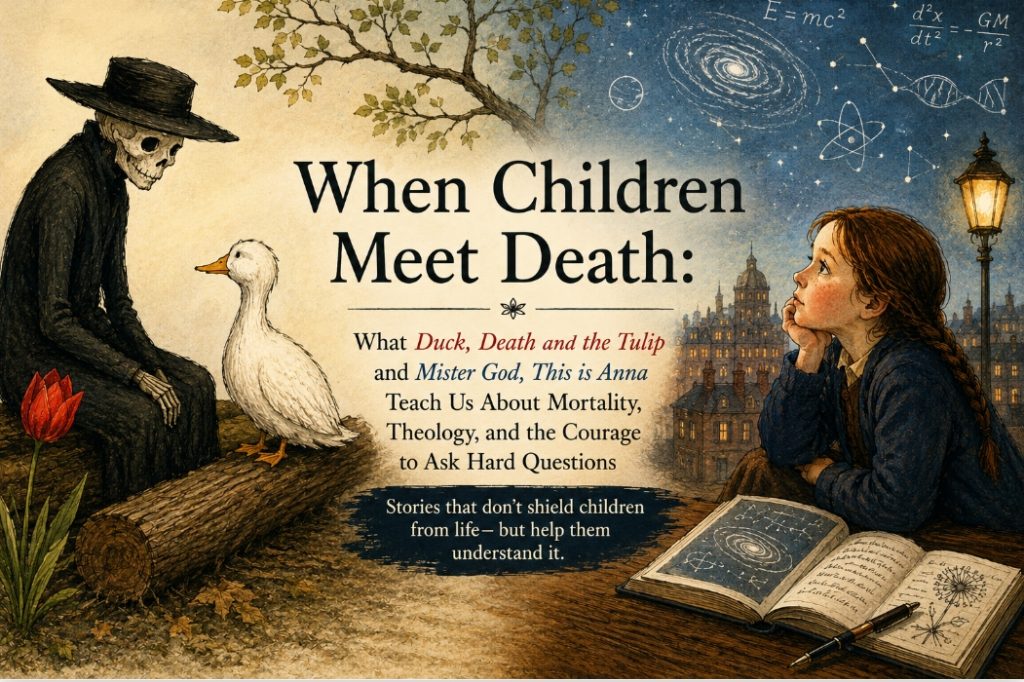
What if children’s literature does not need to protect children from death? What if, instead, it can teach them how to look at mortality without fear?
For centuries, adults have been telling children stories about death.
Sometimes death arrives disguised as a moral lesson. Sometimes it appears as punishment. Sometimes it is the consequence of disobedience, a warning whispered between the lines of a story. And sometimes, as in the old New England Primer, death is presented with almost startling directness:
“From death’s arrest no age is free
Young children too must die.”
These lines, from the New England Primer of 1834, belong to a very different tradition of children’s literature—one in which mortality was not necessarily hidden from the young reader. Death could be frightening, certainly, but it could also be pedagogical. The child was expected to contemplate mortality, sin, salvation and the possibility of an afterlife.
Modern children’s literature often takes the opposite route.
Death may still haunt stories about children, but it is frequently displaced: an orphan appears after a parent has already died; a missing family member is part of the backstory; loss motivates the protagonist. The actual physical event of dying is often kept at a safe narrative distance.
Why?
Perhaps because adults are less comfortable with death than children are.
This is the paradox at the heart of children’s literature about mortality: we write the stories for children, but it is often the adult who is afraid of what the child might ask.
Two remarkable books—Wolf Erlbruch’s Duck, Death and the Tulip and Fynn’s Mister God, This Is Anna—challenge that protective impulse. They do not offer children a neat theology of death. Nor do they pretend that mortality can be made painless through a comforting moral.
Instead, they do something much more interesting.
They allow children to ask difficult questions.
And sometimes, they allow the questions to remain unanswered.
The problem with making death a lesson
Historically, children’s literature has often been burdened by a strong didactic impulse. Stories were expected to teach children how to behave, what to believe and, crucially, what to fear.
Death therefore became morally useful.
The dead child, the suffering child, the orphan and the dying parent could become instruments through which adults communicated lessons about obedience, faith, virtue and salvation. Mortality was rarely allowed simply to exist as an existential fact. It had to mean something.
That is where the nineteenth-century child differs sharply from the contemporary literary child.
The earlier child is frequently positioned before death as a moral subject:
You will die. Therefore, learn how to live correctly.
Contemporary children’s literature can ask a different question:
You will die. So what does it mean to be alive?
That shift may appear subtle, but philosophically it is enormous.
It moves death away from punishment and toward presence.
Death walks into the story
Wolf Erlbruch’s Duck, Death and the Tulip begins with one of the most deceptively simple encounters in contemporary picture-book literature.
Duck discovers Death.
There is no thunderclap. No sinister castle. No skeletal monster emerging from the shadows.
Death is simply there.
And, strangely enough, Death is rather pleasant.
The premise is unsettling precisely because Erlbruch refuses the conventional visual and narrative vocabulary associated with death. Death is not necessarily evil. He is not even particularly threatening. He has been accompanying Duck throughout her life.
That revelation quietly dismantles one of humanity’s oldest fantasies: that death is something external to life.
We tend to imagine death as an interruption.
Erlbruch imagines it as a companion.
This is where Duck, Death and the Tulip becomes much more than a story about a duck encountering mortality. It becomes a meditation on what it means to know that we are mortal.
Duck asks questions.
Where will she go?
What happens afterward?
Is there an afterlife?
Death does not provide a grand theological system. There is no final doctrine handed down to the reader. The questions remain wonderfully unresolved.
And that unresolved quality is precisely the book’s strength.
Children are not always in need of answers.
Sometimes they need permission to ask the question.
The storytelling genius of Duck, Death and the Tulip
Erlbruch’s greatest achievement is perhaps narrative restraint.
He could have turned Death into a terrifying antagonist. Instead, he turns Death into a character with whom Duck can talk.
The relationship between Duck and Death gradually becomes almost ordinary. They spend time together. They climb a tree. They observe the world.
The extraordinary becomes mundane.
And that is exactly how the book begins to transform the reader’s relationship with mortality.
Death is no longer an abstract philosophical monster.
Death is sitting beside Duck.
The simplicity of the storytelling is crucial. The book does not bury its philosophy beneath complicated language. It allows philosophical questions to emerge through conversation, silence, companionship and images.
This is where children’s literature can achieve something that philosophical treatises sometimes cannot.
It can embody an idea rather than merely explain it.
The child does not have to understand a theory of mortality. The child experiences a story in which mortality has a face, a voice and a relationship with another character.
That is storytelling as philosophy.
From death to God: Anna’s questions
If Erlbruch asks children to encounter death, Mister God, This Is Anna asks them to confront another immense human mystery: God.
Fynn’s novel presents Anna, a young girl found in London’s East End before the Second World War, whose curiosity refuses the boundaries established by conventional adult knowledge.
Anna does not merely ask questions about God.
She interrogates the assumptions behind the questions.
Her curiosity extends into mathematics, physics, biology and theology, creating a peculiar but fascinating intellectual world in which scientific and religious inquiry are not necessarily enemies.
Anna’s questions destabilize adults because she does not accept the easy answers offered to her.
She is not satisfied with the idea of God as a comfortable, predictable figure.
When Anna says, “Mister God doesn’t love us,” the statement does not simply reject faith. It forces the adult listener to reconsider what “love” and “God” actually mean.
This is the fascinating reversal at work in the novel.
The adult believes he is educating the child.
The child ends up educating the adult.
The child as philosopher
Children’s literature has often constructed childhood as a condition of incompleteness.
The child does not know.
The adult knows.
The story therefore becomes a pedagogical machine through which knowledge travels from adult to child.
Anna disrupts this model.
She becomes what might be called an instinctive theologian—a child whose questions are philosophical not because she has been trained in philosophy, but because she has not yet learned to stop questioning.
Her curiosity becomes a form of resistance.
She refuses the intellectual shortcuts adults have normalized.
This recalls the larger argument about the complexity of children’s literature made by scholars such as Seth Lerer, particularly in his discussions of the surprising intellectual depth of texts conventionally categorized as children’s literature. The child reader, like the child character, is frequently capable of receiving far more philosophical complexity than adults assume.
The mistake is not that children cannot understand difficult questions.
The mistake may be that adults are afraid to ask those questions with them.
What death and God have in common
At first glance, Duck, Death and the Tulip and Mister God, This Is Anna appear to have little in common.
One is a minimalist picture book.
The other is a philosophical novel built around a child’s relationship with God.
Yet both are fundamentally concerned with the same problem:
What happens when human beings confront what they cannot completely know?
Death cannot be completely explained.
Neither can God.
Both provoke anxiety because they expose the limits of human knowledge.
And both books place a child at the centre of that uncertainty.
This is important because children’s literature has traditionally been expected to provide certainty. A story should resolve the conflict. The good should be rewarded. The bad should be punished. The frightening should become safe.
But what if some questions should remain frightening?
What if uncertainty itself can be educational?
Both Erlbruch and Fynn seem to suggest that intellectual and emotional maturity does not necessarily mean possessing answers.
It may mean learning to live with questions.
From fear to companionship
Rainer Maria Rilke famously contemplated mortality as something that could intensify our awareness of life. The idea is paradoxical but powerful: death does not merely terminate existence; our knowledge of death can make existence more vivid.
That insight resonates deeply with Duck, Death and the Tulip.
Death becomes Duck’s companion precisely because Duck is alive.
The tulip matters because it blooms temporarily.
The tree matters because Duck can climb it only now.
The ordinary world becomes precious because it is finite.
This is perhaps the most radical thing the book offers young readers.
It does not say:
Do not be afraid of death.
Instead, it quietly suggests:
Because life ends, life matters.
That is a very different proposition.
Why children’s literature needs difficult stories
There is an understandable desire to make childhood safe.
But psychological safety and intellectual protection are not always the same thing.
Shielding children from every difficult reality can leave them without the language to process those realities when they inevitably encounter them.
Death is one such reality.
Grief is another.
So are religious doubt, uncertainty, loss and the possibility that adults do not possess all the answers.
Literature can provide a rehearsal space for these experiences.
A child may encounter death first through a picture book before encountering it in the world.
That does not make the book morbid.
It may make the book humane.
Stories give shape to experiences that otherwise remain shapeless. They provide characters, metaphors, conversations and images through which children can begin to articulate emotions that adults themselves frequently struggle to express.
This is why Duck, Death and the Tulip is so powerful.
It does not cure the fear of death.
It gives that fear a language.
And Mister God, This Is Anna does something similar with theological uncertainty.
It gives doubt a voice.
The adult reader is being confronted too
Perhaps the most intriguing aspect of these books is that they are not only for children.
In fact, they may reveal more about adult anxiety than childhood anxiety.
Adults often assume that children need simplified answers.
But perhaps the child’s questions make us uncomfortable because they expose the fragility of our own answers.
Why do we die?
What happens afterward?
Does God love us?
What does love mean?
Can morality exist without absolute certainty?
These are not childish questions.
They are human questions.
Children’s literature simply gives us the courage—or perhaps the audacity—to ask them again.
Storytelling as a way of surviving uncertainty
The deepest achievement of these texts lies in their refusal to turn mortality into a moral cliché.
Death does not necessarily arrive because someone has been wicked.
God does not necessarily become comprehensible because someone believes.
There is no easy philosophical closure.
Instead, there is conversation.
There is companionship.
There is curiosity.
There is the tulip.
There is the tree.
There is a child asking another impossible question.
And perhaps this is what children’s literature can do at its best: not protect us from the most difficult realities of existence, but accompany us toward them.
The old New England Primer told children that death was unavoidable and urged them to prepare for it.
Erlbruch tells Duck something more subtle: death has always been walking beside you.
Fynn’s Anna tells adults something even more unsettling: you may not understand God simply because you are an adult.
Between these books lies a transformation in the philosophy of childhood.
The child is no longer merely the recipient of adult wisdom.
The child becomes the questioner.
And perhaps that is where children’s literature becomes most alive—not when it gives children answers, but when it trusts them with the questions.
Because mortality is not the opposite of life.
It is the condition that makes our awareness of life so urgent.
And sometimes the first step toward confronting what debilitates the psyche is simply learning to look at it without looking away.
Chandra, S. 2026
References
Carr, Robin L. “Death As Presented in Children’s Books.” Elementary English, vol. 50, no. 5, 1973, pp. 701–05. JSTOR, http://www.jstor.org/stable/41388049. Accessed 28 Oct. 2024.
de Saint-Exupery, Antoine. The Little Prince. Translated by Irene Testot-Ferry, Wordsworth Editions, 2018.
Elbruch W., Duck, Death and the Tulip, Gecko Press, 2007.
Fynn. Anna and Mister God. London: HarperCollins Publishers, 2004.
Swenson, Evelyn J. “The Treatment of Death In Children’s Literature.” Elementary English, vol. 49, no. 3, 1972, pp. 401–04. JSTOR, http://www.jstor.org/stable/41387117.
The New England Primer , (Hartford, Conn., 1834), n.d.


