


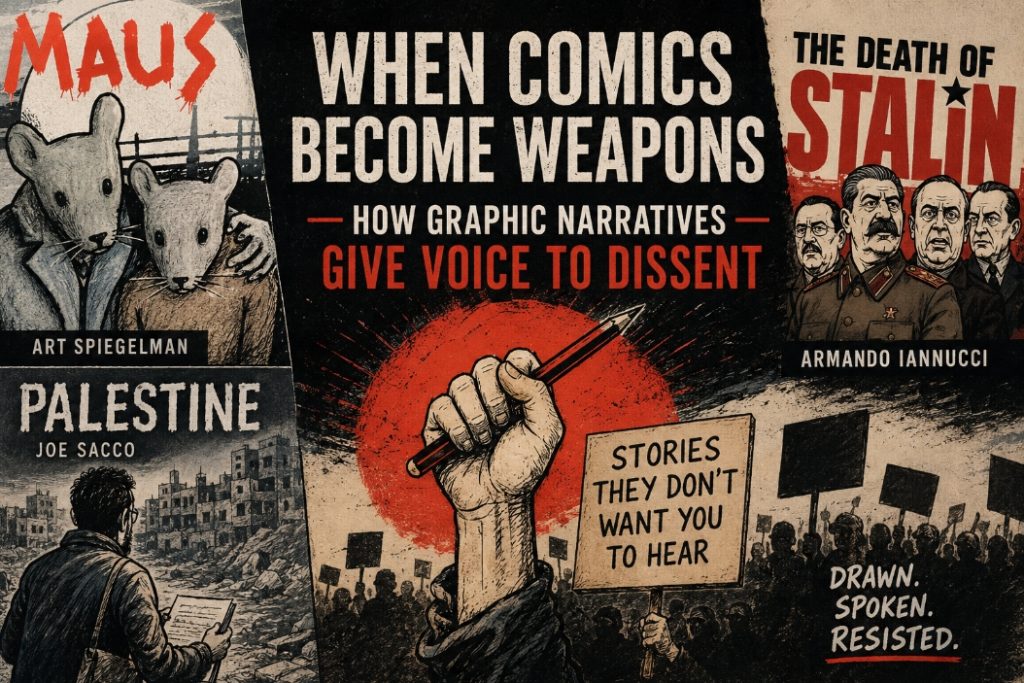
History is often written by those who hold power. But what happens when those pushed to the margins decide to tell their own stories—not through speeches or textbooks, but through comics? At first glance, Graphic Narratives or novels may appear to belong to the realm of entertainment. They are filled with illustrations, speech bubbles, and sequential art that many associate with superheroes or childhood adventures. Yet beneath those deceptively simple pages lies one of the most powerful storytelling mediums ever created. Graphic narratives have become spaces where suppressed voices emerge, uncomfortable truths surface, and history is challenged rather than accepted.
More than merely illustrating events, these works invite readers to experience dissent from the inside.
Dissent Is More Than Resistance
The word dissent is often reduced to disagreement or protest. In reality, it is much more profound. Dissent begins where systems of power silence voices, erase identities, or dictate a single version of truth. It thrives in the gaps left behind by official histories.
Every society builds narratives about itself—stories of heroes, victories, and national identity. Yet every grand narrative also creates shadows where countless untold stories remain hidden. It is within these forgotten spaces that dissent finds its language.
Graphic narratives possess a remarkable ability to illuminate these hidden corners because they communicate through both images and words simultaneously. They allow emotion, memory, silence, and contradiction to coexist on the same page.
Maus: A Story That Refuses Simple Answers
Few graphic novels demonstrate this better than Maus.
Rather than presenting the Holocaust as a neatly organized historical account, Art Spiegelman transforms it into an intimate conversation between generations. The story follows his attempts to understand his father, Vladek, a Holocaust survivor, while simultaneously wrestling with his own role as the storyteller.
The brilliance of Maus lies in its refusal to offer certainty.
The famous visual metaphor—Jews depicted as mice and Germans as cats—initially appears straightforward. Yet the narrative quickly dismantles any simplistic division between victim and oppressor. Memories contradict historical records. Family relationships become strained. Trauma refuses to fit into clean narratives.
Even Spiegelman himself questions his authority to tell the story. His uncertainty becomes part of the narrative, reminding readers that history is never merely about facts—it is also about memory, interpretation, and emotional inheritance.
Instead of providing definitive answers, Maus asks a far more unsettling question:
Can any single story ever capture the truth of historical trauma?
Joe Sacco and Journalism Without Distance
If Maus explores inherited memory, Palestine takes readers directly into the landscape of ongoing conflict.
Unlike traditional journalists who strive for invisibility, Joe Sacco deliberately places himself inside his reporting. His illustrated self appears throughout the narrative—observing, questioning, listening, and sometimes simply witnessing.
This choice changes everything.
Rather than pretending to be an objective observer, Sacco openly acknowledges that every act of reporting carries perspective. His presence becomes a bridge between readers and the people whose lives rarely receive sustained attention in mainstream media.
The result is journalism that feels intensely human.
The crowded refugee camps, ordinary conversations, moments of fear, and flashes of resilience all challenge the polished narratives often presented through headlines and television broadcasts. Sacco reveals that behind every geopolitical conflict are individuals struggling to preserve their dignity.
His work reminds us that dissent often survives not in official statements but in personal testimonies.
When Laughter Exposes Tyranny
Perhaps the most surprising form of dissent comes through comedy.
At first, humor seems entirely out of place when discussing dictatorships, political violence, or mass suffering. Yet satire has long been one of history’s sharpest political weapons.
This becomes brilliantly evident in The Death of Stalin.
Director Armando Iannucci transforms one of history’s darkest political moments into an absurd spectacle of paranoia, manipulation, and self-preservation. Government officials stumble over one another, terrified of making even the smallest mistake under Stalin’s regime.
The comedy is uncomfortable—and intentionally so.
Every awkward silence, exaggerated expression, and perfectly timed joke reveals something terrifying beneath the laughter: authoritarian systems often survive because fear becomes ordinary.
By laughing at power, the film strips away its illusion of invincibility.
Why Graphic Narratives Matter More Than Ever
In an age of endless news feeds and shrinking attention spans, graphic narratives accomplish something increasingly rare.
They slow us down.
They force readers to linger over facial expressions, empty spaces between panels, fragmented memories, and visual metaphors that cannot be conveyed through text alone.
Unlike conventional history books that often present events as settled facts, graphic narratives embrace uncertainty. They acknowledge that memory is incomplete, trauma is fragmented, and truth frequently emerges through competing voices rather than singular conclusions.
Whether it is Spiegelman’s deeply personal exploration of Holocaust memory, Joe Sacco’s immersive documentation of Palestinian lives, or Armando Iannucci’s satirical dismantling of Soviet authoritarianism, each work demonstrates that dissent is not merely an act of opposition.
It is an act of storytelling.
The Final Panel
Graphic narratives remind us that history is never static. It is constantly rewritten by those willing to question accepted truths and recover forgotten voices.
Every illustration, every dialogue box, and every silent panel becomes an invitation to look beyond official narratives and confront the complexities that lie beneath.
Perhaps that is the greatest power of comics.
They do not simply tell stories about dissent.
They become dissent themselves.
Chandra, S. 2026
References
Cutler, Robert M. “Soviet Dissent Under Khrushchev: An Analytical Study.” Comparative Politics, vol. 13, no. 1, 1980, pp. 15–35. JSTOR, https://doi.org/10.2307/421761. Accessed 4 May 2024.
McCloud, Scott, 1960-. Understanding Comics: the Invisible Art. New York: Harper Perennial, 1994.
Rotenstreich, Nathan. “On Lévi-Strauss’ Concept of Structure.” The Review of Metaphysics, vol. 25, no. 3, 1972, pp. 489–526. JSTOR, http://www.jstor.org/stable/20126058. Accessed 2 May 2024.
Sacco, Joe. Palestine. Jonathan Cape, 2003.
Spiegelman, Art. 1994. “Little Orphan Annie’s Eyeballs.” The Nation


