


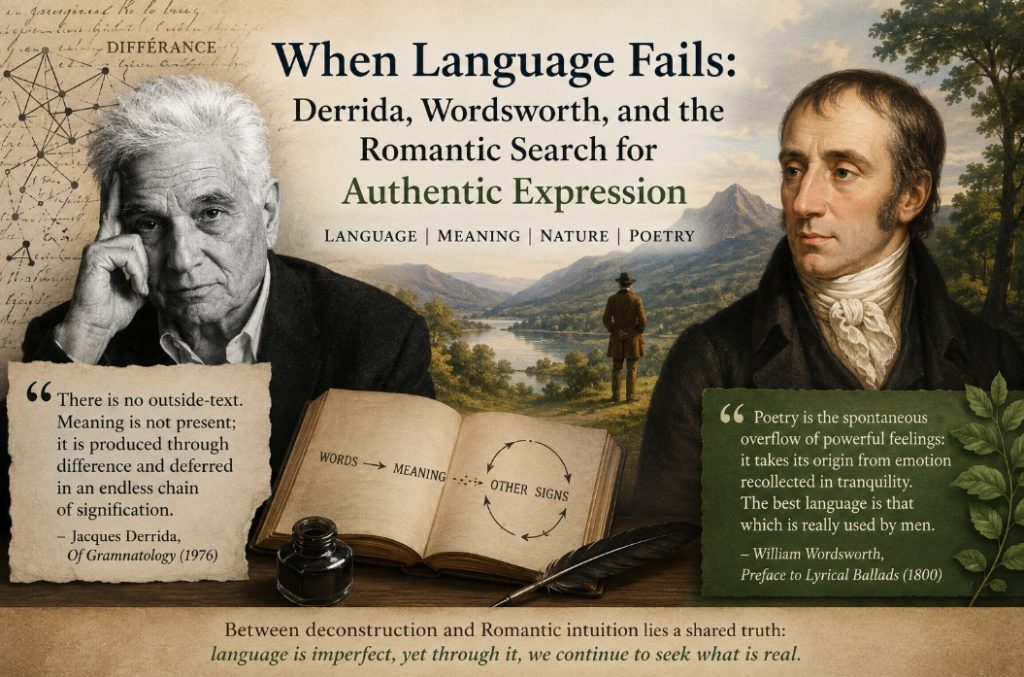
Can language ever truly capture what we feel?
It is a question that has fascinated philosophers, literary critics, and poets for centuries. While we often assume that words simply convey meaning, thinkers like Jacques Derrida challenged this assumption by arguing that language is far more unstable than we imagine. Interestingly, long before Derrida’s theories of deconstruction, the Romantic poets had already sensed this instability. Their poetry can be read as an artistic response to the limitations of language itself.
Derrida and the Endless Journey of Meaning
In Of Grammatology (1976), Jacques Derrida revolutionized literary theory by questioning the belief that words possess fixed meanings. According to him, language functions through différance—a concept suggesting that meaning is constantly produced through difference and endlessly deferred.
A word does not contain meaning within itself. Instead, it points toward other words, other concepts, and other signs. Meaning is therefore never fully present; it exists only through an ongoing network of relationships. Every sign carries traces of other signs, making interpretation an infinite process rather than the discovery of a final truth.
For Derrida, what we commonly call “literal meaning” is not an objective reality but a useful illusion. As he famously suggests, literal meaning is a fiction—a comforting belief that language can present ideas directly and completely. In reality, every act of reading opens new possibilities of interpretation, preventing any text from possessing a single, unified meaning.
Romanticism’s Awareness of Linguistic Limits
Although Derrida articulated these ideas in the twentieth century, Romantic writers had already recognized that ordinary language often fails to express the depth of human experience.
The Romantics were deeply concerned with emotions, imagination, intuition, and spiritual insight—experiences that frequently resist straightforward description. They understood that conventional language, bound by rigid syntax and established meanings, could not adequately communicate moments of profound emotional or visionary intensity.
Rather than accepting these limitations, Romantic poets transformed language itself. Through symbolism, metaphor, musical rhythm, and imaginative imagery, they stretched words beyond their ordinary functions. Poetry became not merely a medium of communication but an attempt to make the invisible visible and the ineffable speakable.
Wordsworth’s Rebellion Against Artificial Language
Among the Romantic poets, William Wordsworth offered one of the most influential critiques of literary language. In the Preface to Lyrical Ballads, he rejected what he called the “capricious and arbitrary habits of expression” that had dominated eighteenth-century poetry.
Wordsworth believed that elaborate poetic diction had distanced poetry from genuine human experience. Instead of relying on ornamented language, he argued that poetry should arise from “the spontaneous overflow of powerful feelings.” Emotion, not rhetorical display, should be the foundation of poetic expression.
This did not mean abandoning artistic craft. Rather, Wordsworth sought a language rooted in authenticity—a language capable of conveying sincere emotional experience without being distorted by artificial literary conventions.
The Language of Ordinary Life
Wordsworth’s solution was both aesthetic and social. He turned to the language of ordinary people, especially those living in humble rural communities.
He believed that individuals living close to nature spoke more directly because their lives were less shaped by social pretension and intellectual affectation. Their language reflected genuine feeling, while their daily relationship with the natural world preserved emotional honesty.
Nature itself became a corrective to linguistic corruption. Since human passions were intertwined with “the beautiful and permanent forms of nature,” Wordsworth believed that authentic speech could recover something essential that polished literary language had lost.
In this vision, language becomes meaningful not because it escapes arbitrariness altogether, but because it remains closely connected to lived experience.
Derrida and Wordsworth: A Productive Contrast
At first glance, Derrida and Wordsworth seem to stand on opposite sides of literary history.
Derrida insists that language can never fully secure meaning because every sign depends upon an endless chain of differences. Wordsworth, meanwhile, appears to search for a form of expression capable of restoring authenticity through emotion and simplicity.
Yet both begin with a shared recognition: language is problematic.
Where Derrida exposes the impossibility of stable meaning, Wordsworth attempts to overcome linguistic instability through emotional sincerity and a renewed intimacy with nature. One deconstructs the foundations of language; the other reconstructs poetry as an alternative mode of expression.
This contrast reveals a fascinating continuity between Romanticism and modern literary theory. The questions that Derrida raises about meaning had already haunted Romantic poets, even if their answers differed dramatically.
Why This Conversation Still Matters
Today, in an age dominated by social media, digital communication, and artificial intelligence, questions about language remain remarkably relevant. We continue to ask whether words truly express what we think, whether communication can ever be fully transparent, and whether meaning belongs to the speaker, the text, or the reader.
Derrida reminds us that meaning is always open to reinterpretation. Wordsworth reminds us that language gains its greatest power when it remains connected to authentic human experience.
Together, they invite us to see language not as a flawless instrument but as a dynamic, evolving space where meaning is constantly negotiated. Poetry, philosophy, and criticism all emerge from this productive tension—between what language can say and what always remains just beyond its reach.
Perhaps that is precisely what makes literature enduringly powerful. It does not eliminate ambiguity; it transforms ambiguity into art.
Chandra, S. 2026
References
Curran, Stuart. The Cambridge Companion to British Romanticism. Cambridge University Press, 1993.
R, Richard. “Derrida on Language, Being, and Abnormal Philosophy.” The Journal of Philosophy, vol. 74, no. 11, Journal of Philosophy, Inc., 1977, pp. 673–81, https://doi.org/10.2307/2025769’
Wordsworth, William, and W J. B. Owen. Wordsworth’s Preface to Lyrical Ballads. Westport, Conn: Greenwood Press, 1979. Print.


