


The National Eligibility cum Entrance Test (Undergraduate) or NEET-UG, is the doorway to studying medicine in India. Over 2.28 million students wrote this exam on 3 May 2026. But the exam was cancelled due to an allegation of a paper leak within days. Importantly, NEET has its own legacy of paper leak.
Chronology of NEET Paper Leak
2015: AIPMT (All India Pre-Medical Test) – Predecessor to NEET
A major paper leak involving a cheating racket using Bluetooth devices and leaked answer keys. The Supreme Court finally cancelled the exam and ordered a re-test.
2016: NEET Phase II
Allegations of inter-state paper leaks surfaced, leading to investigations, but no nationwide cancellation.
NEET 2021
Involvement of invigilator “solver gangs” in some centres. People were arrested locally. But no re-test was ordered.
NEET 2024
It surfaced as a major national scandal due to serious allegations of paper leak in Bihar and Jharkhand. Papers were reportedly photographed after breaking seals and gangs allegedly charged ₹30–50 lakh per candidate.
2026: Full Cancellation
over 22lakh students have been affected
Common Methods
Insider access at printing presses/storage, breaking seals, photographing papers, digital circulation via encrypted apps, “solver gangs”, and high-priced “guess papers”.
Currently, the fully centralised NEET exam is held at a massive scale, as over 2.2 million candidates compete for over 60,000 MBBS seats. The nexus between thriving education mafia, coaching centres and insiders (supply chain of NTA) create a complete ecosystem of paper leak. It is important to note that leak often starts with insiders, including paper setters, moderators, center superintendents, contractors who photograph or memorize questions.
NTA (National Testing Agency) –an agency without accountability
NTA handles several high-stakes exams with limited permanent staff, leading to heavy reliance on outsourced staff, and fragmented oversight. It was originally meant for more digital processes but struggles with pen-paper scale.
While NTA deploys full security measures, including GPS tracking, digital locks, jammers, CCTV and biometrics, gaps in implementation often result in security breach.
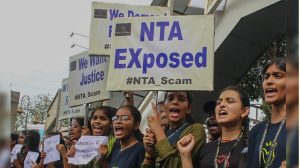

NDTV, 2026
Broader systemic issues
The central government has overly relied on centralisation of exams. But centralisation has its own risk, as even a single point of failure can affect the fate of millions of students. The central government is obsessed with centralisation of examination, overreaching to the domain of state governments. Southern states, including Tamil Nadu, have longstanding opposition to NEET, as they demand for decentralisation of the exam so that students from rural areas, government schools and poor socio-economic backgrounds can successfully compete in the NEET exam. However, the nexus between policy makers and private medical colleges favour full scale centralisation, without fuller accountability and deterrence. Therefore, similar systemic failure may happen again. The real victims of this systemic failure are honest aspirants who lose time, mental health, motivation and money. The government must focus on decentralisation such as high-stake exams and fixing responsibility and accountability.
References
BBC, 2026. Protests in India after medical entrance test scrapped over leak claims [online] https://www.bbc.com/news/articles/cwy2gd508n9o
Forbes India, 2026. From Vyapam to NEET: India’s exam leak crises [online] https://www.forbesindia.com/article/news/from-vyapam-to-neet-indias-exam-leak-crises/2993894/1
The Wire, 2026. Tamil Nadu Chief Minister Vijay Urges Union Govt to Cancel NEET, Allow Admissions Based on 12th Marks [online] https://thewire.in/education/tamil-nadu-chief-minister-vijay-urges-union-govt-to-cancel-neet-allow-admissions-based-on-12th-marks
NDTV, 2026. Opinion | NEET Paper Leak: When Incompetence Becomes The System [online] https://www.ndtv.com/opinion/neet-chaos-when-incompetence-becomes-the-system-11483943


