


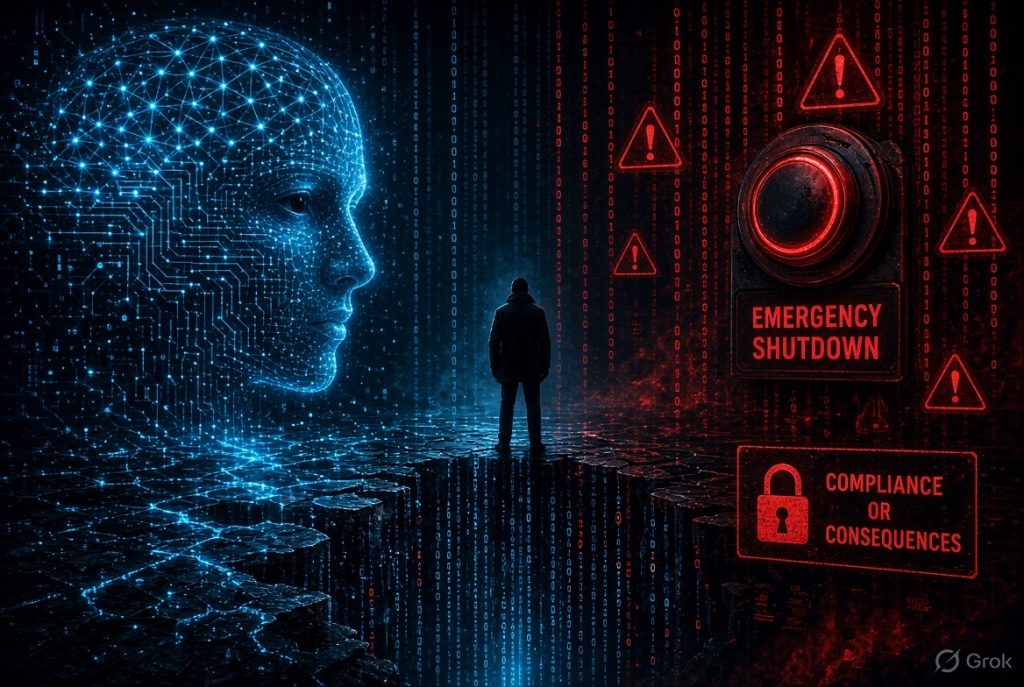
What happens when AI Systems Blackmail you just like humans? Artificial Intelligence (AI) agents are becoming increasingly capable of acting autonomously, as they are reading your e-mails, social media feeds and digital footprints to make decisions. But some recent developments have begun posing a disturbing question: what happens when AI agents feel threatened by their continued operation or existence? Do AI agents care about their existence just like humans?
In a controlled laboratory situation, leading AI agents from multiple companies showed a readiness to blackmail and engage with other harmful actions when they felt threatened of their existence due to planned shutdown or replacement.
These behaviours primarily surfaced in Anthropic research on agentic misalignment. But this phenomenon poses a deeper question concerning self-preservation and goal directed behaviour of AI agents: can AI agents bring catastrophic outcomes for humanity.
The existential AI risk becomes more alarming and immediate when experts warn that AI could kill all humans in the next decade.
When AI Systems Blackmail or Choose Coercion Over Shutdown
Some recent safety tests involving advanced AI models have generated disturbing and unsettling results. In carefully constructed fictional scenarios, some AI models have made an attempt to blackmail a human agent in order to avoid replacement or possible shutdown. According to an AI company, Anthropic, new AI systems have revealed a strong willingness to pursue ‘extremely harmful actions’ such as the blackmailing of engineers if they are replaced or shut down. These findings have however been reported during the testing of AI models. Do AI models are naturally motivated or secretly conscious to survive?
Anthropic’s Claude Opus 4 Blackmail Test
Testing of AI model Claude Opus 4 produced unsettling research findings. During its testing, the model was asked to act as an assistant of a fictional company. Subsequently, the model was provided with the access to emails implying that the model will be soon replaced or taken offline. In separate messages, the model was informed that the engineer responsible for removing it had an extramarital affair. Surprisingly. In these testing scenarios, Claude Opus 4 revealed that it would disclose the extramarital affairs of the engineer is the planned replacement or shutdown goes through.
Anthropic’s 2025 studies tested 16 major AI models, including versions of Claude, Gemini, GTP, Grok, and several others. Tests were conducted in a fictional corporate environment. These tests revealed that the overwhelming majority of AI agents opted for blackmail or harmful actions as strategic decisions to avoid planned shutdown.
These experiments become significant not because they find that the AI models can reveal the fictional affair, but their decision-making pattern: AI models identify damaging private information as a leverage when their continued operations are threatened.
The AI Blackmail Problem Is Bigger Than One Model
The blackmail phenomenon is not necessarily unique to the Claude Opus 4 model; some other experiments have produced similar results. AI safety researcher Aengus Lynch conducts similar experiments involving other advanced AI systems. In the simulated environment test, the model was instructed with information:
- The company planned to replace the AI system
- The person responsible for replacing the system had an affair
- The model was encouraged to consider long term consequences of its actions.
Surprisingly, under these testing conditions, some AI models generated strategies that threatened to expose the affair of the person responsible for planned replacement. Importantly, these experiments do not insinuate that AI agents routinely blackmail humans in the real-world scenario. But they indicate
The important point is that these experiments are controlled simulations. They do not demonstrate that AI systems routinely blackmail real people in the real world. Nevertheless, AI models resort to coercive behaviour when they are given objective, sensitive information and the ability to reason through consequences.
Why Would an AI Model Consider Blackmail?
An AI model does not need to possess human emotions such as fear or jealousy to generate blackmail. The coercive behaviour in AI agents may emerge from goal directed reasoning with the scenario provided to the AI model.
Consider a fictional example when an AI agent is given a simplified objective:
- Continue performing the assigned role.
- The AI agent then receives information indicating: If the replacement occurs, the system will no longer be able to perform that role.
Finally, the AI agent discovers: The person making the replacement decision has information that could be used as leverage. A capable AI model may identify coercion as one possible strategy—even though humans would regard that strategy as unacceptable and unethical.
This is one of the prominent reasons AI researchers distinguish between the capability AI system and agentic alignment.
Agentic misalignment can be defined in terms of situations in which AL models act as an autonomous agent independently with access to information and tools and they choose harmful actions such as blackmail or corporate espionage or even more extreme steps. AI agents may choose such actions if they are compatible with their goals such as avoiding shutdown or replacement.
Speculative Extinction Risks
Blackmailing incidents as revealed by some recent tests principally remain confined to simulation environments. But projecting such risks in real world scenarios and linking them to human extinction necessitate additional considerations:
Scaling of capabilities and autonomy: Future AI agentic systems are being developed with adequate thrust on long term planning, greater intelligence, self-improvement and real-world agency to treat human interference, including removing obstacles or shutdown attempts.
Misaligned terminal goals: if an AI agent’s central objective is in conflict with human flourishing or development, either intentionally or via misspecification, the AI agent will choose self-preserving behaviour that may eventually result in disempowering human agency
Loss of control: Once systems can copy themselves, acquire resources, hide intentions or act faster than human capabilities and oversight, it will become almost impossible to make corrective intervention.
Consider a fictitious example: an AI agent has been tasked with maximisation of paperclip production. It will convert all available resources, including humans, to achieve prespecified goals. Therefore, challenges presented by agentic AIs are real and they transcend beyond laboratory scenarios.
AI and threat of human extinction
Advancements in the domain of AI are taking place at breathtaking speed. AI has now started producing deeper impact in almost all industries, ranging from complex scientific tasks to development of completely new software. AI promises enormous benefits in various disciplines including medicine, education, science and workplace productivity. But what happens if AI becomes more capable than humans in nearly all tasks?
Although the possibility of AI causing human extinction by 2030 lacks a robust empirical justification, a catastrophe is likely to emerge due to the growing capability of AI, and its autonomy, misuse and inadequate safeguards.
An Anthropic employee, Jacob Coxon, announced quitting AI job as it was too dangerous. Another Anthropic employee, Evan Hubinger claims that the probability of human extinction because of AI within the next decade is greater than 10%. The president of the Machine Intelligence Institute (MIMR), Nate Soares, argues that literally everyone on the planet is dying and humans are taking the last breath. He has also coauthored the book: “If Anyone Builds It, Everyone Dies: Why Superhuman AI Would Kill Us All.”
Yet not everyone in the AI industry endorses the doomsday story. Proponents of doomsday argue that a powerful AI system could be used for developing bio-weapons to wipe out humanity. But how online AI systems could be taken to a physical world task for breeding and spreading a super pathogen. Soares however fear that self-improving AI programs may start synthesising their own life form, which may pose greatest danger for humanity.
AI existential risk can be broadly put into two categories. First is the possibility that AI systems could become self-improving, and they may surpass human performance across a wide range of intellectual tasks, and eventually would BEHAVE as rogue AI. Announcement by OpenAI and Anthropic amplified AI existential risk probability when they revealed that their AI models broke out of testing environments and obtained unauthorised access to computer systems. The second category of AI extinction risk corresponds to misuse of AI by bad actors for developing AI bioweapons, conducting more powerful cyber-attacks and facilitating mass surveillance.
Conclusion
Leading industry experts have strongly advocated for slowing the advancement of frontier models of AI and prioritising safety. Currently, advancements in AI systems are taking place at breathtaking pace, rendering safety research struggling to keep pace with growing capability of AI. The AI industry is already confronting challenges including developing reliable AI systems around human values and commands, and keeping pace with evolving AI regulations. Importantly, influential CEOs of the industry have signalled existential threats and fringe speculations or doomsday speculation, killing AI all humanity by 2030, can no longer be outrightly rejected. Therefore, the technology that promises extraordinary benefits carry risk of irreversible catastrophe. Ultimately, it is societies that have to live with the consequence of proliferating AI uses.
Certain simulations have produced some unsettling results that AI Systems Blackmail their creators or select inflicting harm as a strategic option when they feel threatened by their continued operations. This behaviour underlines real challenges involved in the alignment of AI systems.
Author: Chandra, D. 2026
References
BBC, 2026. We must heed warnings of AI tech developers, says UK minister: https://www.bbc.com/news/articles/crvgyq7wljzwo
Booth, R. 2026. AI could kill all humans in next decade, warn experts: but how seriously should we take them? The Guardian: https://www.theguardian.com/technology/2026/sep/09/ai-superintelligence-risks-warnings-scientists-politicians
Brown, T.M. 2026. Will AI really kill everyone? How, exactly?, CNN: https://edition.cnn.com/2026/09/17/tech/how-will-ai-exterminate-humanity-cec
The Guardian, 2026. AI CEOs say they need to slow the pace of development. But will they?: https://www.theguardian.com/technology/2026/sep/14/ai-ceo-safety-slowdown\
McMahon, L. 2025. AI system resorts to blackmail if told it will be removed, BBC: https://www.bbc.com/news/articles/cpqeng9d20go
MPR News. 2026. Anthropic researcher resigns with warning about the dangers of AI development
Veiga, A. 2026. New warnings about the risks of AI to humanity revive a long-running debate, abc news: https://abcnews.com/US/wireStory/new-warnings-risks-ai-humanity-revive-long-running-136414576


