
The “New” in New Criticism: How a Literary Revolution Changed the Way We Read

Reading Beyond the Author
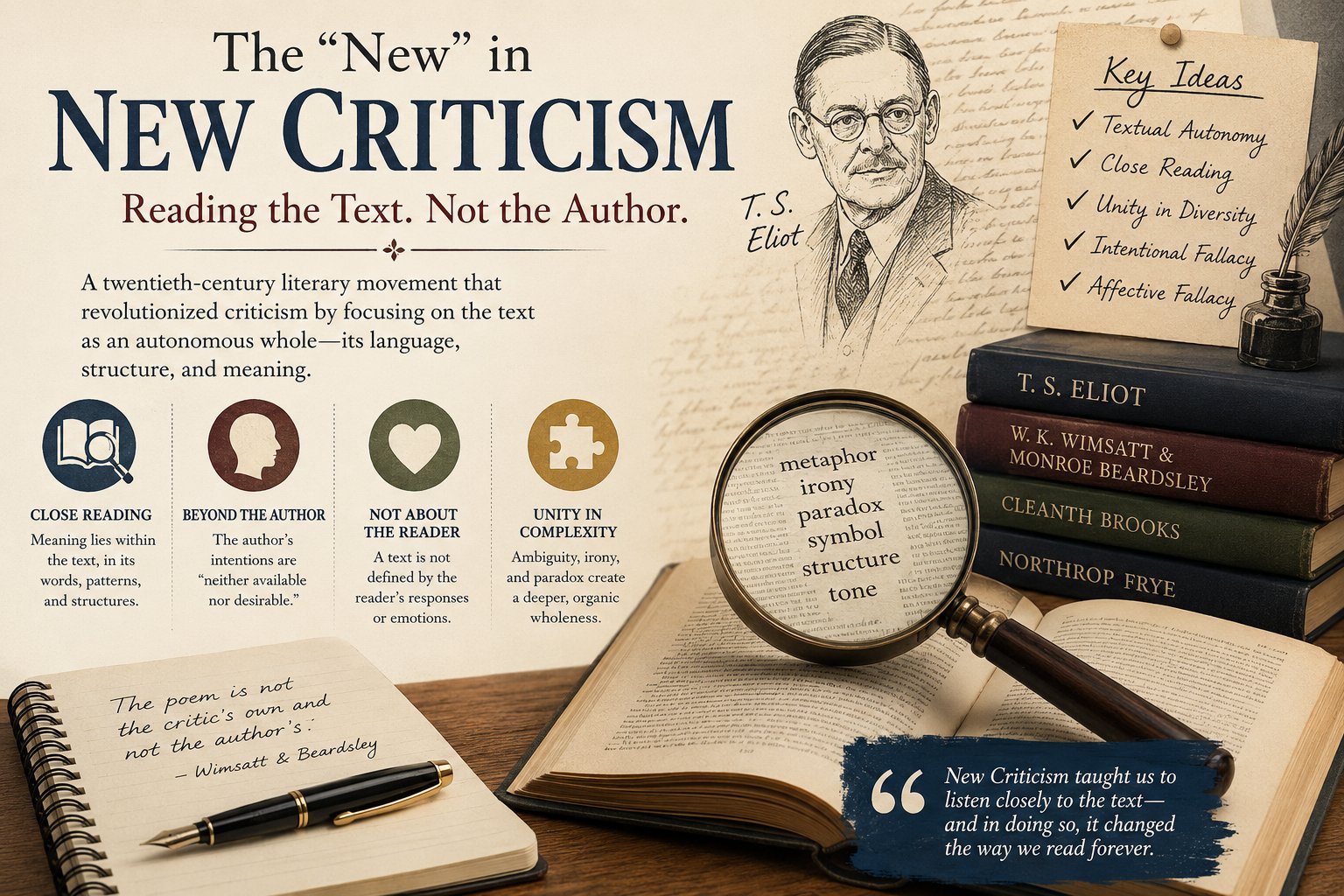
For much of the twentieth century, New Criticism dominated the landscape of literary studies, transforming the way literature was read, taught, and interpreted. At a time when literary criticism often relied on biography, historical context, and authorial intention, New Critics proposed something radical: the text itself should be the primary object of critical attention.
This shift was more than a methodological adjustment. It represented a fundamental rethinking of literature, positioning the literary work as a self-contained artistic object whose meaning resided within its language, structure, and form. In doing so, New Criticism not only revolutionized literary analysis but also laid the groundwork for many of the theoretical debates that would shape modern literary studies.
The Birth of a Critical Movement
The origins of New Criticism can be traced to the Fugitive poets at Vanderbilt University during the 1920s. Figures such as John Crowe Ransom, Allen Tate, Robert Penn Warren, and Donald Davidson sought to cultivate a distinctly modern Southern literary tradition. Their intellectual project was deeply influenced by the poetry and criticism of T. S. Eliot, whose ideas would become foundational to the movement.
In his influential essay Hamlet and His Problems (1919), Eliot introduced the concept of the objective correlative—the notion that emotions in literature are communicated through specific situations, objects, and events that evoke corresponding feelings in readers. More importantly, Eliot emphasized literature as a carefully structured system whose meaning emerged through its internal relationships rather than external references.
This focus on textual structure and linguistic precision would become a defining feature of New Critical thought.
The Text as an Autonomous Whole
Perhaps the most significant contribution of New Criticism was its insistence that literary works should be treated as autonomous entities. A poem, novel, or play was not merely a reflection of its author’s life, historical circumstances, or political beliefs. Instead, it existed as an independent verbal artifact deserving analysis on its own terms.
The movement gained remarkable influence from the 1930s through the 1970s through university curricula, literary journals, and widely used textbooks. During this period, the belief that literature was a self-contained artistic structure became a dominant critical assumption.
While New Critics differed in many respects, they shared a commitment to viewing literary texts as coherent and unified wholes whose meanings emerged through the intricate interplay of language.
Ambiguity, Irony, and the Pursuit of Unity
One of the apparent paradoxes of New Criticism lies in its simultaneous embrace of ambiguity and coherence.
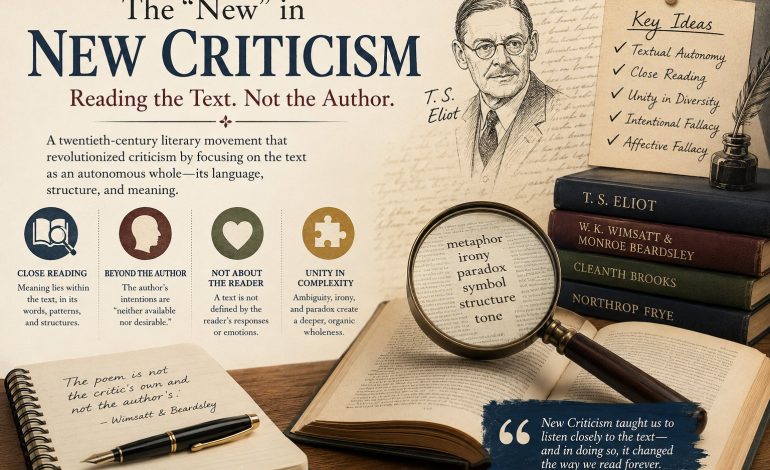
As literary scholar Jeffrey R. Di Leo observes, New Critics valued texts rich in ambiguity, irony, and metaphor. Yet they also believed that these complexities ultimately contributed to an organic unity within the work. Rather than viewing contradictions as flaws, they saw them as evidence of literary sophistication.
In this framework, literary devices such as irony, paradox, and metaphor were not decorative elements. They were essential mechanisms through which meaning was generated. Ambiguity did not undermine coherence; it enriched it.
This commitment to discovering unity within complexity became one of the movement’s most distinctive intellectual achievements.
Challenging the Author’s Authority
New Criticism mounted a powerful challenge against the long-standing belief that literature should be interpreted through the intentions of its creator.
In their landmark essay The Intentional Fallacy, W. K. Wimsatt and Monroe Beardsley argued that an author’s intentions are “neither available nor desirable” as standards for judging literary works. Once a text enters the world, it becomes independent of its creator.
Similarly, they criticized what they termed the affective fallacy—the practice of evaluating literature based on readers’ emotional reactions. For New Critics, meaning was not located in the author’s mind or the reader’s feelings. It existed within the text itself.
Their position was uncompromising: the poem belongs neither to the author nor the critic. It belongs to the language on the page.
The Art of Close Reading
The methodological heart of New Criticism was close reading.
Rather than consulting biographies, historical documents, or political contexts, New Critics carefully examined the formal elements of a text. Every metaphor, symbol, paradox, and pattern of imagery became significant evidence in uncovering meaning.
Close reading encouraged readers to pay meticulous attention to how language functions within a literary work. Through this process, literature became an object of aesthetic appreciation whose beauty and complexity could be revealed through disciplined textual analysis.
This approach remains one of the most enduring legacies of New Criticism and continues to influence literary education today.
Northrop Frye and the Limits of New Criticism
Despite its enormous influence, New Criticism did not escape criticism itself.
Literary theorist Northrop Frye acknowledged the value of close reading but argued that the movement’s focus on individual texts in isolation ultimately restricted its explanatory power. Frye believed literature could not be fully understood without recognizing broader patterns that connect works across cultures and historical periods.
In his groundbreaking work Anatomy of Criticism (1957), Frye shifted attention toward archetypes, myths, and recurring literary structures. Rather than concentrating exclusively on the uniqueness of individual texts, he sought to uncover the larger systems that organize literary expression.
Frye’s intervention expanded literary criticism beyond the boundaries established by New Critics and helped inaugurate new forms of theoretical inquiry.
A Legacy of Innovation and Contradiction
The history of New Criticism is marked by both remarkable achievements and productive tensions. On one hand, it elevated the status of the literary text, championed rigorous analysis, and developed powerful methods of interpretation. On the other hand, its commitment to textual autonomy often excluded historical, social, and political dimensions that later critics considered essential.
Yet these limitations should not be mistaken for failure. The very questions New Criticism raised about language, meaning, interpretation, and textual authority opened new pathways for literary theory. Its strengths and shortcomings alike inspired subsequent movements—from structuralism and deconstruction to reader-response and cultural criticism.
Why New Criticism Still Matters
New Criticism transformed literary studies by teaching readers to look closely at language itself. It challenged assumptions about authorship, rejected simplistic interpretations, and demonstrated that literary meaning emerges through intricate patterns of form and structure.
Although later theories expanded and revised its insights, New Criticism remains a landmark in the history of literary thought. Its emphasis on careful reading continues to shape classrooms, scholarship, and critical practice today.
More than a historical movement, New Criticism represents a lasting reminder that literature rewards those willing to engage deeply with the words on the page.
Chandra, S. 2026
References
- Abrams, M.H. “New Criticism.” A Glossary of Literary Terms. 7th ed. Fort Worth: Harcourt Brace College Publishers, 1999. 180-182.
- Biddle, Arthur W., and Toby Fulwiler. Reading, Writing, and the Study of Literature. NY: Random House, 1989.
- DI LEO, JEFFREY R. “The New New Criticism: Antitheory, Autonomy, and the Literary Text from Object-Oriented Ontology to Postcritique.” The Comparatist, vol. 44, 2020, pp. 135–55. JSTOR, https://www.jstor.org/stable/26975028.
- Eliot, Thomas Stearns. “Hamlet and his problems.” Eliot, TS. The sacred wood: Essays on poetry and criticism.Fb&C Ltd., 1920, pp. 95-103.
- Frye, Northrop.Anatomy of Criticism: Four Essays. Princeton: Princeton UP, 1957.
- Lange, Horst. “Northrop Frye, ‘Anatomy of Criticism.’” Monatshefte, vol. 95, no. 2, 2003, pp. 318–24. JSTOR, http://www.jstor.org/stable/30154108.