

How Manusmriti Turned Hierarchy into Destiny: The Making of a Social Order That Resembled Slavery
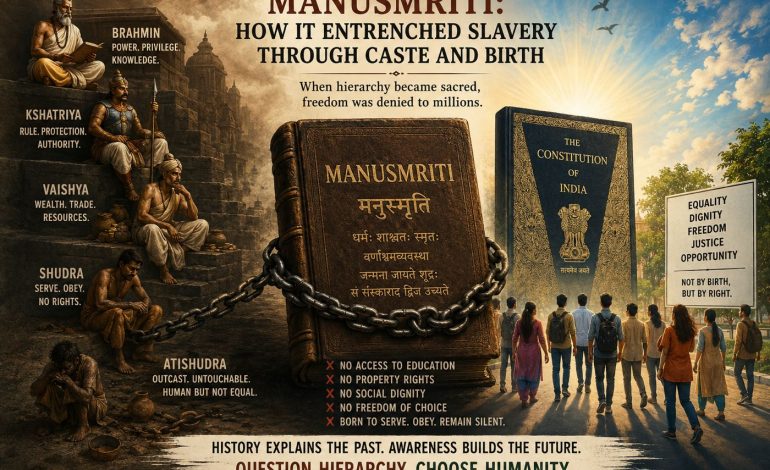

When Inequality Becomes Sacred
Imagine a society where your future is decided before your first breath. Your profession, your education, your social status, whom you can marry, where you can live, and even whose shadow you may touch—all determined not by your talents, choices, or character, but by the circumstances of your birth.
For millions of people in the Indian subcontinent, this was not merely a social reality. It was presented as a religious duty. At the heart of this transformation stood a text that would profoundly influence social thinking for centuries: Manusmriti.
While defenders describe it as a legal and moral code of an ancient age, critics argue that Manusmriti did something far more consequential. It converted social hierarchy into a sacred obligation and transformed birth-based inequality into an enduring system of inherited servitude.
The result was not slavery in the classical Greco-Roman sense, where people were bought and sold as property. Instead, it was something different—and in some ways more enduring: a system in which entire communities were permanently assigned subordinate status from generation to generation.
Before Manusmriti: A More Fluid Social Landscape?
The Vedas, the oldest surviving texts of ancient India, certainly mention social categories and divisions. Yet many historians argue that early Vedic society displayed greater flexibility than the rigid caste order that emerged later.
Ancient traditions contain stories of individuals crossing social boundaries through learning, spiritual achievement, or personal merit. Knowledge was not always portrayed as the exclusive possession of a single hereditary group.
Over time, however, social divisions hardened. What had once been social distinctions increasingly became hereditary identities. Manusmriti played a significant role in giving this process ideological legitimacy.
The Birth of a Sacred Social Blueprint
Compiled roughly between 200 BCE and 200 CE, Manusmriti presented itself not merely as advice but as a guide for organizing society according to divine order.
It categorized society into distinct varnas and assigned each group specific duties, privileges, and restrictions. At first glance, this may appear to be a simple division of labor. But a closer look reveals something more profound. The text did not merely describe social differences—it prescribed them. More importantly, it treated these differences as natural, moral, and sacred. In doing so, it transformed hierarchy from a social arrangement into a religious obligation.
When Service Becomes a Birthright
One of the most controversial aspects of Manusmriti concerns its treatment of Shudras. The text repeatedly describes service to higher varnas as the primary duty of Shudras. Access to education, religious authority, and social prestige was heavily restricted.
The implications were enormous. A person born into a subordinate group was expected to remain in that position throughout life. Their children would inherit the same status. Their grandchildren would inherit it too. Unlike temporary economic inequality, this was a system designed to reproduce itself across generations. Modern scholars often describe such arrangements as forms of hereditary servitude. The individual was not owned by another person, but social mobility was severely constrained. Birth determined destiny.
That is why many critics compare the system to slavery—not because people were legally traded as property, but because entire communities were locked into inherited subordination.
Knowledge as a Tool of Power
Every enduring hierarchy depends on controlling access to knowledge. Manusmriti reinforced this principle by placing educational and religious authority primarily in the hands of upper varnas. Knowledge became a gatekeeper. If one group controls education, law, scripture, and interpretation, it also controls the narrative of what is considered natural and just. The exclusion of lower groups from learning did more than deny opportunity. It made resistance difficult.
A population deprived of education is often deprived of the tools needed to challenge its position. In this way, social inequality could sustain itself without constant force.
The Psychology of Hierarchy
Modern social psychology offers a useful lens for understanding why systems like caste endure. Researchers speak of ingroup and outgroup dynamics.
People naturally favor groups they identify with and often distrust or exclude those they perceive as outsiders. Manusmriti elevated these tendencies into social doctrine. Certain groups were associated with purity, authority, and prestige. Others were associated with service, dependence, and exclusion. These distinctions were not temporary. They were hereditary. Over generations, such ideas become deeply embedded in social consciousness.The hierarchy begins to feel normal—even inevitable. People stop seeing it as a human creation and start seeing it as the natural order of the world.
The Long Shadow of Manusmriti
Texts alone do not create social systems. Political power, economic structures, cultural traditions, and historical circumstances all play important roles. Yet ideas matter. And Manusmriti provided a powerful intellectual framework for legitimizing inequality.Its influence can be traced in centuries of restrictions on education, occupation, social interaction, and marriage. Even today, echoes of these divisions persist. Caste-based discrimination, social exclusion, and violence continue to appear in modern India despite constitutional guarantees of equality. The persistence of these problems reminds us that laws can change faster than social attitudes.
Constitution Versus Manusmriti
Perhaps the greatest ideological challenge to Manusmriti came not from another religious text but from modern democracy. The Constitution of India rests on principles fundamentally different from hereditary hierarchy. It assumes that every individual possesses equal dignity. It recognizes citizenship, not caste, as the basis of rights. It values liberty, equality, and opportunity over inherited status. In many ways, the Constitution represents a direct rejection of the idea that birth should determine a person’s worth.
A Final Question
The most important question is not whether Manusmriti was progressive or regressive by the standards of its own time. The real question is whether any society should allow ancient hierarchies to dictate modern values. Human beings created social systems. Human beings can change them. If inequality was constructed, it can be dismantled. If hierarchy was made sacred, it can be questioned. And if birth once determined destiny, a just society must ensure that it no longer does. History is not a prison. It is a lesson. The choice of what comes next belongs to us.



1 Comment
[…] returned at the centre of political debate after Rahul Gandhi, leader of the opposition, invoked Manusmriti and Smash the Patriarchy at his Chhatron Ki Goonj programme in Pune on August 22, […]