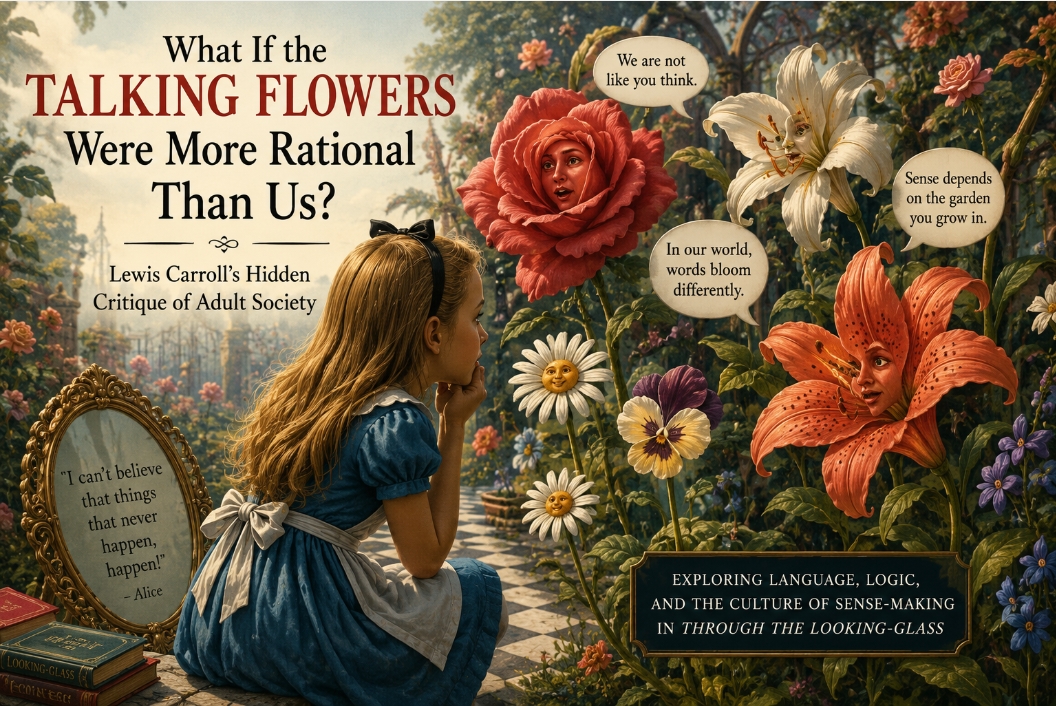

What If the Talking Flowers Were More Rational Than Us? Lewis Carroll’s Hidden Critique

When most readers encounter the talking flowers in Through the Looking-Glass, they dismiss the scene as whimsical fantasy—a charming moment in Alice’s surreal adventure. But what if Lewis Carroll intended something far more provocative? What if those flowers, rooted in an impossible world, actually expose the irrationality of our own?
This iconic episode is not merely children’s fiction. It is a sophisticated cultural commentary on language, logic, and the fragile foundations of what adults confidently call “common sense.”
The Garden That Questions Reality
As Alice steps into the Garden of Live Flowers, she enters a world where flowers hold conversations, trees bark, and language behaves in unexpected ways. At first glance, everything appears absurd. Yet the longer Alice remains in this strange landscape, the more its internal logic begins to emerge.
Consider the famous exchange where the Rose explains that a tree can “bark,” prompting the Daisy to joke that its branches are called “boughs” because they say “bough-wough.” Carroll deliberately plays with the double meanings of words, revealing that language itself is built upon arbitrary conventions rather than fixed truths.
The joke is amusing—but it also asks a serious question:
How much of what we call “logic” depends simply on habit?
When Nonsense Starts Making Sense
One of the most fascinating moments occurs when Alice wonders why flowers in her world cannot speak. The Tiger Lily confidently explains that ordinary gardens make their flower beds too soft, causing flowers to remain asleep.
The explanation is completely impossible.
Yet within the Looking-Glass world, it is perfectly reasonable.
This inversion forces readers to confront an uncomfortable realization: every society operates according to rules that feel natural only because its members accept them. Carroll invites us to question whether our own world is truly more logical—or merely more familiar.
Language Is More Fragile Than We Think
Carroll’s playful conversations anticipate ideas that modern literary theory would explore decades later.
Rather than treating words as stable containers of meaning, the Garden of Live Flowers demonstrates how meanings constantly shift depending on context, interpretation, and association. A single word can generate multiple realities, making communication far less predictable than adults often assume.
Instead of offering certainty, language becomes a playground where meanings are negotiated rather than discovered.
This insight transforms a seemingly innocent children’s scene into a philosophical challenge.
A Quiet Critique of Adult Culture
The true target of Carroll’s satire is not childhood imagination but adult confidence.
Adults pride themselves on being rational, organized, and sensible. Yet the Looking-Glass world repeatedly reveals that many adult systems—from language to social conventions—are no less arbitrary than the magical rules governing Alice’s journey.
The flowers do not simply entertain Alice.
They expose the illusion that adulthood possesses absolute wisdom.
By reversing expectations, Carroll suggests that innocence sometimes perceives reality more honestly than experience does.
Why This Scene Still Matters Today
In an age dominated by political rhetoric, viral misinformation, and endless debates over the meaning of words, Carroll’s Garden of Live Flowers feels remarkably contemporary.
Every day we witness language being stretched, manipulated, and redefined. Words acquire new meanings, familiar expressions become contested, and communication often creates confusion rather than clarity.
Carroll reminds us that meaning is never entirely fixed. It depends on culture, context, and perspective.
Perhaps that is why Through the Looking-Glass continues to resonate with modern readers—not because it offers escape from reality, but because it exposes reality’s hidden contradictions.
Final Thoughts
The talking flowers are not simply magical characters decorating Alice’s adventure. They represent one of Lewis Carroll’s boldest intellectual experiments.
By making nonsense appear logical and logic appear questionable, Carroll challenges readers to rethink language, authority, and the cultural assumptions that shape everyday life.