
Dussehra and the Burning of Ravana: Are We Destroying Evil or Celebrating Hypocrisy?

Revisiting the Ramayana through the lens of postmodern society, particularly in relation to ethnic and national identities, is illuminating. The Ramayana possesses profound symbolic and cultural significance, having shaped the collective consciousness of South Asia and its diaspora across generations. The epic recounts one of the most enduring civilisational narratives, situated at the intersection of mythology, cultural memory, and social values. Rama, the protagonist, continues to occupy a central place in the popular imagination as the Maryada Purushottam—the ideal man who embodies righteousness, duty, and moral restraint. Ravana, conventionally portrayed as the antagonist and a symbol of evil, represents a more complex figure when examined through alternative cultural, regional, and political interpretations. In contemporary society, therefore, the Ramayana extends beyond its religious and mythological dimensions, offering a critical lens through which to examine the construction of identity, the negotiation of cultural difference, and the relationship between mythology, nationalism, and collective belonging.
While transgressive retellings of the Ramayana encourage more tragic, nuanced, and ambiguous interpretations of Ravana, mainstream versions of the epic predominantly portray him as the antagonist. Ravana, the demon king of Lanka, is depicted as a learned scholar, a formidable warrior, and a powerful ruler endowed with immense knowledge and supernatural abilities. Yet, despite his intellectual brilliance and extraordinary prowess, his moral transgressions, particularly his abduction of Sita and his refusal to acknowledge the consequences of his actions, ultimately contribute to his downfall. In contrast, Rama emerges as the embodiment of dharma, moral restraint, and righteous conduct. In Valmiki’s Ramayana, the climactic battle between Rama and Ravana culminates in Ravana’s death at Rama’s hands, signifying the triumph of righteousness over arrogance and moral transgression. Nevertheless, when examined through contemporary critical perspectives, Ravana’s character complicates the conventional binary between good and evil, inviting questions about the ways in which cultural narratives construct villainy, legitimise moral authority, and shape collective perceptions of identity and difference.
To celebrate victory of good over evil, on the occasion of Dusshera every year, effigies of Ravana are burnt across countries. This tradition serves as an important remainder that moral failure would eventually lead to downfall, as even almighty Ravana could not scale the outcome of his personal moral failure, leading to mass extinction of how own clan and demons. But something has been continuously changing surrounding this annual celebration, deeply entrenched in festivities and political sloganeering. Though political participation has increased significantly, avoidance of moral responsibilities in political class has exacerbated brazenly. With the growing size of Ravan’s effigies, decline in moral obligation has touched bottom.
The annual burning of Ravana’s effigies on the occasion of Dussehra symbolises the triumph of good over evil and serves as a reminder that moral transgressions, however powerful their perpetrators may be, ultimately carry consequences. Despite his immense knowledge, military prowess, and political authority, Ravana’s arrogance and moral failings culminated in his own destruction and the devastation of his kingdom and kin. Yet, the significance of this annual ritual appears to be changing amid the growing entanglement of religious festivities with political mobilisation and sloganeering. While political participation in such celebrations has become increasingly visible, the willingness of political actors to assume moral responsibility for their conduct appears to have diminished. The growing size of Ravana’s effigies thus offers a compelling metaphor for a contemporary paradox: as the spectacle of burning evil grows more imposing, the commitment to confronting its manifestations in public life seems increasingly fragile. The ritual, intended to reaffirm ethical values, consequently invites a deeper question: has the symbolic destruction of evil begun to overshadow the moral introspection that the tradition is meant to inspire?
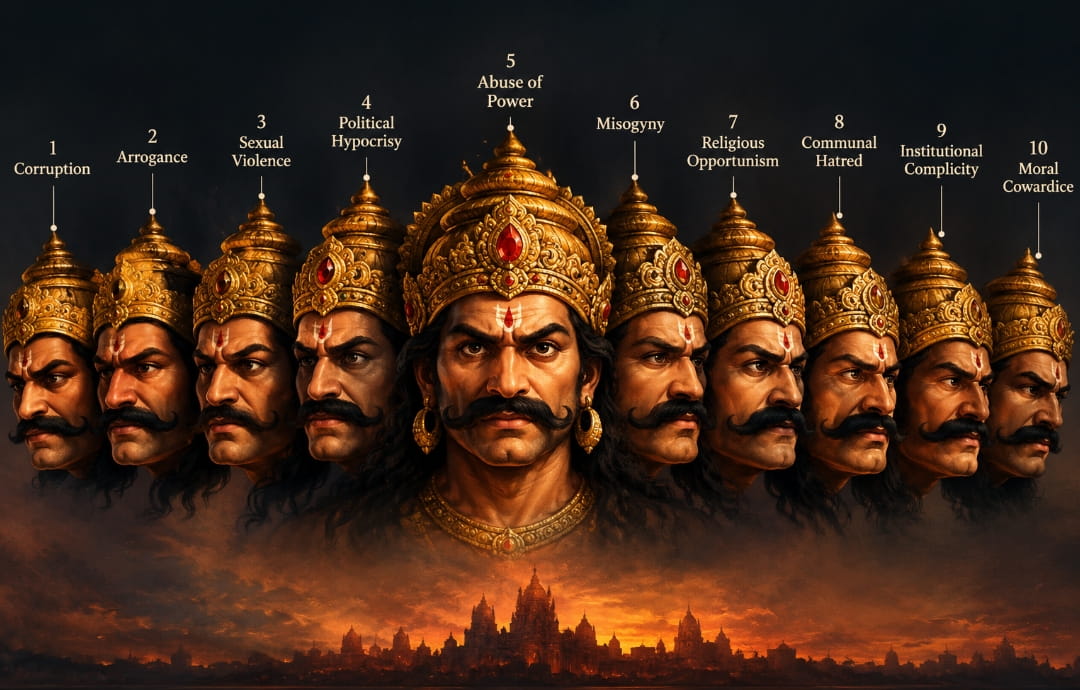
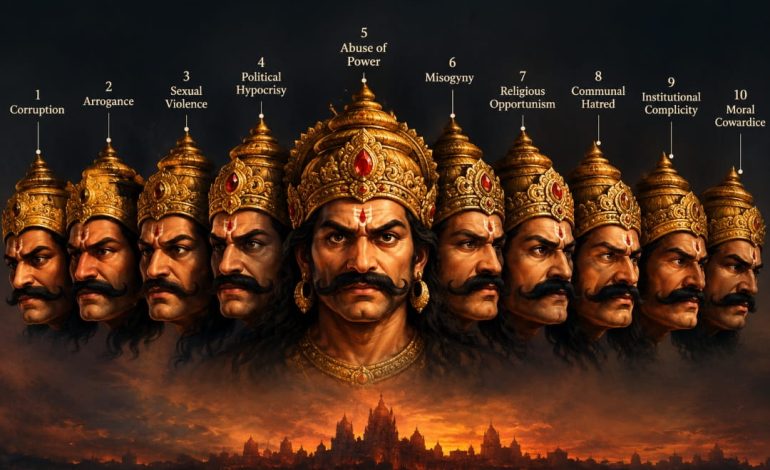
Ravana’s ten heads offer a powerful metaphor for understanding the interconnected moral and social challenges confronting contemporary society, although their symbolic interpretations vary across cultural and regional traditions. In a contemporary reading, these ten heads may represent the multiple manifestations of social and political dysfunction: (1) corruption, (2) arrogance, (3) sexual violence, (4) political hypocrisy, (5) abuse of power, (6) misogyny, (7) religious opportunism, (8) communal hatred, (9) institutional complicity, and (10) moral cowardice. Viewed through this lens, Ravana becomes more than a mythological antagonist; he becomes a symbolic representation of the evils that persist within society and its institutions. This interpretation, however, raises a fundamental question: if Ravana’s ten heads represent the moral failures that continue to afflict contemporary society, what does the annual burning of his effigy actually achieve? Does the ritual signify a genuine commitment to confronting these evils, or does it offer the reassuring spectacle of moral victory without demanding the corresponding introspection, accountability, and social transformation? The paradox lies in celebrating the destruction of evil as a symbolic act while allowing its manifestations to endure in everyday life.
Citation
Stanton, G., 2025. Sympathy for the Rakshasa: Understanding Ambivalence Towards Ravana in South Asia.
Shankar, M.J., INDIAN SOCIETY: PROGRESSING OR REGRESSING?.