
The “Idiot” Who Wasn’t: How a Greek Citizen Became Dostoevsky’s Greatest Hero

What comes to mind when you hear the word “idiot”?
Probably someone foolish, careless, or lacking common sense. It’s one of the most common insults in modern English:
“I locked myself out again. I’m such an idiot.”
But the word has traveled an extraordinary journey across history. Its original meaning was almost the opposite of what we think today—and that forgotten meaning unlocks a deeper understanding of Fyodor Dostoevsky’s novel The Idiot.
From Ancient Greece to Modern Insult
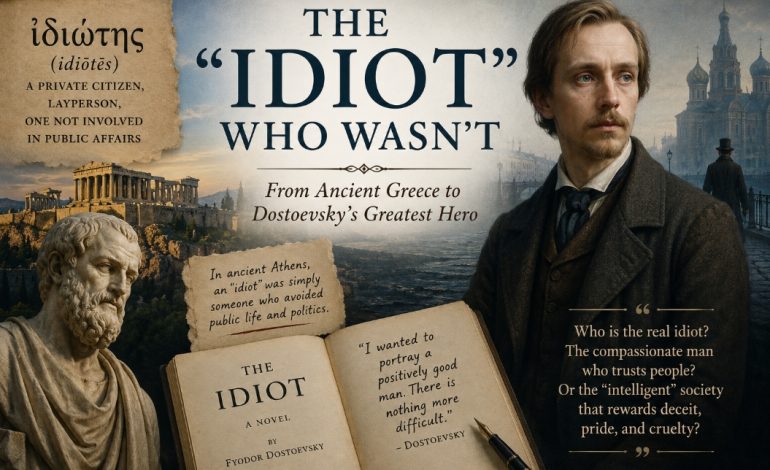
The word idiot comes from the Ancient Greek idiōtēs (ἰδιώτης).
Surprisingly, it didn’t originally describe a stupid person.
An idiōtēs was simply a private citizen—someone who stayed out of politics and public affairs. In democratic Athens, participating in civic life was considered a duty. Those who focused only on their private concerns were called idiōtai.
Over centuries, the meaning shifted.
The word gradually came to describe someone who lacked education or specialized knowledge. Later, it evolved further into someone considered lacking judgment or intelligence. By the nineteenth century, it had also become a medical label for profound intellectual disability—a usage now regarded as outdated and offensive.
Today, “idiot” survives almost entirely as an everyday insult.
Yet buried beneath that insult lies a much richer history.
Dostoevsky’s “Idiot”
When Dostoevsky titled his novel The Idiot in 1869, he wasn’t simply calling his protagonist stupid.
Prince Lev Nikolayevich Myshkin is anything but unintelligent.
He is thoughtful, perceptive, compassionate, and almost painfully honest. After years spent in Switzerland receiving treatment for epilepsy, he returns to Russian society carrying something far rarer than cleverness: complete moral innocence.
The people around him cannot understand such a person.
His kindness is mistaken for weakness.
His honesty is mistaken for naïveté.
His refusal to manipulate others makes him appear incapable of surviving in society.
They call him an “idiot.”
The Real Question the Novel Asks
Dostoevsky once wrote that he wanted to portray a perfectly good man.
That turned out to be a dangerous experiment.
Myshkin enters a world driven by vanity, ambition, jealousy, money, and social status. Unlike everyone else, he refuses to play these games.
Ironically, this makes him seem irrational.
The novel quietly asks:
Who is the real idiot?
- The compassionate man who trusts people?
- Or the “intelligent” society that rewards deceit, pride, and cruelty?
The title becomes deeply ironic.
Perhaps the true foolishness belongs not to Myshkin, but to the society incapable of recognizing genuine goodness.
The Ancient Greek Echo
Remember the original Greek meaning?
An idiōtēs was someone outside public power and political competition.
Prince Myshkin occupies a similarly unusual position.
He stands outside society’s endless contests for wealth, prestige, and influence. He neither schemes nor seeks power. In that sense, he resembles the ancient idiōtēs—someone who remains fundamentally separate from public ambition.
Yet Dostoevsky transforms this outsider into a moral mirror.
Everyone who meets Myshkin reveals something about themselves.
Some exploit him.
Some love him.
Some resent him.
Some cannot bear the uncomfortable truth reflected in his innocence.
A Word That Changed—and a Novel That Changed It Again
The history of “idiot” is a story of shifting values.
It began as a neutral description of a private citizen.
It became a label for ignorance.
Eventually it turned into an insult.
Dostoevsky performs one final transformation.
He invites us to question whether society has confused innocence with stupidity and cleverness with wisdom.
By the novel’s end, readers often discover that the title points less toward Prince Myshkin than toward the world surrounding him.
Why It Still Matters
More than 150 years later, we still admire intelligence measured by success, influence, and strategic thinking.
But The Idiot asks a timeless question:
If kindness, honesty, and compassion make someone look foolish in the modern world, what does that say about the world—not the person?
Perhaps the greatest irony is that every time we casually call someone an “idiot,” we use a word whose history reminds us that appearances—and judgments—are rarely as simple as they seem.
Sometimes, the “idiot” is the wisest person in the room.