
How Hinduism, Buddhism and Sikhism Shape Art, Design & Visual Culture


When Faith Becomes a Visual Language? What does religion look like? How religion shapes Shape Art, Design & Visual Culture
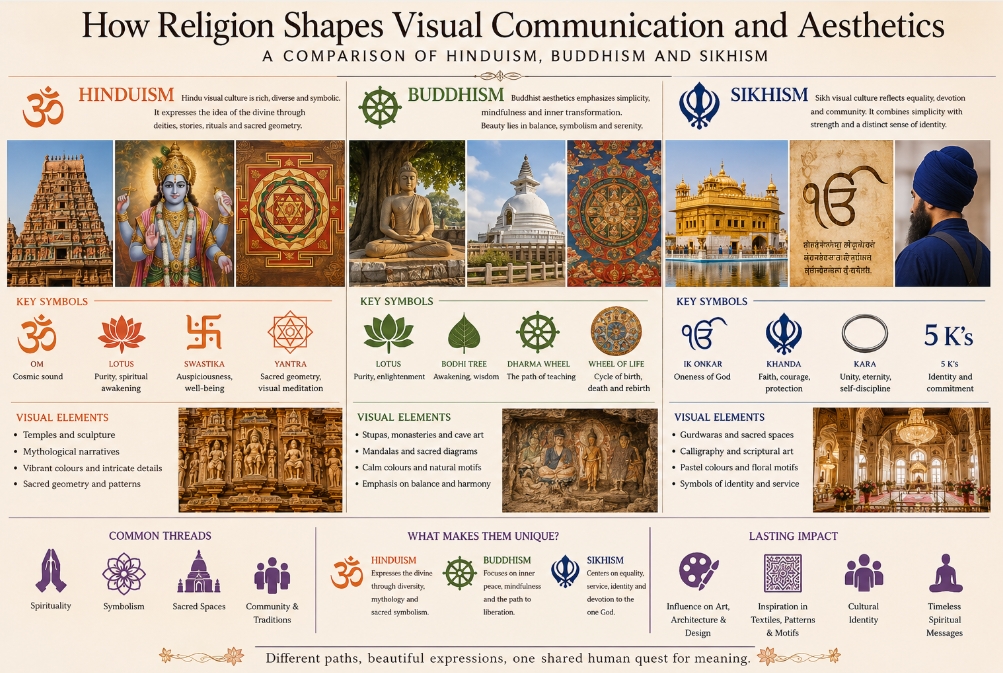
Sometimes, it looks like a lotus blooming from still water. Sometimes, it takes the form of a Khanda, a turban, a temple, a mandala, a richly decorated textile—or the serene face of the Buddha. Long before people encountered religious ideas through books or digital media, they experienced them through images, symbols, colours, architecture, objects, clothing and rituals.
This is where religion and visual communication meet.
Aesthetics is not simply about deciding what is beautiful. It is also about how humans experience and interpret the world through their senses. Vision, sound, touch, smell and even spatial experience can become carriers of meaning. Religious traditions have therefore played a powerful role in shaping not only what people believe, but also what they see, how they see it and what visual symbols mean to them.
Scholars including Walter Benjamin have explored the close relationship between religion, art and aesthetic experience, while researchers of religious aesthetics have argued that artistic representations can make spiritual ideas perceptible. In this sense, a religious image is rarely just an image. It can become a bridge between the visible and the invisible.
Among the world’s rich religious traditions, Hinduism, Buddhism and Sikhism offer particularly fascinating examples of how belief can become visual communication.
But their visual languages are not identical.
They overlap, influence one another and share cultural histories, particularly across South Asia, yet each tradition has developed distinctive approaches to symbolism, beauty, identity and sacred space.
Hinduism: A Universe Designed in Symbols
Hindu visual culture is extraordinarily diverse because Hinduism itself encompasses a vast range of philosophies, deities, rituals and regional traditions.
Its visual language frequently transforms abstract ideas into recognisable forms.
A deity with multiple arms, for example, can communicate multiple powers or attributes. A lotus can represent purity and spiritual unfolding. The Om symbol can represent sacred sound and cosmic reality. Geometric diagrams such as yantras translate metaphysical concepts into visual structures.
This makes Hindu aesthetics highly communicative: form becomes meaning.
Temples provide another powerful example. Their architecture is not merely decorative. Spatial organisation, sculpture, iconography and movement through sacred spaces can collectively construct a religious experience.
Indian painting, sculpture, jewellery, textiles and architecture have similarly incorporated religious narratives and motifs for centuries. Stories from the Ramayana, Mahabharata and Puranas have repeatedly been translated into visual form.
In Hindu visual communication, therefore, aesthetics often works through abundance, symbolism, narrative and sacred multiplicity.
The visual experience can be highly detailed and richly ornamented—but beneath that visual richness lies a system of meanings.
Buddhism: When Simplicity Becomes Spiritual
If Hindu visual culture often communicates through multiplicity and narrative richness, Buddhist aesthetics frequently places greater emphasis on calm, balance, contemplation and transformation.
The lotus is one of the clearest examples.
Growing from muddy water yet emerging clean and beautiful, the lotus became a powerful metaphor for spiritual purity and awakening. The Bodhi tree, meanwhile, is associated with the Buddha’s enlightenment beneath the tree at Bodh Gaya.
Buddhist visual communication developed through stupas, sculptures, paintings, manuscripts, cave art, textiles and ritual objects. The artistic traditions associated with sites such as Ajanta and Ellora demonstrate how Buddhist narratives and symbols became part of India’s visual heritage.
The Wheel of Life, Bhavachakra, offers another remarkable example. It visually represents samsara—the cycle of birth, death and rebirth. Instead of communicating a doctrine through lengthy written explanation, the image creates a visual map of existence

At the same time, Buddhist aesthetics is often associated with simplicity, restraint and contemplative beauty.
The objective is not necessarily visual extravagance. Beauty can emerge through balance, proportion, emptiness, repetition and stillness.
In this sense, Buddhist design can communicate a powerful message without shouting.
Sikhism: Identity, Equality and the Power of Symbols
Sikh visual culture developed later than the Buddhist and Hindu traditions discussed above, emerging in the Punjab region in the late 15th century through the teachings of Guru Nanak.
Its visual language is strongly connected to ideas of faith, equality, community, courage and collective identity.
The transformation of Sikh identity in the late 17th century was particularly significant. In 1699, Guru Gobind Singh established the Khalsa and formalised practices and symbols that became central to Sikh identity.
The Five Ks—Kesh, Kangha, Kara, Kachera and Kirpan—became powerful visual and material markers of belonging.
The Kara, an iron or steel bracelet, is both an everyday object and a religious symbol. The dastar, or turban, is simultaneously a practical garment, a marker of identity and an important element of Sikh visual culture.
The Ik Onkar symbol occupies another central position. It communicates the Sikh understanding of the oneness of the divine and has become one of the most recognisable symbols associated with Sikhism.
Sikh architecture also demonstrates the interaction between religion and visual culture. The development of gurdwara architecture drew upon regional and historical influences, including elements associated with Mughal and Persian architectural traditions, while creating spaces suited to Sikh religious practice.
The Golden Temple in Amritsar is perhaps the most recognisable example. Its architecture, water setting, materials and relationship with the surrounding complex create an experience in which visual beauty, community and spirituality intersect.
Sikh aesthetics therefore cannot be separated easily from identity and lived practice.
Three Religions, Three Visual Languages
Although Hinduism, Buddhism and Sikhism developed within the broader cultural landscape of South Asia, their visual communication reveals important differences.
| Feature | Hinduism | Buddhism | Sikhism |
| Core visual tendency | Symbolism, narrative and sacred multiplicity | Contemplation, balance and spiritual transformation | Identity, equality, community and devotion |
| Major symbols | Om, lotus, yantra, deities | Lotus, Bodhi tree, Dharma wheel, stupa | Ik Onkar, Khanda, Five Ks |
| Architecture | Temples, shrines, sacred landscapes | Stupas, monasteries, temples | Gurdwaras |
| Visual storytelling | Strong use of mythology and epic narratives | Strong use of Buddha’s life and Buddhist teachings | Strong connection to Gurus, scripture and Sikh history |
| Material culture | Sculpture, jewellery, textiles, ritual objects | Sculptures, manuscripts, mandalas, textiles | Clothing, Five Ks, manuscripts, architecture |
| Aesthetic emphasis | Richness, symbolism and ornamentation | Simplicity, serenity and contemplation | Dignity, identity, devotion and community |
Yet these categories should not be treated as rigid rules.
Religions are living traditions. Their visual cultures change as they encounter new societies, technologies, artists and cultural environments.
What Makes Their Visual Communication So Powerful?
The most interesting similarity between these traditions is that they make abstract ideas visible.
Concepts such as enlightenment, divine unity, purity, morality, identity and liberation can be difficult to explain in ordinary language. Religious visual culture provides another communication system.
A symbol can communicate in seconds what might otherwise require paragraphs.
A lotus can suggest purity.
A Wheel of Life can represent an entire Buddhist understanding of existence.
Ik Onkar can communicate a profound theological principle.
A turban can communicate identity, commitment and belonging.
A temple or gurdwara can transform architecture into an experience of community and devotion.
This is why religious aesthetics remains relevant to contemporary designers.
From Sacred Symbols to Modern Design
The influence of religion does not end at the doors of temples, monasteries or gurdwaras.
Religious motifs continue to appear in fashion, interior design, architecture, jewellery, graphic design, textiles, branding and contemporary art.
Buddhist-inspired minimalism, lotus motifs, mandala-inspired graphics, Indian temple patterns and Sikh symbols have all entered contemporary visual culture in different ways.
But this influence raises an important question:
When does inspiration become appropriation?
A sacred symbol may carry centuries of religious, historical and emotional meaning. Using it purely as a decorative pattern can strip away that context.
For designers, understanding the cultural meaning behind a symbol is therefore as important as understanding its visual appearance.
Good design does not simply borrow a symbol because it looks beautiful.
It understands why the symbol became beautiful in the first place.
The Bigger Picture: Religion as a Design System
Hinduism, Buddhism and Sikhism demonstrate three fascinating approaches to the relationship between belief and visual communication.
Hindu visual culture frequently turns mythology, philosophy and the divine into richly symbolic forms.
Buddhist aesthetics often uses visual harmony, repetition, symbolism and simplicity to encourage contemplation and communicate the path toward awakening.
Sikh visual culture places particular emphasis on identity, equality, community and lived faith, turning symbols, clothing and architecture into powerful expressions of belonging.
Despite these differences, all three traditions reveal the same fundamental truth:
People do not experience religion only through words. They experience it through images, spaces, objects, colours, sounds, clothing and rituals.
Religion can therefore be understood not only as a system of belief, but also as a visual communication system—one capable of carrying ideas across generations and cultures.
And perhaps that is why religious aesthetics continues to influence designers and artists today.
Because long before we learned to scroll, swipe and share, humanity was already communicating through symbols.
Final Thought
The next time you see a lotus, a temple, a mandala, a turban, a Khanda or a richly decorated religious textile, look beyond its surface.
Ask:
What is this image communicating?
The answer may reveal an entire philosophy hiding inside a single visual form.
That is the enduring power of religion on visual communication and aesthetics.
SChandra Literature Team, 2026
References
Abraham, M.H. and Harpham, G.G. (2015). ‘A Glossary of Literary Terms, Eleventh Edition, Cengage Learning’, India.
Adams, T. (2014). ‘Interview MF Husain: the barefoot ‘Picasso’ of Indian art’, The Guardian [online] https://www.theguardian.com/artanddesign/2014/jun/01/mf-husain-barefoot-picasso-indian-art-civilization
Agrawal, R. (2014). ‘Aesthetic and Artistic Appreciation of B-40 Janamsakhi Manuscript’, Indian Journal of Research, Vol. 3 (8), pp. 53-54.
Asian Art, (2020). ‘Japanese Buddhist Architecture’ [online] https://www.buddhist-art.com/blog/japanese-buddhist-architecture/
Asia Society, (2019).’Tibetan Buddhist Monks Return for Fifth Year to Create Sand Mandala’, Present Sacred Music and Dance[online]https://asiasociety.org/texas/tibetan-buddhist-monks-return-fifth-year-create-sand-mandala-present-sacred-music-and-dance
Bal, M. (2003). ‘Visual essentialism and the object of visual culture’, Journal of Visual Culture, 2 (5).
BBC, (2009). ‘The Five Ks’ [online] https://www.bbc.co.uk/religion/religions/sikhism/customs/fiveks.shtml
BBC, (2014). ‘Buddhist Wheel of Life’ [online] https://www.bbc.co.uk/religion/galleries/bhavachakra/
Behrendt, K. (2014). ‘Tibetan Buddhist Art in the Twenty-First Century’, The Met [online] https://www.metmuseum.org/blogs/now-at-the-met/2014/tibetan-buddhist-art
Brown, K(ed).(1999). ‘Sikh Art and Literature, Routledge’, Google Book [online] https://www.google.co.in/books/edition/Sikh_Art_and_Literature/ddgO-DldmSwC?hl=en&gbpv=1&dq=sikh+art&printsec=frontcover
Buddhist Art News, (2017). ‘Mystic and Glamorous Exhibition of Goryeo Buddhist Painting’, [online] https://buddhistartnews.wordpress.com/2017/04/19/mystic-and-glamorous-exhibition-of-goryeo-buddhist-painting/
Chattopadhyay, P. (2014). Holy Fonts: ‘Two calligraphers exhibit their work on Buddhist and Islamic calligraphy’, The Indian Express [online] https://indianexpress.com/article/lifestyle/holy-fonts/
Cotter, H. (2006). ‘Wonders of Sikh Spirituality Come Alive’, The New York Times [online] https://www.nytimes.com/2006/09/18/arts/design/18sikh.html
Glueck, G. (1985). ‘RELIGION MAKES AN IMPACT AS A THEME IN TODAY’S ART’, New York Time [online] https://www.nytimes.com/1985/04/07/arts/religion-makes-an-impact-as-a-theme-in-today-s-art.html
Graham, P. (2011). ‘The Visual Culture of Japanese Buddhism from the Early Modern Period to the Present’, Wiley Online Library, https://doi.org/10.1111/j.1749-8171.2011.00294.x
Gupta, S. (2019). ‘Sikh Visual Culture in the Twentieth and Twenty-First Centuries: Suffering, Trauma and Martyrdom’, [online] https://www.sahapedia.org/sikh-visual-culture-twentieth-and-twenty-first-centuries-suffering-trauma-and-martyrdom
Huffpost, (2014). ‘Sikhism 101: Facts, History, Beliefs, Gurus, Traditions, And Signs Of The Faith’, [online] https://www.huffpost.com/entry/sikhism-101_n_4698378
Ikeda, A. (2019). ‘Early Sikh imagery in Janam-sakhi painting: A comparison of the B-40, the Guler and the Unbound set’, Sikh Formations, DOI: 10.1080/17448727.2019.1702836
Karlsson, (2006). ‘The formation of early buddhist visual culture’, Material Religion volume 2 (1), pp. B&-95.
Karetzky, P.E. (2000). ‘Early Buddhist Narrative Art, University Press of America Inc’,. Google Books [online] https://www.google.co.in/books/edition/Early_Buddhist_Narrative_Art/9LjmXHFXju4C?hl=en&gbpv=1&dq=Buddhist+art+and+its+evolution&pg=PR12&printsec=frontcover
Kaur, G. and Sharma, R. (2017). ‘Visual Translation of Guru Nanak’s Philosophy by Janamsakhi Illustrators’, The Chitrolekha Journal on Art and Design, Vol. 1 (2), PP. 22-39.
Kirti, K. (2014). ‘The Hidden Meaning of Michelangelo’s ‘Creation of Adam’, Medium [online] https://medium.com/the-collector/the-hidden-meaning-of-michelangelos-creation-of-adam-3eb73ad987b9
Lambert, S. (2014). ‘Art and religious inspiration’, The Guardian [online ]https://www.theguardian.com/artanddesign/2014/aug/18/art-and-religious-inspiration
Lumen, (2020). ‘Buddhist Art’, [online] https://courses.lumenlearning.com/boundless-arthistory/chapter/buddhist-art/#:~:text=In%20India%2C%20caves%20have%20long,of%20Buddhist%20rock%2Dcut%20architecture.
Meyer, B. (2015). ‘Picturing the Invisible Visual Culture and the Study of Religio’, Method and Theory in the Study of Religion 27, PP. 333-360.
Meyer, B. (2006). ‘Religious Sensations. Why Media, Aesthetics and Power Matter in the Study of Contemporary Religion’, Utrecht University, ISBN-10: 90-77472-10-X ISBN-13: 978-90-77472-10-1.
Mitchell, W.J.T. (2002). ‘Showing seeing: a critique of visual culture, Journal of visual culture’, Vol 1(2): 165-181.
NCERT, (2007). ‘Themes in Indian History Part 1, First Edition, National Council of Education and Research’,
onartandaesthetics.com, (2017). ‘ART OF PUNJAB”: SIKH HISTORY AND SPIRITUALITY BY CANADIAN PAINTER KANWAR SINGH’ [online] https://onartandaesthetics.com/2017/12/13/art-of-punjab-sikh-history-and-spirituality-by-canadian-painter-kanwar-singh/
Pachauri, S. (2015). ‘SanchiStupa: Things you would want to know about the monument’, The Indian Express [online] https://indianexpress.com/article/lifestyle/life-style/sanchi-stupa-things-you-would-want-to-know-about-the-monument/
Plate, S.B. (2005). ‘Walter Benjamin, Religion and Aesthetics; Rethinking Religion Through Arts’, Taylor and Francis Books, Google Books [online] https://books.google.co.in/books?id=qbfYxDxU62UC&printsec=frontcover&source=gbs_ge_summary_r&cad=0#v=onepage&q&f=false
Plate, S.B. (2019). ‘Religion and Visual Art, Hamilton College’,
Royal Collection Trust, (2020). ‘The First Guru, Nanak circa 1800circa 1840’, [online] https://www.rct.uk/collection/themes/exhibitions/splendours-of-the-subcontinent-four-centuries-of-south-asian-paintings-and-manuscripts/the-queens-gallery-buckingham-palace/the-first-guru-nanak
Shusterman, R. (2008). ‘Art and Religion, Journal of Aesthetic Education’, Vol. 42 (3), PP. 1-18.
Singh, P. and Fenech, L. (2014). ‘The Oxford Hanbook of Sikh Studies, Oxford University Press’, First Edition, Google Book [online] https://www.google.co.in/books/edition/The_Oxford_Handbook_of_Sikh_Studies/7YwNAwAAQBAJ?hl=en&gbpv=1&dq=Sikhism+visual+culture&pg=PA449&printsec=frontcover
Song, Y. and Qin, Z. (2019). ‘Towards the Beauty of Buddhism: The Development and Validation of a Buddhist Aesthetics Scale’, Religions, 10 (343). PP.2-13.
The Tribune, (1999). ‘The magnificence of Sikh architecture’, [online] https://www.tribuneindia.com/1999/99feb20/saturday/head1.htm
Uehlinger, C. (2015). ‘Approaches to Visual Culture and Religion, Method and Theory in the Study of Religion’, 27, PP. 384-422.
unesco, (2021). ‘Mahabodhi Temple Complex at Bodh Gaya’ [online]https://whc.unesco.org/en/list/1056/