

From Tenali Rama to Prime-Time Darbar: When the Jester Became the Court Historian
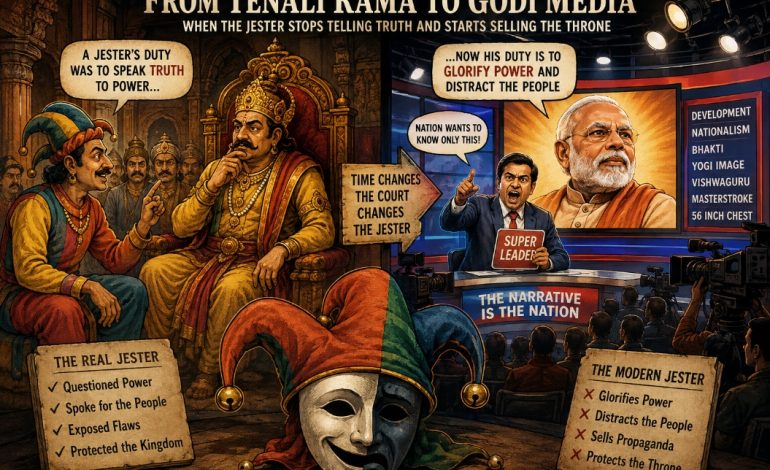

There was a time when the king needed a jester. Not because the king lacked entertainment, but because the king needed someone who could tell him what nobody else in the court dared to say. But what has changed From Tenali Rama to Prime-Time Darbar?
The jester could laugh at the king, mock his ministers, expose his vanity and, occasionally, save his kingdom with nothing more than a sharp tongue and sharper intelligence. He had no throne, no army and no official authority. Yet he possessed something more dangerous: proximity to power.
Tenali Rama understood this perfectly.
He could make the king laugh, make the people forget their troubles for a while, and, when necessary, prevent the king from walking into a political trap. He was not merely a clown. He was a friend, philosopher, guide and—most importantly—a mirror.
The mirror had one condition: it had to reflect.
Today, the mirror has discovered make-up.
The modern court jester does not necessarily wear bells. He wears a television microphone, carries a prime-time slot, operates a YouTube channel or sits behind a digital newsroom desk. His costume is no longer colourful; it is branded.
And his most important skill is not making the king laugh.
It is making the king look magnificent.
The ancient jester knew his place. The modern one knows his market.
The court jester occupied an unusual position in pre-modern political life. He stood close enough to authority to see its absurdities but far enough from formal authority to ridicule them.
That ambiguity gave the jester his power.
He could insult the king without becoming a revolutionary. He could expose the minister without becoming a minister. He could say the uncomfortable thing and then hide behind laughter.
This is why the jester was never simply a buffoon.
Across civilizations, versions of the court jester appeared in royal courts from Europe and Asia to Africa and the Americas. Their functions varied, but the underlying political drama remained familiar: power needs entertainment, but it also needs somebody who can speak near power without immediately being crushed by it.
The tragedy begins when the jester forgets that his proximity to the king is not his purpose.
His purpose is to make the king see himself.
And that brings us to the television studio.
Welcome to the new Raj Darbar
If the medieval court had a throne, the modern political spectacle has a television studio.
If the king once sat beneath a royal canopy, today’s political sovereign appears beneath studio lights, giant graphics, patriotic music and carefully produced images.
The court has not disappeared.
It has been digitised.
The old court poet composed flattering verses. The modern media ecosystem produces flattering visuals.
The old court painter made the ruler appear majestic.
The television screen does something more sophisticated: it can make the ruler appear simultaneously heroic, omniscient, tireless, compassionate and permanently victorious.
The king does not even have to enter the room.
The room enters your living room.
This is where the idea of the jester becomes politically interesting.
A media establishment that should ideally interrogate power can instead become part of the architecture of power’s image-making. The journalist becomes less a watchdog and more a court announcer. The debate becomes less an examination of policy and more a theatre of loyalty.
The question is no longer:
“What did the king do?”
It becomes:
“How brilliantly can we explain why whatever the king did was brilliant?”
That is a very different profession.
From Brahminical authority to manufactured authority
The comparison with Brahmanism requires some caution.
Brahmanism, like the category “jester”, is historically complex and cannot be reduced to a single political formula. But the author’s broader question about hereditary authority, claims to superior knowledge and the social production of legitimacy is worth examining.
The traditional Brahmanical order derived authority partly through claims concerning sacred knowledge, ritual status and inherited social position.
Modern political communication works differently.
Nobody needs to claim descent from Brahma.
Today, authority can be manufactured through repetition.
Say something often enough, show it dramatically enough, surround it with enough symbols of national pride, and eventually the distinction between political messaging and political reality begins to blur.
The modern court does not necessarily say:
“We are superior because we were born superior.”
It can say:
“We are successful because everything around us demonstrates our success.”
The distinction may appear enormous.
Psychologically, it is not.
Both systems raise the same fundamental question:
Who gets to define reality?
And once a particular class, institution or media ecosystem acquires disproportionate power to define reality, disagreement can easily be transformed into disloyalty.
The court jester, ironically, becomes useful here.
A real jester destabilises power by laughing at it.
A court-approved jester stabilises power by laughing for it.
The jester who stopped looking at the king
Imagine Tenali Rama entering the royal court.
He notices the king’s expensive new palace.
He notices that the treasury is under pressure.
He notices that ordinary people are complaining.
The ministers insist that everything is wonderful.
Tenali looks at the king.
Then he laughs.
The king asks, “Why are you laughing?”
Tenali replies, “Because everyone is telling you the kingdom is flourishing, Maharaja, but nobody has bothered to ask the kingdom.”
That was the political genius of the jester.
He stood between the palace and the street.
The modern media jester has another option.
He can stand inside the palace and tell the street what the palace wants it to believe.
That is where satire becomes tragedy.
When journalism becomes excessively invested in glamourising political leadership, the citizen is no longer treated as an observer of politics. The citizen becomes the audience for a political performance.
The leader becomes the protagonist.
The government becomes the hero.
The opposition becomes the villain.
The journalist becomes the narrator.
And facts?
Facts become supporting characters.
The Modi-era spectacle
The Narendra Modi era has been particularly fertile ground for the politics of image.
This is not because political image-making began with Modi. It certainly did not. Political leaders have always cultivated images, symbols and narratives.
What has changed dramatically is the scale, speed and technological sophistication of the spectacle.
A leader can now be simultaneously projected as administrator, global statesman, spiritual figure, development icon, nationalist symbol and tireless worker.
Every visit becomes an event.
Every event becomes an image.
Every image becomes a message.
And every message can become a headline.
This is where sections of what critics describe as “Godi media” enter the story.
The phrase itself is political and polemical, and it should not be treated as a neutral description of the entire Indian media. India’s media landscape is enormous, contradictory and populated by institutions with very different editorial positions.
But the criticism behind the phrase is serious: that some media organisations have become so close to the ruling establishment that scrutiny is replaced by celebration.
The jester, once employed to puncture royal vanity, is now occasionally employed to inflate it.
The question is almost Shakespearean:
When everyone in the court applauds, who is left to tell the king that the music is terrible?
The genius of glamour
Propaganda does not always look like propaganda.
That is its genius.
Sometimes it looks like a beautifully produced documentary.
Sometimes it looks like an interview.
Sometimes it looks like a patriotic montage.
Sometimes it looks like twenty television panels discussing the same achievement from twenty different angles.
Sometimes it simply looks like a photograph.
The modern political image is powerful precisely because it does not always demand belief.
It demands repetition.
And repetition is one of the oldest teachers in human history.
The ancient court had bards.
The modern court has broadcasters.
The ancient ruler had inscriptions.
The modern ruler has social media.
The ancient king had a palace procession.
The modern leader has a media event.
The technology has changed.
The political instinct has not.
But where is the jester now?
Perhaps the answer is uncomfortable.
The jester has not disappeared.
He has multiplied.
There are comedians.
Satirists.
Cartoonists.
Independent journalists.
Political commentators.
YouTubers.
Writers.
Citizens making memes on their phones.
They perform the oldest democratic function of humour: they remind power that it is ridiculous when it becomes too convinced of its own grandeur.
But they operate in a more complicated environment.
The old jester had one king.
The contemporary jester has algorithms.
The old jester feared royal displeasure.
The contemporary satirist may fear trolling, lawsuits, censorship, advertisers, organised outrage, platform restrictions and the economic consequences of offending the wrong audience.
The court is no longer located in one palace.
It is everywhere.
And its walls are invisible.
From Vidushak to television anchor
There is also an important Indian tradition that complicates the Western image of the jester.
The Vidushaka was not simply a clown. In Sanskrit theatrical traditions, the Vidushaka could function as a comic companion, commentator and disruptive figure. He could puncture solemnity.
That is an extraordinarily democratic function.
Laughter can flatten hierarchy.
The king may be taller than the farmer.
The minister may be richer than the labourer.
The ruler may have an army.
But once the joke lands, everybody understands the joke.
For a few seconds, power becomes human.
That is why authoritarian instincts have historically disliked uncontrolled humour.
A joke cannot easily be commanded.
Unless, of course, the court owns the microphone.
Then humour becomes decoration.
The greatest danger is not the flattering jester
The greatest danger is the disappearance of the uncomfortable question.
A democracy does not need journalists who hate the government.
It needs journalists who are not afraid of it.
There is a difference.
The purpose of journalism is not to embarrass rulers for entertainment. Nor is it to praise rulers for access, ratings or political convenience.
Its fundamental responsibility is much less glamorous:
Ask the question again.
Where did the money go?
Who benefited?
Who lost?
What happened to the promise?
What does the data say?
Who is being excluded?
What does the government say?
What does the government not say?
And, occasionally:
Maharaja, are you sure about this?
That final question is the soul of the jester.
The court needs a mirror
Perhaps the lesson of Tenali Rama is not that every journalist should become a comedian.
It is that proximity to power should produce greater courage, not greater flattery.
The jester was valuable because he occupied a strange space between authority and society. He could enter the palace but still understand the street.
That is precisely the space a healthy media institution should occupy.
Not the palace.
Not the opposition camp.
The public square.
When media becomes a permanent publicity department for the government, democracy loses something more important than neutrality.
It loses its mirror.
And a ruler without a mirror is dangerous—not necessarily because he becomes evil, but because eventually he may begin to believe his own portrait.
That is when the jester has failed.
Not when he stops making jokes.
When he stops telling the truth.
The ancient jester could laugh at the king.
The modern jester sometimes laughs with him.
And somewhere between the royal court and the television studio, between Tenali Rama’s irreverence and prime-time spectacle, lies the central question of our age:
Who is entertaining whom—and who is really being ruled by the story?
SChandra Literature Team
References
Bhargava, R. 2019. What does it mean to oppose Brahmanism?, The Hindu [online] https://www.thehindu.com/opinion/op-ed/what-does-it-mean-to-oppose-brahmanism/article28658412.ece
Haug, M. 1863. Origin of Brahmanism, Observer Press.
Otto, B.K. 2001. Fools Are Everywhere, University of Chicago press [online] https://press.uchicago.edu/ucp/books/book/chicago/F/bo3615397.html
Robertson, M.G. and Fields, V.M. 1991. The Iconographic Heritage of the Maya Jester God, University of Oklahoma Press.


1 Comment
[…] Source: From Tenali Rama to Prime-Time Darbar: When the Jester Became the Court Historian […]