
The Dark Side of the Internet: Data, Monopoly and Platform Capitalism
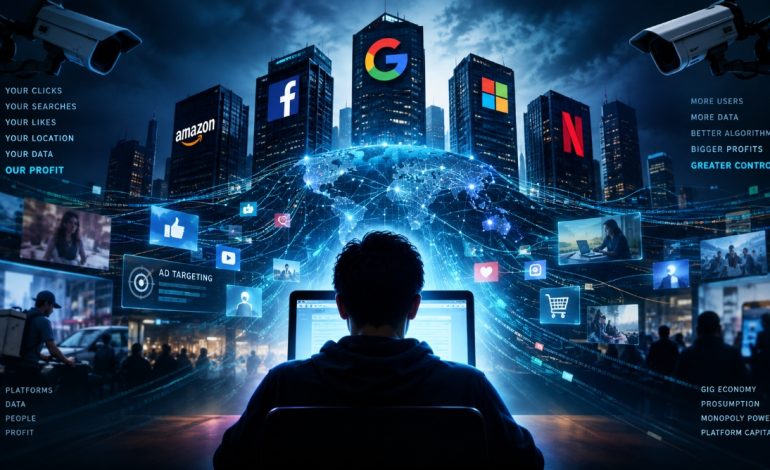

The Dark Side of the Internet
We were promised an open internet. Somewhere along the way, we became the product, the worker, and the data.
The internet arrived with an almost irresistible promise: freedom. Freedom to speak. Freedom to create. Freedom to connect. Freedom to build a business without needing a powerful institution behind you.
It sounded like the ultimate democratic space—a place where geography mattered less, gatekeepers could be bypassed, and ordinary people could finally have a voice. But there is an uncomfortable question hiding beneath that promise: What if the internet did not escape capitalism at all? What if it simply redesigned it?
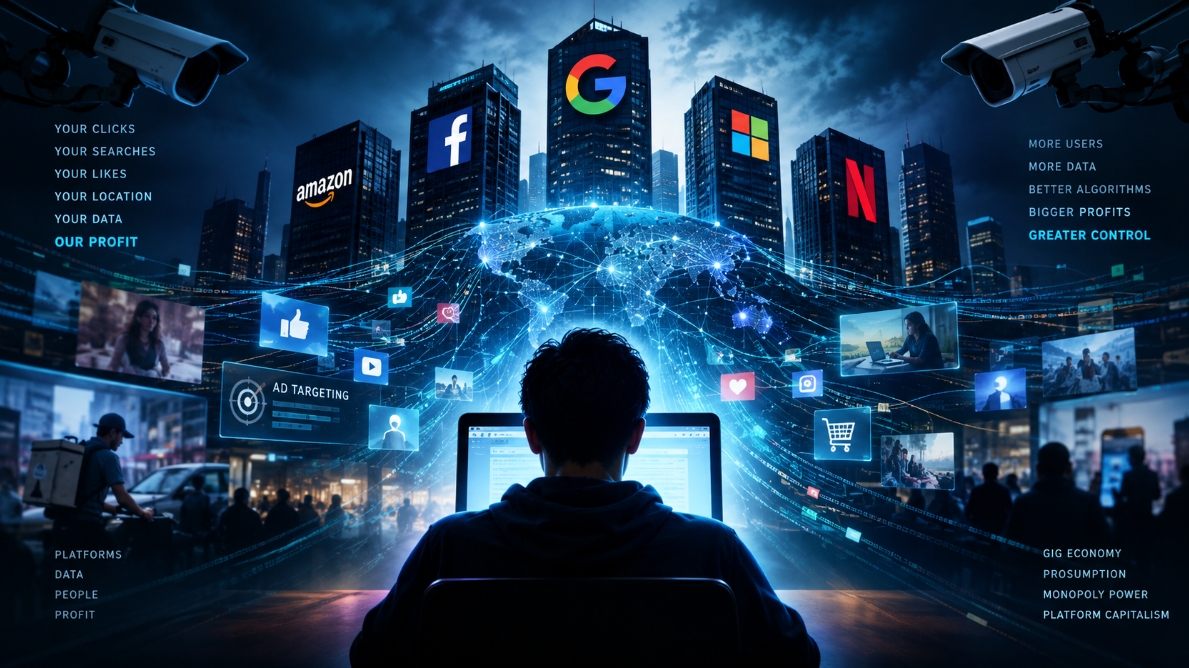
The rise of Google, Facebook, Amazon, Microsoft, Netflix and other technology giants suggests that the internet has not abolished economic power. Instead, it has helped create a new form of it—one built not only on factories, buildings and financial capital, but on data, networks and control over digital platforms.
And that changes everything.
We Think We Are Using the Internet. But the Internet Is Also Using Us.
Open a social media app and it feels like you are the customer.
You scroll. You post. You comment. You watch videos. You share opinions. You connect with friends.
But behind that apparently simple activity sits an enormous economic machine.
Your clicks, searches, interests, interactions and habits generate information. That information can become valuable to corporations because it helps them understand, predict and influence behaviour.
This creates one of the internet’s biggest contradictions.
The same technology that gives people a voice can also make them easier to monitor.
Social media is often celebrated for empowering citizens and strengthening democratic participation. Yet governments have also sought greater control over digital communication, while corporations have built business models around collecting and monetising user data. The Cambridge Analytica scandal became a particularly striking example of how personal data could become connected to political influence.
So the internet can be both liberating and controlling.
It can give you a platform while simultaneously turning your activity on that platform into an economic asset.
That contradiction is not a glitch.
It may be the business model.
Welcome to the Age of the Prosumers
There was once a fairly simple distinction between producers and consumers.
Companies produced.
People consumed.
The internet began to blur that boundary.
Today, the same person can be a consumer in the morning, a content creator in the afternoon and an unpaid promoter by evening.
You watch a YouTube video—but someone had to create it.
You post a photograph—but the platform can generate value from your activity.
You write a review, upload a video, make a meme, share a product or build a following—and suddenly you are participating in the production of digital value.
This is the logic of prosumption: production and consumption happening at the same time. Web 2.0 and social media dramatically accelerated this model, allowing users to generate content while platforms organise, distribute and monetise that activity.
On the surface, this looks wonderfully democratic.
Everyone can create.
Everyone can publish.
Everyone can potentially find an audience.
But there is a catch.
Who owns the platform where all this creation happens?
The user may create the content, but the platform controls the environment in which that content travels. Algorithms decide what becomes visible. Business models decide what gets monetised. Corporate policies determine what can remain online.
The internet may have turned millions of people into creators.
It has also turned millions of people into contributors to someone else’s business model.
The Real Power Isn’t Just Having Data. It’s Controlling the Network.
The old image of monopoly was straightforward.
Imagine one company controlling almost everything in a particular market.
Digital monopolies can be much less obvious.
A platform becomes more powerful as more people use it. More users attract more businesses. More businesses attract more users. More activity generates more data. More data can improve the platform’s ability to compete.
The network grows—and so does the advantage of the company at its centre.
This is why the dominance of major internet corporations raises questions that go beyond simply asking whether their technology is good.
What happens when the network itself becomes a barrier to competition?
The internet has certainly lowered barriers for many entrepreneurs. A small company can reach customers across the world, gather information, advertise online and sell products without building the infrastructure once required by large corporations.
But access to the internet does not necessarily mean access to equal power.
The infrastructure of information remains concentrated in the hands of a relatively small number of powerful firms.
That is the paradox:
The internet can make it easier to enter the market while making it harder to challenge the companies that already dominate it.
Platform Capitalism: The New Face of an Old Game
Call it digital capitalism. Platform capitalism. Data capitalism.
Whatever label we choose, the basic transformation is difficult to ignore.
Today’s platform economy operates across several different models. Some platforms make money primarily through advertising. Others rent cloud infrastructure. Some provide industrial systems, while others charge users for access to digital products and services. Then there are so-called lean platforms, such as Uber and Airbnb, which build businesses around assets largely owned by users or workers rather than by the platform itself.
Different businesses.
Different industries.
Similar logic.
Build the platform. Grow the network. Control the interaction. Capture the value.
This is where the phrase “winner takes all” becomes important.
Once a platform achieves enormous scale, competitors are not simply competing against a better product. They are competing against an ecosystem of users, data, infrastructure and established relationships.
The biggest platforms can also expand horizontally and vertically, acquire potential competitors and strengthen their position through network effects. The acquisition of Instagram and WhatsApp by Facebook is one example of how major platforms expanded their reach and user networks.
The result is a new kind of monopoly.
Not necessarily a company sitting behind a single factory gate.
Rather, a company sitting between millions of people and the things they want to do.
And Then There Are the Workers We Don’t Call Workers
Perhaps the most uncomfortable part of platform capitalism is what happens to labour.
The twentieth-century corporation was built around a relatively visible employment relationship.
You worked for a company.
The company employed you.
In return, you could expect some combination of wages, benefits, career progression and social protections.
Platform capitalism often rearranges that relationship.
The worker becomes a driver.
A delivery person.
A warehouse worker.
A contractor.
A service provider.
The platform becomes the intermediary connecting people, managing transactions and extracting value—while often keeping a greater distance from the traditional responsibilities associated with employment.
This creates a strange economic arrangement.
The platform can depend heavily on the worker without necessarily treating the worker as part of the traditional corporate workforce.
And yet the worker remains essential.
Without drivers, there is no ride-hailing platform.
Without delivery workers, there is no rapid delivery network.
Without warehouse workers, there is no physical infrastructure behind online shopping.
The technology may look futuristic.
The labour behind it is very real.
The Internet Didn’t Destroy Capitalism. It Made Capitalism Faster.
This may be the biggest lesson.
The internet did not simply create a new economy from nothing. It took familiar capitalist ideas—competition, markets, ownership, labour, profit and monopoly—and rebuilt them around something extraordinarily powerful:
information.
In the industrial economy, physical assets were central.
Factories mattered.
Machines mattered.
Buildings mattered.
In the digital economy, another asset has moved to the centre of the stage:
data.
The more information platforms collect, the more effectively they can understand users, target markets, optimise services and strengthen their networks. Information becomes a form of capital—and controlling that capital can translate into enormous economic power.
That is why the internet’s capitalist character can be difficult to see.
There is no obvious factory chimney.
No giant industrial gate.
No single physical product that reveals the entire business model.
Instead, there is an app on your phone.
A search bar.
A recommendation.
A notification.
A delivery arriving at your door.
A ride appearing on a map.
The machinery of capitalism has become almost invisible because so much of it is embedded in the platforms we use every day.
So, Is the Internet Really Free?
Yes—and no.
It is free in the sense that the internet has created extraordinary opportunities for communication, creativity, entrepreneurship and participation.
But freedom of access does not automatically mean freedom from economic power.
We can speak on platforms we do not own.
We can build businesses on infrastructures we do not control.
We can create content for audiences we do not directly possess.
We can generate data that becomes valuable to corporations whose business models we may barely understand.
That is the central contradiction of the digital age.
We feel like participants in the internet. But we are also part of the economic system that makes the internet profitable.
The internet did not necessarily replace the old capitalist system.
It gave capitalism a new operating system.
And perhaps that is the question we should be asking now—not whether the internet is free, but:
Who owns the freedom?
SChandraLiterature