
Why Modi Is Obsessed With Hunting Dimagi Naxals
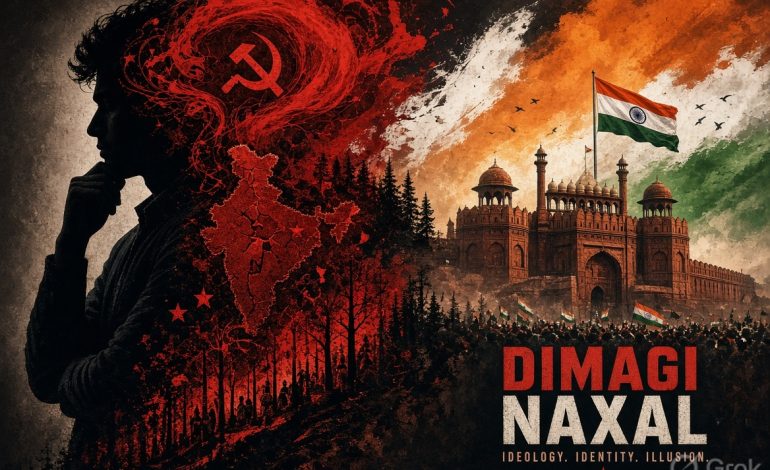

From the ramparts of the Red Fort on Independence Day 2026, Prime Minister Narendra Modi declared that armed Naxalism and Maoist violence were “breathing their last.” Decades of operations had pushed the gun-wielding insurgents from vast forested tracts. Yet he immediately pivoted to a new warning: the hathyari Naxal (armed Naxals) may be gone from the jungles, but the Dimagi Naxals—the intellectual or mental Naxal—remains, seeking opportunities to foment unrest, revive paths of violence and anarchy, and drag society onto the wrong path. These must be identified and isolated, he said, so that the nation’s youth can be aligned with the mainstream project of a developed India.
Weeks later, at the centenary celebrations of Shri Ram College of Commerce, Modi returned to the phrase with characteristic flair. He called his Red Fort remark a “homeopathic pill.” Just as such treatment can initially aggravate symptoms before curing, the term had reportedly flushed out those it targeted—they “started coming out one after another.” The country, he suggested, was now watching.
Origins of the Word and the Idea
“Naxal” itself is rooted in the 1967 uprising in Naxalbari, West Bengal, where landless peasants and tribal communities rose against landlords under Communist Party of India (Marxist) radicals influenced by Maoist ideas of protracted people’s war. What began as a local agrarian revolt evolved into a decades-long left-wing extremist insurgency that at its peak affected over a hundred districts, established parallel authority in remote areas, and claimed thousands of lives—civilians, security forces, and insurgents alike. More than 3,500 police and security personnel died fighting it, according to Modi’s account.
The intellectual dimension is older than the current political vocabulary. Maoist strategy documents, including the CPI (Maoist) “Urban Perspective,” have long stressed the need for urban networks to provide leadership, logistics, recruitment, propaganda, and ideological cover for the rural armed struggle. The working class, students, intellectuals, and middle-class professionals were to be organised to play a “crucial leadership role.”
The popular Indian political term “urban Naxal” gained wide currency later. Right Wing Filmmaker Vivek Agnihotri popularised it around 2017–2018 in essays and his book Urban Naxals, describing urban intellectuals, academics, activists, and professionals who allegedly support or enable the Maoist movement without taking up arms. It entered mainstream discourse especially after the 2018 Bhima Koregaon-related arrests. Critics have long called the label vague, oxymoronic, or a tool to stigmatise dissent. Government responses in Parliament have sometimes noted that “urban Naxal” is not a formal official category. “Dimagi Naxal” is Modi’s sharper, more recent coinage—emphasising the mindset rather than mere urban location.
Modi’s Motive and the Broader Ecosystem
Modi’s framing is consistent with the post-2014 priority of dismantling left-wing extremism. The government presents dramatic reduction in violence and the shrinking of affected areas as evidence of success against the physical threat. The next frontier, in this view, is the residual ideology that once influenced policy corridors, advisory committees, and institutions, and that continues to romanticise or apologise for violence, reject constitutional means, or prioritise perpetual agitation over development.
From the BJP-RSS perspective, this is not abstract. The Sangh ecosystem has long viewed radical left ideology as an existential challenge to cultural nationalism, social cohesion, and the constitutional order. Naxalism is seen as having destroyed the futures of countless young people in tribal and rural belts while certain urban intellectual circles provided moral and logistical oxygen. Terms like “urban Naxal” or “Dimagi Naxal” serve as political and rhetorical instruments to name what they regard as a continuum: from jungle guns to campus and media narratives that, in their assessment, weaken the state, fracture society along caste or identity lines, and resist the developmental mainstream.
Modi’s personal style amplifies this. He often uses memorable, folksy, or medical metaphors to crystallise complex threats for a mass audience and to force opponents into revealing positions. The “homeopathic pill” analogy at SRCC fits the pattern: name the phenomenon, watch the reaction, and claim the reaction itself validates the diagnosis. Critics, including opposition figures, have responded by owning the label ironically, dismissing it as a catch-all for dissent, or accusing the government of expanding the definition of threat to chill legitimate criticism of policy, inequality, or governance failures.
The Real Stakes
The physical success against armed Naxalism is substantial and measurable in reduced violence and expanded state presence in former strongholds. Yet ideology does not vanish with the last gun. Any society that has faced a violent insurgency must confront the residual romanticism, the networks that once sustained it, and the temptation to use old grievances to justify new forms of disruption. At the same time, elastic labels carry risks: they can blur the line between genuine ideological support for violence and robust democratic disagreement over economic models, social justice, or the use of state power.
“Dimagi Naxal,” as articulated by Modi, is an attempt to keep the focus on the mindset that once helped turn large parts of India into killing fields and that, he warns, still seeks openings. Whether the term sharpens vigilance or becomes a blunt instrument depends on how precisely it is applied—whether it targets those who reject the Constitution and abet violence, or merely those who disagree with the ruling dispensation’s vision of development and nationhood. But Modi should also coin a word for self-appointed policeman, and supported by BJP-RSS ecosystem, like Swatantra Bharadwaj and thousands of other violent right-wing activists such cow vigilante, who relentlessly spread hatred in society.
Coining term like Dimagi Naxal only helps in closing the democratic space for ideas. Job of Prime Minster is to champion the vision of national development, and not engaging the nation with trivial issues by coining new terms, including Dimagi Naxal or Urban Naxal, and Andolanjeevi, AK-49 (Arvind Kejriwal), RSVP (Ruhul, Sonia, Vadra and Priyanka).