


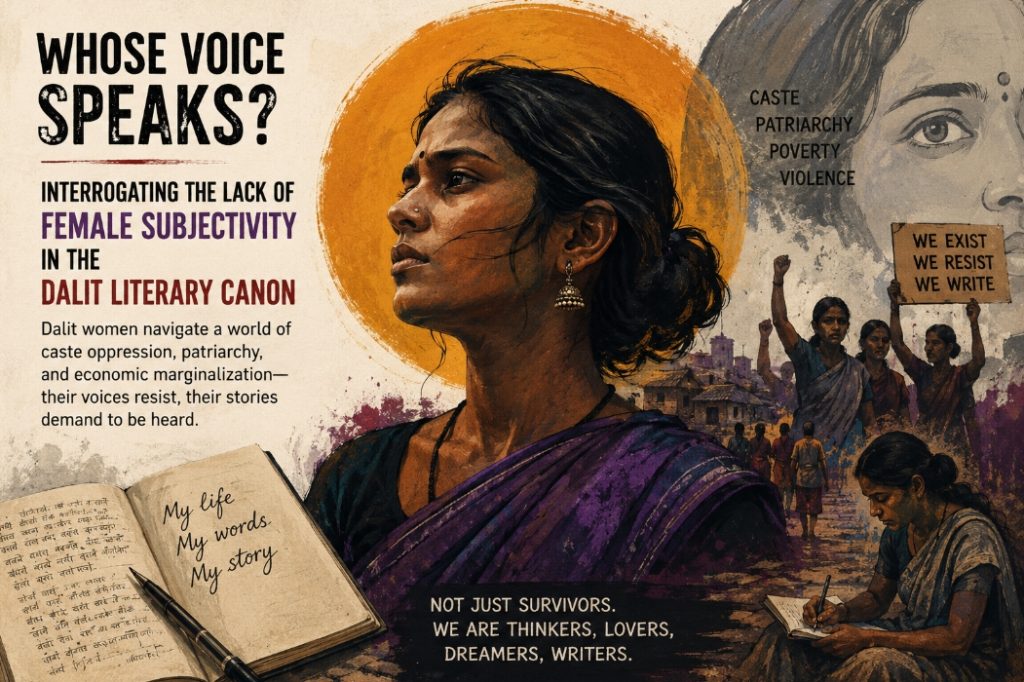
The caste system has remained one of India’s most enduring social institutions, shaping power, identity, and exclusion for nearly 3,500 years. Far from being a relic of the past, caste continues to structure everyday experiences, opportunities, and inequalities, making it one of the most persistent forms of discrimination in contemporary India (Deshpande, 2011). While Dalit literature emerged as a powerful movement to challenge caste oppression and reclaim dignity, one uncomfortable question continues to linger: Whose voices are truly being represented? Hitherto Dalit Female Subjectivity has reamiend significantly unexplored subject in the existing dalit literarary cannon.
For decades, Dalit literature has been celebrated for exposing the brutality of caste. Yet, within this emancipatory tradition, the subjective experiences of Dalit women have often remained on the margins. Their agency—their desires, negotiations, fears, pleasures, and everyday acts of resistance—has received only limited literary attention. The result is a paradox: a literature that seeks to dismantle oppression sometimes reproduces the silencing of women.
Beyond Victimhood: Recovering Dalit Female Subjectivity
Historically, patriarchal societies have controlled women’s agency through multiple mechanisms: regulation of sexuality, control over reproduction, preservation of patrilineal inheritance, and enforcement of cultural continuity. Marriage itself has long functioned as one of patriarchy’s strongest institutions, legitimizing male authority over women’s bodies and labour.
Among upper-caste communities, women’s sexual autonomy has historically been constrained by caste-based religious codes and notions of purity. However, the assumption that Dalit women enjoy greater sexual freedom because Dalit communities are supposedly more gender egalitarian deserves closer scrutiny. Their sexual agency and bargaining power remain remarkably underexplored within the Dalit literary canon (Palriwala & Uberoi, 2008).
Rather than portraying Dalit women as complex individuals negotiating intimate relationships, many literary narratives reduce them to symbols of suffering or collective resistance. Their emotions, aspirations, and negotiations within families and communities often disappear behind broader political narratives of caste oppression.
The Triple Burden of Dalit Womanhood
Dalit women inhabit one of the most precarious social locations in India. Their lives are shaped simultaneously by economic marginalization, caste discrimination, and patriarchal subordination. This “triple burden” cannot be understood through a single axis of identity.
Yet much of the existing literature tends to homogenize Dalit women’s experiences, treating them as a uniform category. Such representations overlook the diversity of their lives and the everyday decisions they make while navigating structural inequalities.
Their stories are not merely about victimhood; they are about constant negotiation. Dalit women continuously bargain with competing realities—between gains and losses, love and survival, desire and social obligation, dignity and violence. Their everyday existence is marked by subtle forms of resistance as much as by visible oppression (Bama, 2000, 2005; Geetha, 2000).
The Myth of Egalitarianism
A persistent assumption within sections of the social sciences suggests that Dalit communities practice relatively egalitarian gender relations. Scholars have argued that factors such as women’s greater physical mobility, economic participation, material poverty, and relatively flexible marital practices contribute to more egalitarian social arrangements.
While these structural conditions may indeed offer women greater mobility compared to many upper-caste contexts, they should not be mistaken for genuine empowerment. Mobility does not necessarily translate into autonomy. Economic participation does not automatically produce bargaining power. Most importantly, sexual agency cannot be inferred simply from women’s presence in the labour force.
The everyday negotiations surrounding consent, intimacy, desire, reproduction, and domestic authority remain insufficiently documented within Dalit literary narratives.
Between Resistance and Vulnerability
The contradictions become even sharper when viewed alongside caste violence. Despite participating extensively in productive labour, Dalit women continue to face disproportionate violence, particularly from dominant castes. Their bodies often become sites upon which caste power is asserted through sexual violence, humiliation, and social exclusion (Irudayam, Mangubhai, & Lee, 2011).
This dual reality—relative mobility within their communities alongside extreme vulnerability in wider caste society—complicates simplistic portrayals of Dalit women as either empowered or powerless.
Their lived experiences demand more nuanced storytelling.
Towards a Feminist Dalit Literary Imagination
Dalit literature transformed Indian literature by centring voices historically excluded from mainstream narratives. Yet its emancipatory potential remains incomplete unless Dalit women emerge not merely as characters, but as narrators of their own lives.
What is missing is not simply more representation, but deeper subjectivity. We need narratives that explore how Dalit women experience desire, negotiate marriage, resist patriarchal authority, exercise agency within constraints, and imagine futures beyond survival.
Listening to Dalit women’s voices means moving beyond stories that speak about them towards stories that speak with them.
Only then can the Dalit literary canon fully realize its promise of social justice—not merely by challenging caste hierarchy, but by confronting the gendered silences that continue to shape its own boundaries.
The question, therefore, is not whether Dalit women have agency. The question is whether our literature has been willing to hear it.
Chandra, S. 2026
References
Rao, N. 2015. Marriage, Violence, and Choice; Understanding Dalit Women’s Agency
in Rural Tamil Nadu, GENDER & SOCIETY, Vol. 29 (3), pp. 410–433


