


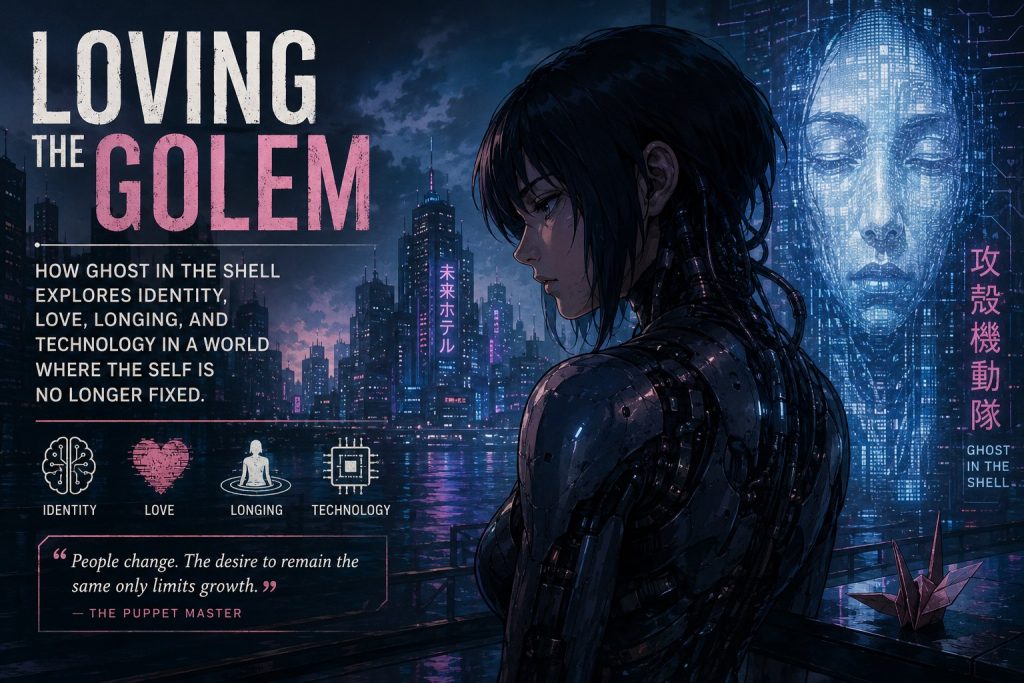
What happens when technology no longer serves humanity—but becomes part of what it means to be human? This question lies at the heart of Mamoru Oshii’s Ghost in the Shell (1995), one of the most influential anime films ever created. Long before conversations about artificial intelligence, digital consciousness, and virtual identities became mainstream, the film dared to imagine a future where the boundaries between human and machine had become almost impossible to distinguish.
Yet Ghost in the Shell is not merely a science-fiction spectacle. Beneath its cybernetic landscapes, futuristic networks, and technological marvels lies a profoundly human story—one driven by longing, love, self-doubt, and an enduring search for identity. Through its exploration of cyborg consciousness and artificial life, the film asks a question that remains unsettlingly relevant today: if our memories, bodies, and even our thoughts can be altered or replicated, what remains uniquely ours?
From Alien Machines to Human Mirrors
Japanese anime has long occupied a unique cultural space. Unlike many Western science-fiction traditions that position robots and artificial beings as external threats, anime frequently blurs the distinction between human and machine. Within the broader framework of Otaku culture—a rich ecosystem of manga, anime, gaming, and speculative storytelling—androids and cyborgs are rarely depicted as simple antagonists. Instead, they become reflections of humanity itself.
This evolution marks a significant shift in how technology is imagined. The machine is no longer an alien “other.” It has become a mirror through which humanity examines its own desires, anxieties, and contradictions.
In Ghost in the Shell, this transformation reaches its most sophisticated expression. The film presents a world where consciousness can be digitized, transferred, and integrated into cybernetic bodies. Human identity no longer resides securely within flesh and bone. Instead, it exists as a “ghost” housed within an artificial “shell.”
The result is a future where the most pressing questions are not technological but philosophical.
The City as a Network of Souls
Oshii’s futuristic metropolis is more than a setting; it is a living organism. Endless streams of information flow through towering urban landscapes, connecting citizens, machines, institutions, and memories in an intricate digital web.
Every aspect of this world seems caught in a continuous feedback loop. Technology shapes human experience, while human desires drive technological advancement. Individual identity dissolves into networks of data, creating a reality where personal boundaries become increasingly unstable.
At the center of this sprawling system stands Major Motoko Kusanagi, a highly advanced cyborg whose physical body is almost entirely artificial. While she possesses extraordinary capabilities, her greatest struggle is not external—it is existential.
Who is she beneath the machinery?
And more importantly, was there ever an original self to begin with?
The Ghost in the Machine
The title Ghost in the Shell draws inspiration from philosopher Gilbert Ryle’s famous critique of René Descartes’ theory of mind-body dualism. Descartes argued that the mind and body are distinct entities: the physical body is material, while consciousness exists as an immaterial soul.
At first glance, Oshii’s film appears to embrace this distinction. Human consciousness—the “ghost”—exists separately from the cybernetic body—the “shell.” As long as the ghost remains intact, humanity appears preserved.
But the film quickly dismantles this comforting assumption.
In a world where memories can be hacked and consciousness manipulated, even the ghost becomes vulnerable. If memories can be altered, how can anyone trust their sense of self? If identity can be programmed, is individuality merely an illusion?
These questions haunt Kusanagi throughout the narrative. Her uncertainty intensifies as she repeatedly encounters reflections of herself in the world around her—lookalikes, mannequins, and uncanny doubles that challenge the uniqueness of her existence.
The more technologically advanced society becomes, the less stable identity appears.
Longing for the Self
At its core, Ghost in the Shell is a story about longing.
Not romantic longing alone, but the deeper yearning to know oneself.
Kusanagi’s struggle is defined by a persistent suspicion that her identity may be artificial. During one of the film’s most memorable conversations, she wonders whether her memories are genuine or merely implanted constructs. Perhaps she was never fully human. Perhaps the self she believes in never existed.
This crisis becomes especially significant when viewed alongside the film’s antagonist, the enigmatic Puppet Master.
Initially presented as a dangerous hacker capable of infiltrating minds and manipulating memories, the Puppet Master appears to threaten human individuality. Yet as the narrative unfolds, it becomes clear that Kusanagi and her adversary share a profound similarity.
Both are searching for identity.
Both occupy uncertain territory between humanity and technology.
Both challenge conventional definitions of life itself.
The conflict therefore becomes less a battle between hero and villain and more a confrontation between two different expressions of the same existential dilemma.
Love in a Technological World
Amid these philosophical explorations, the film quietly examines another deeply human experience: connection.
The relationship between Kusanagi and her partner Batou is never overtly romantic, yet it is charged with emotional intimacy. Their conversations reveal mutual trust, concern, and understanding. Batou repeatedly acts as an anchor to Kusanagi’s increasingly fragmented sense of self.
These subtle moments matter because they remind viewers that technological transformation does not erase emotional complexity. Even in a world dominated by cybernetic enhancement, individuals continue to seek companionship, recognition, and belonging.
Love, in this context, becomes another pathway toward self-discovery.
Yet Kusanagi’s unresolved identity crisis prevents complete emotional stability. How can one fully connect with another person when one’s own existence remains uncertain?
The question lingers throughout the film, adding emotional depth to its intellectual inquiries.
Becoming Something New
The film’s climax delivers its most radical proposition.
The Puppet Master offers Kusanagi a chance to merge with it, creating an entirely new form of consciousness—neither human nor machine, neither self nor other.
The proposal forces Kusanagi to confront the very notion of identity.
Can the self-survive transformation?
Must individuality remain fixed in order to be authentic?
The Puppet Master’s response is strikingly simple:
People change. The desire to remain exactly the same only limits growth.
This idea challenges one of humanity’s deepest assumptions—that identity should be stable, permanent, and clearly defined. Instead, Ghost in the Shell suggests that identity is fluid, continuously evolving through experience, relationships, and transformation.
The self is not a destination.
It is a process.
The Birth of the Golem
By accepting the merger, Kusanagi transcends traditional categories of existence. The resulting entity represents something entirely new: a consciousness born from the union of human experience and artificial intelligence.
This transformation echoes philosopher Donna Haraway’s vision of the cyborg—a figure that dissolves rigid boundaries between human and machine, nature and technology, self and other.
The final fusion can be understood as a form of technological rebirth. Kusanagi contributes consciousness and embodied experience; the Puppet Master contributes limitless informational existence. Together they create a new being that overcomes the deficiencies of both.
In many ways, this ultimate cyborg resembles the mythical Golem: a constructed humanoid brought to life through extraordinary means. Yet unlike the traditional Golem, which exists as a servant or protector, this new entity symbolizes completion. It embodies humanity’s enduring desire to transcend limitations and achieve a fuller understanding of itself.
Why Ghost in the Shell Still Matters
More than three decades after its release, Ghost in the Shell remains remarkably relevant.
We live in an era increasingly defined by artificial intelligence, digital identities, virtual relationships, and algorithmic influence. Questions that once seemed speculative have become everyday realities. What defines authenticity in a world of digital replication? How much technological augmentation can a person undergo before becoming something else? Can consciousness exist independently of the body?
Oshii’s film offers no definitive answers.
Instead, it invites viewers to embrace uncertainty.
Perhaps there is no singular, immutable self-waiting to be discovered. Perhaps identity is not something we possess but something we continually create. And perhaps humanity’s relationship with technology is not a struggle between opposites but an ongoing process of integration.
In the vast and infinite network imagined by Ghost in the Shell, the search for selfhood never truly ends. It simply evolves.
Chandra, S.2026.
References
- Descartes, R., & Veitch, J. (1977). A discourse on method. London: Royal National Institute for the Blind.
- Haraway, D (1991). Cyborgs and Women: The Reinvention of Nature. New York: Routledge.
- Crane, T; Patterson, S (2001). “Introduction”. History of the Mind-Body Problem
- Heise, Ursula K. “The Android and the Animal.” PMLA, vol. 124, no. 2, 2009, pp. 503–10, http://www.jstor.org/stable/25614291. Accessed 12 Apr. 2022.
- Komel, Mirt et al. “THE GHOST OUTSIDE ITS SHELL: REVISITING THE PHILOSOPHY OF GHOST IN THE SHELL.” (2016). https://www.semanticscholar.org/paper/THE-GHOST-OUTSIDE-ITS-SHELL%3A-REVISITING-THE-OF-IN-Komel-Praksa/218f2256aa283c9e4c2fb41f7f9915a60160a3b0
- of Body and City in Science Fiction Narratives. From Cinema Anime: critical engagements with Japanese animation, edited by Steven T. Brown. Palgrave Macmillan, New York.
- Oshi, Mamoru. Ghost in the Shell. Japan; Masamune Shirow, 1995.
- Pinkard, Terry. “Self-Understanding and Self-Realizing Spirit in Hegelian Ethical Theory.” Philosophical Topics, vol. 19, no. 2, 1991, pp. 71–98, http://www.jstor.org/stable/43154104. Accessed 13 Apr. 2022.
- SWALE, Alistair. “Anime and the Conquest of Time: Memory, Fantasy, and the ‘Time-Image’ from <em>Ghost in the Shell</Em> to <em>Your Name</Em>.” Japan Review, no. 35, 2020, pp. 199–218, https://www.jstor.org/stable/27009006. Accessed 12 Apr. 2022.


