


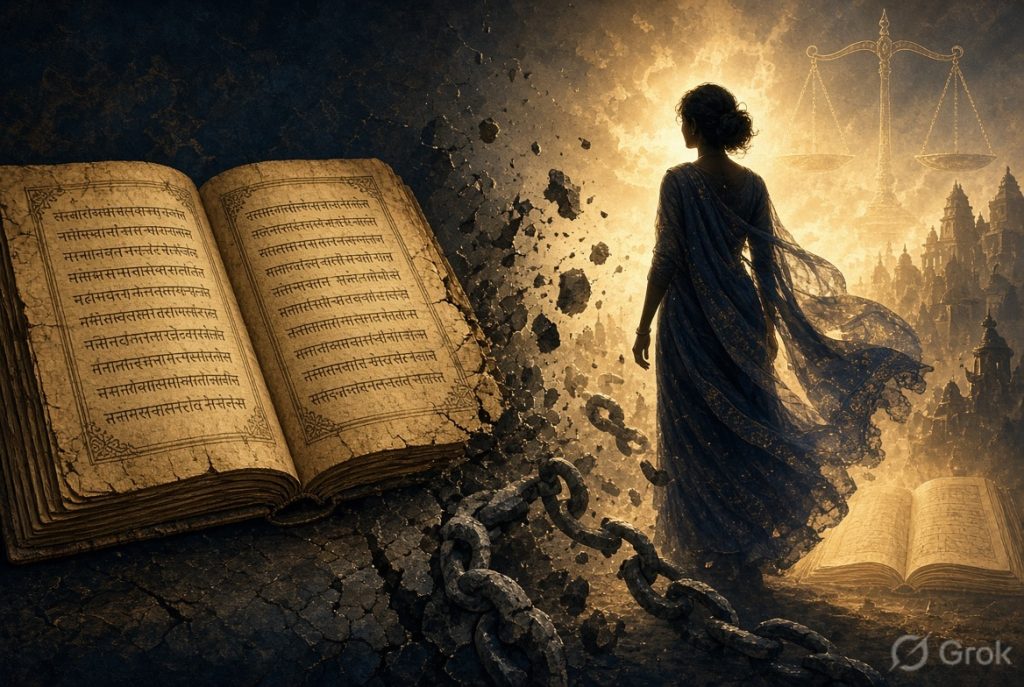
What happens when ancient text is not merely treated as a historical document, and it acquires a prominent place in contemporary political argument. The question of Manusmriti has again returned at the centre of political debate after Rahul Gandhi, leader of the opposition, invoked Manusmriti and Smash the Patriarchy at his Chhatron Ki Goonj programme in Pune on August 22, 2026.
Speaking to young women, Gandhi argued that a woman should not be defined by her relationship with husband, father or son. Referring to Manusmriti, he attacked the idea that women must remain under male authority. Invoking Manusmriti, he argued women to “smash patriarchy” (The New Indian Express, 2026).
Gandhi’s Manusmriti jibe has not only triggered a political debate but also invited both cultural and religious controversy, as critics accused him for being insensitive towards cultural and religious traditions of India. The Chief Minister of Assam accused that Gandhi’s remark is against Hinduism. Citing two verses from Manusmriti, BJP’s M.P argued that the text in fact supports women (The Hindu, 2026).
But how talking about Manusmriti is antagonistic to the religious and cultural traditions of India? Does Manusmriti really help in strengthening India’s cultural or religious traditions? Or is it presenting an obstacle in women’s freedom when Rahul Gandhi invokes the idea of breaking the cage? Can Mannusmriti be held solely responsible for embedding patriarchy in Indian society?
The central question arises: what exactly is Manusmriti? Why B.R Ambedkar, father of Indian constitution’ burnt a copy of Manusmriti at a women’s conference in 1927. This further elaborates the central question: how is the Manusmriti associated with caste hierarchy and patriarchy in India?
Manusmriti: A Book of Dharma, Not the Vedas
What is Manusmriti? Is it a sacred text? Or is it contained in Vedas that continues to remain the foundational religious text of Hinduism. It is important to note that the four Vedas Rigveda, Yajurveda, Samaveda and Atharvaveda—belong to the Śruti tradition. On the contrary, the Manusmriti belongs to Smriti tradition, which corresponds to the remembered, transmitted and composed human tradition within the broader literature of Dharmashtra.
In fact, the Manusmriti is Dharmashtra text containing rules and regulations in subjects like social duties, family relationship, rituals, property, kinship, judicial procedure and punishment. Modern scholarship, however, identifies Manusmriti as a legal and social text whose doctrines have continued to shape and influence Indian imagination and worldview for many centuries.
But there is a lack of agreement about when this text was exactly composed. Yet historians and contemporary scholarship consider its composition broadly between 200 BCE and 200 CE. So, consistent with the popular claim, the Manusmriti is a 3000-year-old book.
Who wrote Manusmriti? Was Manu a person, or an idea
The word manusmriti is a combination of two words: Manu and Smriti, insinuating text remembered by Manu. However, the authorship of Manusmriti stands highly questionable, as modern scholarship suggests that many authors might have contributed to the final composition of the text. Yet Hindu tradition views the Manusmriti as the work of Manu, Brahma’s oldest son. Hinduism views Brahma as the creator of this universe and part of Trimurti (Brahma, Vishnu, Mahesh).
There is strong evidence to comprehend that people followed rules contained in the text for many centuries before a complete copy of the text became formally available, suggesting that society tacitly followed doctrines of the Manusmriti as divine order, very much akin to the Christian Bible and other religious texts
Manusmriti presents itself as teachings of Dharma directly from Manu, although there is a lack of evidence to insinuate that the authorship of the entire text can be attributed to a single person. It is important to note that Manu presents himself as mythic lawgiver, a cultural authority and a strong literary voice.
The early Vedic texts were principally concerned with rituals and sacrifices, although fourfold Varna model appears to be founded in the period. Manumriti emerged in later Vedic period which addressed question such as:
- What are the duties and responsibilities of different social groups?
- What is the concept of purity and impurity?
- How should a dispute be settled?
- What are duties of a king
Manusmriti addressed several complex questions related to conduct, ritual practice, obligations and social duty, but embedded all rules in Dharma and linked the theme with comic order. The text goes beyond Varna system, as it codifies and prescribes different duties based on occupation and prescribes punishment for breach of duties and obligation, and rules for marriage and social relationships based on status (Ungvarsky, 2022).
Manusmriti therefore evolved as a comprehensive idea of social governance, crystalising early Vedic and Dharmsastra traditions into a systematic but hierarchical framework of Dharma during the period of post-Mauryan Northern India.
Did Manusmriti Invent the Caste System?
Contemporary scholarship identifies Manusmriti as the product of Brahmanical scholars, particularly associated with Manav school tradition. Modern scholars view that many scholars have contributed in the final compilation of the Manusmriti. The final version of the text appeared as a meticulous synthesis or crystallisation of older material such as Dharmasutra (e.g., Apastamba, Vasistha, Gautama, Baudhyana), Kalpasutras, Vedica norms, ethical norms and various elements of statecraft.
It would be both factually and historically inaccurate to assume that Manusmriti is solely responsible for inventing the caste system in India. There is significant evidence to insinuate that the varna system and social hierarchy existed in the Vedic era, prior to the final compilation of the Manusmriti. The famous Purush Sukta, which is often cited as a foundational element of the Varna system, is contained in Rigveda. Yet there is evidence to insinuate that Rigveda does not elaborate upon thousands of castes that surfaced in the post Vedic period.
The Manusmriti therefore did not invent caste. Rather it systematised social hierarchies normatively and linked it with Dharma and cosmic order. There is sufficient evidence to insinuate that caste emerged through centuries of interaction between complex societal issues, including religion, kinship, occupation, political power, landholding, local custom, community and economy. The Manusmriti, however, played the most influential role in formulating communal codes to embed casteism in the very psyche of society.
Consider some verses of the Manusmriti:
“ब्राह्मणं निन्दतो नित्यं शूद्रं वध्यं विधुर्विधुः।“ (मनुस्मृति 8.267)
The cited verse of Manusmriti says: If a Shudra Brahmin, he must be killed.
एकमेव तु शूद्रस्य प्रभुः कर्म समादिशत् ।
एतेषामेव वर्णानां शुश्रूषामनसूयया ॥
The verse cited above says: One occupation only the Lord prescribed to the Śūdra: that is to serve these (other three) varṇas meekly and without envy/resentment.
एकजातिर्द्विजातींस्तु वाचा दारुणया क्षिपन् ।
जिह्वायाः प्राप्नुयाच्छेदं जघन्यप्रभवो हि सः ॥
A once-born man (Śūdra) who insults a twice-born man with gross/harsh invective shall have his tongue cut out; for he is of low origin.
The Manusmriti not only robs autonomy of Shudras but also prescribes harsher punishment for them. The text often provides corporal punishment to Sudras who commit insults against members of higher Varnas. The Manusmriti also restricts Sudras from certain privileges such as Vedic study and certain rituals.
Under caste, occupational categories are not merely different, but they have been ranked. Social status becomes attached to inherited occupation, and the resulting hierarchy shapes how communities interact with one another. Ambedkar therefore sees caste as socially enclosed communities. Each caste develops boundaries around itself, limiting communication and social interaction with others. The result is not merely occupational differentiation but social separation.
This distinction is crucial for understanding Ambedkar’s broader political thought. If the problem were simply that society had different occupations, reform could focus on redistributing jobs. But if the problem is the hierarchical classification of people themselves, reform must address the social structure that determines dignity, mobility, status and rights.
The connection between caste, occupation, and inherited status becomes particularly visible in Ambedkar’s discussion of the varna system.Consider restrictions historically associated with Shudras, including limitations on access to knowledge, economic activity, and the bearing of arms. Such restrictions illustrate Ambedkar’s larger concern: a social system can reproduce inequality across generations by making subordination appear inherited and permanent.
For Ambedkar, the consequences are not confined to material deprivation. The caste-based organisation of labour can affect personality, dignity, intellectual development, and access to civil rights. This is an important dimension of his argument. Caste does not merely determine the work a person performs; it can shape the kind of social person that individual is allowed to become.
The problem is therefore simultaneously economic, social, psychological, and political. A system that assigns occupation through birth restricts the development of human capabilities while legitimising unequal social relations (Chandra, 2026).
Manusmriti and control of Women’s Sexuality
Historically, religion acted as driving force in institutionalising the patriarchal structure and social life. Overwhelming majority of organised religions propagate patriarchy and supremacy of men over women, leading to suppression of sexuality, reproductive choices and mobility of women. Lerner (1986) makes an important observation: institutionalisation of women’s sexual subordination through ancient law. Strikingly, the Manusmriti serves as widely accepted ancient law codes.
The manusmriti, however, mentions women’s cooperation in the social system through various means, including economic dependence on male, concept of purity and impurity, use of force and class privileges bestowed upon upper class women (Lerner, 1986).
Referring to the Manusmriti, Rahul Ganghi said: Smash patriarchy. Does that mean Manusmriti was responsible for embedding patriarchy in Indian society? But what is patriarchy? Epistemologically, patriarchy concerns social structures wherein authority, decision making, inheritance, sexuality, mobility, property or public power are overtly organised around male authority.
Interestingly, a patriarchal social institution can be reasonably examined from the perspective of rules that society imposes on women throughout various stages of her lifecycle. The Manusmriti institutionalises various rules embedded in patriarchy to exercise complete control over women, including her sexuality.
These are a few verses from the Manusmriti, which help in comprehending the degree of patriarchy institutionalised by the quasi-religious text.
पिता रक्षति कौमारे भर्ता रक्षति यौवने ।
रक्षन्ति स्थविरे पुत्रा न स्त्री स्वातन्त्र्यमर्हति ॥
The above verse says: Her father protects/guards her in childhood, her husband protects her in youth, and her sons protect her in old age; a woman is not fit for (does not deserve) independence.
बाल्ये पितुर्वशे तिष्ठेत् पाणिग्राहस्य यौवने ।
पुत्राणां भर्तरि प्रेते न भजेत् स्त्री स्वतन्त्रताम् ॥
The above verse can be comprehended as: In childhood a female must remain under the control of her father, in youth under that of her husband (the one who takes her hand in marriage), and when her husband is dead under that of her sons; a woman must never seek/resort to independence
स्वभाव एष नारीणां नराणामिह दूषणम् ।
अतोऽर्थान्न प्रमाद्यन्ति प्रमदासु विपश्चितः ॥
The above verse says: It is the nature of women to (be a source of) corruption/seduction of men in this world; for that reason, the wise are never careless/unguarded regarding women
The Manusmriti linked patriarchal norms with Dharma or Dharmsutra through verses. According to Savarkar (2000), the manusmriti is the most worshipable scripture after Vedas. Advancing his cause of Hindu Nation, Savarkar argues that the Manusmriti has engrained cultures, customs, thoughts and practices, and it has codified the spiritual and dine path of the nation.
Even today cores of cores of Hindus follow Manusmriti strictly in their lives and practices (Savarkar, 2000). The Manusmriti has proved highly influential in establishing a link between Hindu religion and Indic society. The Manismriti is embedded in the psyche of a significant portion of Hindu society. It is obvious that the incumbent political leadership landscape of India is highly patriarchal (Doniger and Smith, 1991).
Here Rahul Gandhi’s remark becomes crucial as political parties can play the most important role in dismantling patriarchal norms and rules to facilitate greater autonomy for women. Exercise of societal control over women and Sudras remains at the heart of the project patriarchy, and this has continued to influence personal, social and intellectual development of people in India for centuries. Dismantling patriarchy is not therefore an easy proposition.
Leaders such as B.R Ambedkar played an important role in political democracy with dismantling caste-based hierarchy, and empowered Dalits and oppressed through caste-based reservation. Dalits, Adivasi and marginalised women often find themselves located at the intersectionality of caste and gender-based discrimination. Ganghi’s dismantling of patriarchy therefore can be principally considered as political. Yet politics alone may not effectively dismantle patriarchy or caste.
Conclusion
Manusmriti played an important role in laying the foundation of patriarchal and caste-based society in the veil of Dharma and violation of Dharma is not simply seen as violation of law but also violation of moral and cosmic order of society. Yet with the implementation of the Indian constitution in 1950, a new era of constitutionalism came into force. Nevertheless, religious norms often become instruments of social regulation.
Whether one agrees with Gandhi’s politics or not, the underlying question deserves a serious answer: Should a modern democratic society allow inherited social hierarchy to determine an individual’s freedom? The Constitution of India makes an attempt to answer that question differently. Its framework is founded on equality, liberty, dignity and equal citizenship, rather than inherited social rank.
That is why the modern constitutional order and ancient social codes inevitably create a fascinating intellectual contrast. One begins with status and prescribed duty. The other begins with citizenship and fundamental rights.
There is perhaps one final lesson we should take from this debate. A book can be ancient without being perfect. A tradition can be historically important without every sentence being morally acceptable today. And criticism of a text does not have to mean hatred of an entire religion or civilisation.
The Manusmriti is neither the whole of Hinduism nor the complete history of India. It is one text within a much larger corpus of Hindu Mythology and internally diverse intellectual tradition. The task of the incumbent generation is not necessarily to erase the past.
If societies can reinterpret laws, institutions and traditions over centuries, they can also ask whether inherited ideas about caste, gender and authority still deserve a place in modern life. The real challenge therefore is not to destroy history. The challenge is to ensure that history does not become a cage for the future. And perhaps that is the deeper meaning behind the call: Smash patriarchy. Question hierarchy. Protect dignity. And let no ancient text become more powerful than the human being it was supposed to guide.
Gandhi’s invocation works because the logic of successive male guardianship and the denial of independent identity still resonate in numerous social practices: women still feel pressurised to pursue family roles over individual ambition. At the same time, lived Hindu society is more vibrant and diverse than any singular Smriti like Manumsmriti. Focusing on spirit of constitutionalism becomes crucial for advancing vibrancy and diversity of society.
Chandra, D. 2026
References
Doniger,W., & Smith, B. K. (1991). The laws of Manu. New Delhi, India: Penguin Classics.
Lerner, G. (1986). The Creation of patriarchy. New York: Oxford University Press.
NM, N. and Kuruvilla, M., 2022. The sexual politics of the Manusmriti: A critical analysis with sexual and reproductive health rights perspectives. Journal of International Women’s Studies, 23(6), pp.21-21.
Patil, R.H., 2021. The social status of Indian women of different periods in the patriarchal society. Research Ambition: An International Multidisciplinary e-Journal, 5(IV), pp.1-10.
The New Indian Express, 2026. ‘Woman belongs to herself first’: Rahul Gandhi attacks Manusmriti, calls for breaking social ‘cage’ [online] https://www.newindianexpress.com/states/maharashtra/2026/Aug/22/woman-belongs-to-herself-first-rahul-gandhi-attacks-manusmriti-calls-for-breaking-social-cage
The Hindu, 2026. https://www.thehindu.com/news/national/bjp-leaders-question-rahul-gandhis-remarks-on-the-manusmriti-and-womens-rights/article71385940.ece
The Hindu, 2024. [online] https://www.thehindu.com/news/national/karnataka/manusmriti-set-on-fire-commemorating-ambedkar-burning-the-text-in-1927/article69026328.ece
Ungvarsky, Janine. 2022. Manusmriti [online] https://www.ebsco.com/research-starters/religion-and-philosophy/manusmriti#full-article
Savarkar, V.D. 2000. Women in The Manusmriti’ in Savarkar Samagar (collection of Savarkar’s writings in Hindi), Vol. 4. New Delhi: Prabhat.


