


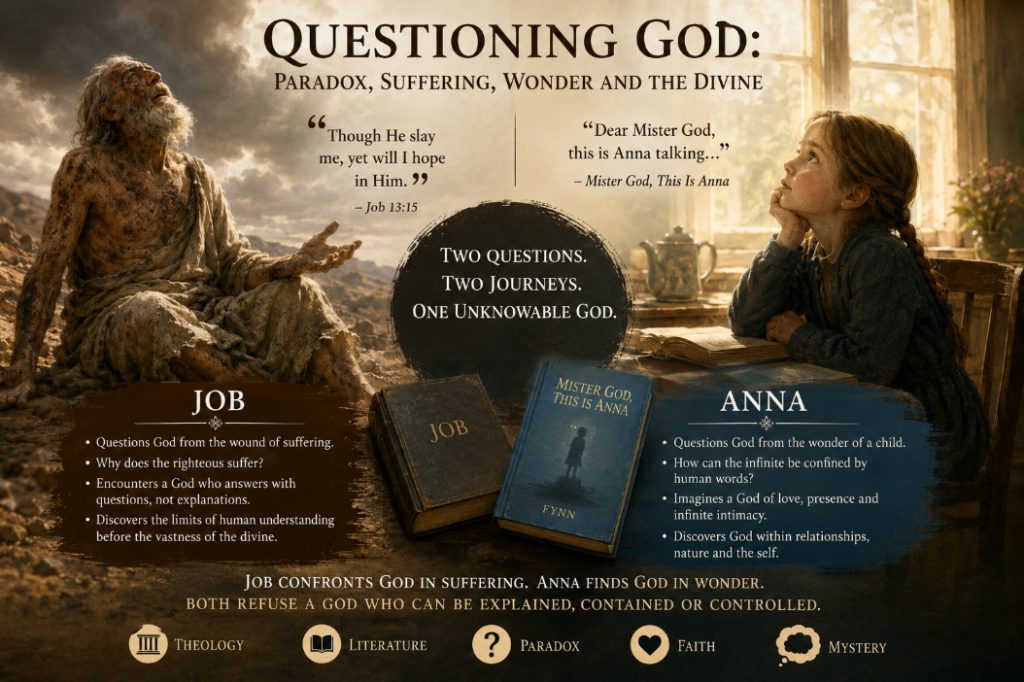
Abstract
What happens when a human being refuses to accept the God consistent with the prescribed conventional theology? The Book of Job and Fynn’s Mister God, This Is Anna appproach this question from radically different literary, historical, and theological positions, yet both literary masterpieces construct protagonists whose relationship with God is not contingent on obedience to seek answers from God but with an insistence on questioning. Job questions God from the position of suffering: if God is omnipotent, just and sovereign, why does an innocent person suffer? Anna questions God from the position of wonder: if God is infinite, how can human beings confine the divine within doctrine, representation, institution or conventional categories? The resulting conceptualizations of God are paradoxical. Job discovers a God who refuses to explain suffering and instead overwhelms the human demand for explanation through questions about creation, power, and cosmic order. Anna, conversely, imagines a God who becomes increasingly intimate precisely by escaping conventional definitions of divine distance. This paper argues that Job and Anna represent two contrasting but ultimately complementary modes of theological questioning.
Keywords: Mister God, This Is Anna, Book of Job, children’s literature, theodicy, theology, paradox, God, suffering, Anna, Job, literary theology
What Happens When the Believers Question God?
Religious literature often remains foregrounded in faith, but some of its most enduring works begin with an interruption of faith: a question.
The Book of Job is perhaps on of the most enduring and radical example of faith. The central thesis of this literary masterpiece is deceptively simple: why does a righteous person suffer? Fynn’s Mister God, This Is Anna, principally belongs to the corpus of children literature. Yet, it asks deceptively simple question: is it possible to manage God intellectually or institutionally?
Job, a righteous man loses everything. A luminous child, Anna, falls from a tree and dies while saving a kitten. Both cases pose a radically simple question: why does God permit or orchestrate such painful and heartbreaking events.
Job’s story is classical example of theodicy. A blameless, righteous and successful man is suddenly stripped of wealth, health and family. Using theological paradigm, his friends blame that Job must have committed sin and almighty has punished him for his hidden sin. Job refuses to accept this divine prophecy. He argues his case with God. There no courtroom defense and no ledger of moral calculus. Job poses a barrage questions: Why have you made me target of your attention? If I have sinned, what I have done? Why do you hide your face? Why you consider me your enemy? But God does not provide rational answer to Job’s questions. Instead, God comes with a series of inverted questions: where were you when I laid foundation of the earth? Have you commanded the morning since your days began? The Book of Job portrays God himself as a character and after argumentative and extensive speech among other characters, God appears and pronounces merciful and just verdict. Biblical literature remains preoccupied with the world of bold assertion about the possibilities of freedom and the demands of transcendence. Nevertheless, the paradox remains unresolved: why righteous people suffer.
Nearly three millennia later, a different voice confronts the same paradoxical question in 1930s London dockyard, when Fynn finds a four-year girl protagonist, Anna, whose relationship with God is foregrounded in intimacy, wonder, interrogation and intellectual freedom. Anna does not treat God as divine as she calls God as ‘Mister God’. He relationship with God is both intimate and conversational. While adult often think they know God, Anna seeks to know God through all her innocence and questions. For Anna, God is not an abstract theological proposition but someone with whom she can speak. Seven years old Anna climbs to rescue a kitten, slips, and is impaled. She dies crying: “I bet Mister God lets me get into heaven for this. Anna trust God and considers someone in the middle of everything. How can God allow such as bright, loving and curious child to extinguish casually like this?
Job: When Suffering Becomes a Question Addressed to God
The Book of Job is traditionally read as one of the great texts of theodicy to understand God’s justice in a world containing suffering. Scholarly interpretations continue to disagree about whether the book offers an answer to the problem at all. Ellen Davis, for example, emphasizes Job’s refusal of the conventional explanations offered by his friends, while Warren Zev Harvey argues that the speeches of Job and God constitute the profound centre of the book’s treatment of evil and suffering.
Job’s friends attempt to protect a familiar conception of God.
Their logic is essentially:
God is just → suffering is punishment → Job suffers → therefore Job must have sinned.
The problem is that Job knows this explanation is false.
He knows he is not guilty of the sin that would supposedly justify his suffering.
Consequently, Job refuses to protect theology at the expense of his own experience.
This is where his questioning becomes radical.
Job does not abandon God.
He argues with God.
That distinction is crucial.
His faith is not passive acceptance. It becomes confrontation.
Recent scholarship has emphasized precisely this feature. One reading describes Job’s desire to argue with God as a challenge to God to defend the divine case, while another stresses the “unfinalizable” quality of Job’s voice—the text’s refusal to silence the sufferer with a definitive theological explanation.
Job therefore becomes a peculiar theological figure:
the believer who refuses to stop believing enough to question.
His protest is possible because God still matters.
If God were irrelevant, Job would have no reason to demand an answer.
His anger is therefore a form of relationship.
Anna: When a Child Refuses a Small God
Anna’s theological questioning proceeds in almost the opposite direction.
Job begins with a God whom he knows intimately enough to accuse.
Anna begins with a God whom she refuses to allow adults to make small.
Her phrase “Mister God” is deceptively simple. It personalizes the divine while simultaneously resisting conventional theological abstraction.
Anna does not appear interested in constructing a systematic theology.
Instead, she asks questions about God through everyday experience—love, bodies, numbers, nature, perception, death and human relationships.
The result is a theology that is simultaneously childlike and philosophically ambitious.
The Guardian’s discussion of the book calls Anna an “instinctive theologian” whose questions repeatedly reject conventional answers and push Fynn toward a fuller conception of God’s nature.
This is important because Anna’s theology does not simply reject religion.
She rejects reduction.
She is suspicious of a God who can be comfortably packaged into doctrines that explain everything.
Her God is larger than the categories used to contain God.
The paradox is therefore different from Job’s.
Job’s problem is:
If God is just, why does injustice exist?
Anna’s problem is:
If God is infinite, how can human beings speak of God as though they have contained Him?
- Anna’s God: Infinite, Relational, and Interior
One of the most striking conceptual features of Anna’s theology is the movement from divine transcendence toward divine interiority.
God is not simply “somewhere else.”
God is not merely an external observer.
The theological imagination associated with Anna instead places God within the relational and interior dimensions of human existence.
A discussion of direct address to God in Mister God, This Is Anna emphasizes this relational conception: God becomes present not as an isolated supernatural object but as something encountered “in” the self and between persons.
This becomes particularly important after Anna’s death.
The narrative does not resolve grief by providing Fynn with a rational explanation for why Anna had to die.
Instead, Fynn’s understanding of God changes through his experience of Anna’s absence and continuing presence.
He comes to the realization that Anna is somehow “in my middle”—a formulation that turns theological presence into an interior and relational experience.
This is radically different from Job.
Job encounters God through overwhelming transcendence.
Anna’s God is encountered through intimacy.
Job is reminded that the universe exceeds human comprehension.
Anna suggests that God is so intimate that the boundary between divine presence and human interiority becomes porous
The Paradox of the Child Theologian
Anna’s status as a child is crucial to the book’s theological method.
The adult traditionally occupies the position of knowledge.
The child occupies the position of incompleteness.
Anna reverses this hierarchy.
She is apparently the one who asks the questions that adults have ceased to ask.
The adult has inherited theological vocabulary.
The child interrogates the vocabulary itself.
This makes Anna’s questioning a form of epistemological resistance.
She does not simply ask:
“What does Christianity teach about God?”
She asks questions that precede doctrine:
What does it mean to love?
What does it mean for God to be everywhere?
Why do human beings experience the world from limited perspectives?
What does it mean to know another person?
What happens when a person dies?
The questions are theological because they are also ontological.
Anna’s God is not merely the answer to a religious question.
God becomes a way of conceptualizing existence itself.
This is why the book’s theology frequently intersects with mathematics and science. Anna’s intellectual curiosity is not divided into “religious” and “secular” compartments. Her investigation of numbers, bodies, perception and nature becomes part of her attempt to understand reality as an integrated whole.
Two Protagonists, Two Gods
The deepest difference between Job and Anna can therefore be understood through the direction of their questioning.
| Job | Anna | |
| Starting point | Suffering | Wonder |
| Central question | Why does the righteous suffer? | How can God be reduced to human categories? |
| Relationship to God | Confrontational intimacy | Intimate curiosity |
| God initially appears as | Judge/Sovereign | Companion/Mystery |
| Major theological movement | From explanation toward mystery | From abstraction toward intimacy |
| Response to uncertainty | Argument | Exploration |
| Final movement | Human limitation before divine transcendence | Human interiority as a site of divine presence |
The contrast can be condensed into two propositions:
Job discovers that God is greater than justice as humans understand justice.
Anna discovers that God is greater than the definitions through which humans attempt to contain God.
Yet neither text simply abandons human moral or theological language.
Instead, both expand it.
The God of Job and the God of Anna Are Both “Unmanageable”
This is where the two texts become unexpectedly close.
At first, Job’s God and Anna’s God appear radically different.
Job’s God is terrifyingly transcendent.
Anna’s God is tenderly intimate.
Job encounters divine power through the cosmic scale of creation.
Anna encounters divine presence through love, relationship and interiority.
But both ultimately resist the same thing:
the manageable God.
The manageable God is the God who can be reduced to a formula.
A God who rewards the righteous.
A God who punishes the wicked.
A God whose actions can always be explained.
A God who exists comfortably inside institutions.
A God whose nature can be summarized once and for all.
Job’s friends construct precisely such a God. Their theology requires suffering to have a clear moral cause. Job’s experience destroys that certainty.
Anna similarly resists religious reductionism. The God she imagines cannot be confined to institutional religion or to an external theological object. Contemporary discussion of the book emphasizes her rejection of a merely “cosy” or easily comprehensible God.
Thus, paradoxically, the questioning protagonist becomes the protector of divine mystery.
God’s Silence in Job and God’s Presence in Anna
There is another fascinating difference.
In Job, God speaks.
But God’s speech does not provide the explanation Job wants.
In Mister God, This Is Anna, God does not directly speak as a character.
Instead, Anna speaks about God.
This produces opposite narrative strategies.
Job gives God a voice but refuses to give the reader a complete explanation.
Fynn gives Anna a voice through which God becomes imaginable.
In Job, God’s speech enlarges the distance between human knowledge and divine knowledge.
In Anna, the child’s speech attempts to narrow that distance through intimacy.
Thus:
Job’s God speaks and remains mysterious.
Anna’s God remains silent and becomes intimate.
This is one of the most productive paradoxes in a comparative reading of the two texts.
Theodicy Without Easy Answers
Both works ultimately challenge theodicy—the human desire to explain God’s goodness in the face of suffering.
Job is the obvious example.
The book refuses to provide Job with a straightforward causal explanation for his suffering. Scholars have consequently argued that the Book of Job may be less interested in solving the problem of suffering than in exposing the limitations of theological systems that claim to solve it.
Anna’s story produces an equally disturbing problem.
Anna believes intensely in Mister God.
She experiences God as love and presence.
And yet Anna dies as a child.
The contradiction cannot be avoided.
If God is love, why does Anna die?
If God is present, where is God when the child dies?
The book does not solve this through a conventional theological argument.
Instead, Fynn’s grief transforms his understanding of divine presence.
The answer is not:
“Now I understand why God allowed Anna to die.”
It is closer to:
“Anna has changed the way I understand where God is.”
This is a radically different response to theodicy.
The question of why is not necessarily answered.
The experience of presence changes.
From “Why?” to “Where?”
This distinction may provide the strongest conceptual bridge between Job and Anna.
Job repeatedly asks why.
Why has this happened?
Why does God allow suffering?
Why is the innocent person treated as guilty?
Anna’s theology is principally concerned with where.
Where is God?
Where is God located?
Where does divine presence occur?
Where does the self meet the other?
For Job: Why does God permit suffering?
For Anna: Where is God within existence?
Job’s question is ethical and theodical.
Anna’s question is ontological and relational.
But both questions destabilize conventional theology.
The first challenges the morality of divine action.
The second challenges the spatial and conceptual boundaries assigned to God.
Questioning God as an Act of Faith
The most provocative conclusion of this comparison is that questioning God does not necessarily represent the collapse of faith.
It may represent its intensification.
Job’s protest demonstrates that faith can include accusation.
Anna’s curiosity demonstrates that faith can include intellectual rebellion.
Neither protagonist is satisfied with inherited certainty.
This makes both texts particularly important for understanding literature as a space of theological experimentation.
The believer is not simply someone who possesses answers.
The believer can also be someone who refuses inadequate answers.
Job refuses the theology of his friends.
Anna refuses the reduction of God to conventional categories.
Both therefore enact a kind of negative theology: God becomes more visible precisely through the failure of human language to contain God.
But their negative theologies move in opposite directions.
Job reaches mystery through transcendence.
Anna reaches mystery through intimacy.
The Child and the Ancient Sufferer
There is also a striking literary irony in comparing Anna and Job.
Job is an adult whose suffering makes him question the God he thought he knew.
Anna is a child whose questioning allows her to discover a God she refuses to reduce to what adults claim to know.
One loses certainty through suffering.
The other refuses certainty through wonder.
Yet both reveal something fundamental about theological consciousness:
certainty can become a form of blindness.
Job’s friends are certain.
They know why Job suffers.
Their certainty makes them incapable of listening to Job.
Anna’s strength lies in her refusal to settle for explanations that are too small.
In both texts, therefore, the problem is not ignorance alone.
The greater danger is premature knowledge—the conviction that the mystery has already been solved.
Two Questions, One Unknowable God
The Book of Job and Mister God, This Is Anna are separated by centuries, genre, culture, theology and narrative form. Yet both are profoundly interested in what happens when a human being asks God a question that cannot be comfortably answered.
Job asks:
How can a just God permit innocent suffering?
Anna asks, in her own radically different way:
How can an infinite God be confined by human definitions?
Job’s God responds not with a theory of suffering but with the overwhelming scale of creation.
Anna’s God becomes progressively less external and more relational, intimate, and interior.
Job discovers that God cannot be placed within the limits of human moral calculation.
Anna discovers that God cannot be placed within the limits of human conceptual categories.
Their Gods therefore seem paradoxically opposed:
Job’s God is too distant to explain.
Anna’s God is too intimate to define.
And yet these two propositions ultimately meet.
Both texts insist that God exceeds the human desire for possession through knowledge.
Neither Job nor Anna receives the kind of answer that would close the theological question.
Instead, the question changes the questioner.
Job emerges from his confrontation with God aware of the limits of human comprehension.
Fynn emerges from Anna’s life and death with a transformed understanding of divine presence.
This may be the deepest connection between the two works.
God is not discovered when the question disappears. God becomes more mysterious—and perhaps more meaningful—when the question is allowed to remain open.
In Job, questioning God becomes an act of resistance against simplistic explanations of suffering.
In Anna, questioning God becomes an act of resistance against simplistic definitions of divinity.
The paradox is therefore not that these protagonists doubt God.
The paradox is that their questioning may be the very thing that prevents God from becoming an idol of human certainty.
Job refuses to accept a God who can be explained by his friends.
Anna refuses to accept a God who can be contained by adults.
One confronts God from the wound of suffering.
The other approaches God through the wonder of childhood.
Between them emerges a theology of uncertainty:
God is neither the answer that ends the question nor the silence that makes questioning meaningless. God is the mystery that keeps the question alive.
And perhaps that is why Job and Anna remain such powerful theological protagonists: neither allows the human being to stop asking.
Chandra, D.2026
Works cited & Suggested Scholarly Readings
Davis, Ellen F. “Learning to Struggle with God—Job.” Opening Israel’s Scriptures. Oxford University Press, 2019. Davis reads Job as a profound exploration of theodicy and emphasizes Job’s refusal of conventional explanations for suffering.
Harvey, Warren Zev. “Questions on the Book of Job.” Religious Studies, vol. 59, special issue S1, 2023, pp. S7–S16. Harvey’s analysis is particularly useful for understanding the reciprocal questioning between Job and God and the limitations of divine and human judgment.
Morriston, Wesley. “God’s Answer to Job.” Religious Studies, vol. 32, no. 3, 1996, pp. 339–356. This study examines the difficulty of understanding God’s whirlwind speech as an answer to Job’s problem of suffering.
Williams, Trevor B. “Job’s Unfinalizable Voice: An Addendum to David Burrell’s Deconstructing Theodicy.” New Blackfriars, vol. 101, no. 1096, 2020, pp. 681–697. Particularly valuable for thinking about Job’s continuing, unresolved voice and the refusal of definitive theodicy.
Fynn. Mister God, This Is Anna. 1974. The book presents Anna’s theological conversations with Fynn and her distinctive conception of God as an intimate presence. The work is marketed as a true story, although its autobiographical status has generated questions; for scholarly purposes, it is therefore useful to distinguish the book’s literary/theological construction of Anna from claims about its historical factuality.
“I and Thou and the Tau: The Semiotics of Addressing God Directly.” Church Life Journal, University of Notre Dame. This discussion provides a useful theological framework for understanding Anna’s conception of divine presence as relational and interior.
Carr, Robin L. “Death As Presented in Children’s Books.” Elementary English, vol. 50, no. 5, 1973, pp. 701–05. JSTOR, http://www.jstor.org/stable/41388049. Accessed 28 Oct. 2024.
de Saint-Exupery, Antoine. The Little Prince. Translated by Irene Testot-Ferry, Wordsworth Editions, 2018.
Elbruch W., Duck, Death and the Tulip, Gecko Press, 2007.
Fynn. Anna and Mister God. London: HarperCollins Publishers, 2004.
Swenson, Evelyn J. “The Treatment of Death In Children’s Literature.” Elementary English, vol. 49, no. 3, 1972, pp. 401–04. JSTOR, http://www.jstor.org/stable/41387117.
The New England Primer , (Hartford, Conn., 1834), n.d.


