


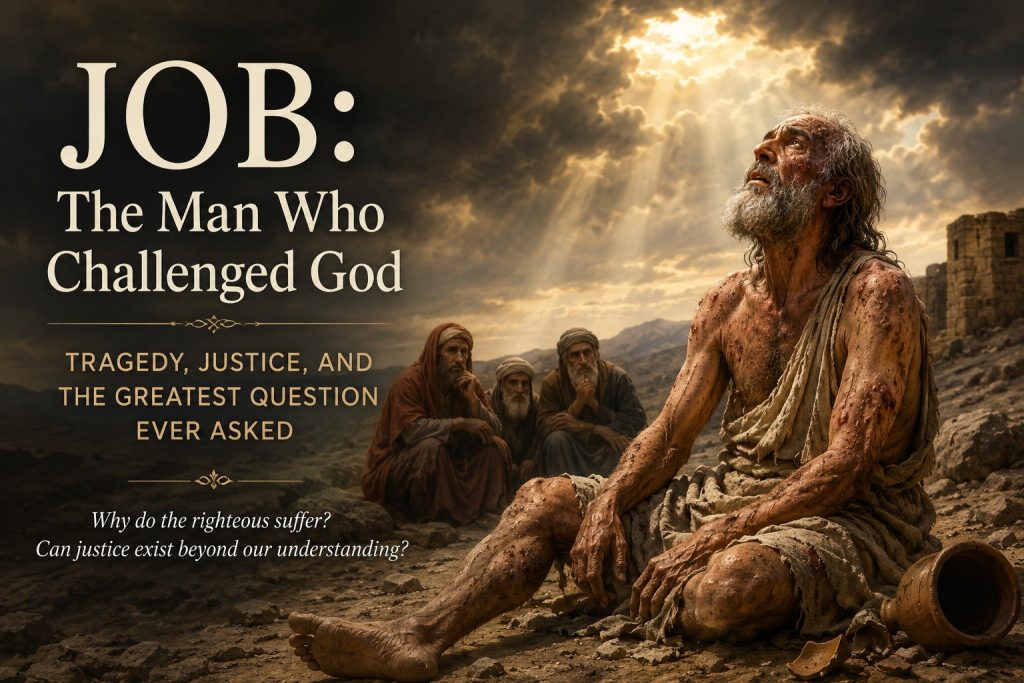
The Book of Job
The book of job is inundated with enigmas and puzzles that define its roots, genre and structure. According to Andrew E. Hill, the book of Job a verity of generic and literary traits including epic drama, epic history, disputation, judicial process, lament, comedy and tragedy. Scholars argue that the book of Job has all the elements of classical greek-tragedy but concept of suffering demonstrated in this book is very much akin to religious suffering rather than purely Greek suffering. In a similar stream of argument, J. Cheryl Exum argues that in the book of Job, “the suffering, the misery, the evil, and the inexplicable in the world are part of an inscrutable, larger plan for the good.”
Imagine waking up to a knock on your door.
A messenger arrives breathless.
Your business is gone.
Before you can process the news, another messenger appears.
Your home has collapsed.
Then another.
Your children are dead.
Then another.
Your health is failing.
Your friends avoid you.
Your wife asks why you continue believing.
And heaven remains silent.
This is not the plot of a modern psychological thriller. It is the story of Job—a man whose suffering has haunted humanity for nearly three thousand years.
At first glance, Job appears to be the perfect tragic hero. Like Oedipus, he falls from prosperity into misery. Like Shakespeare’s King Lear, he finds himself abandoned and bewildered. Like every tragic protagonist, he is forced to confront the terrifying fragility of human existence.
Yet the Book of Job refuses to become a tragedy.
And that is what makes it one of the most fascinating books ever written.
The Perfect Man
The story begins not with suffering but with perfection.
Job is wealthy, respected, and deeply religious. He is described as blameless and upright. His life appears to be evidence of a comforting moral equation:
Good people are rewarded.
Bad people are punished.
This belief forms the foundation of many ancient societies. It reassures us that the universe is fair.
Work hard.
Live morally.
Trust God.
Everything will be fine.
Then the story shatters that illusion.
A Wager in Heaven
Without Job’s knowledge, a strange conversation unfolds in heaven.
God praises Job’s faithfulness.
The Adversary responds with a challenge.
Of course Job is faithful, he argues.
Look at everything he has.
Take away his blessings and see what remains.
The wager is shocking because Job never participates in it. He does not choose his trial. He does not commit a crime. He does not make a fatal mistake.
His suffering arrives without explanation.
In Greek tragedy, suffering usually emerges from a flaw, an error, or fate.
In Job, suffering arrives without cause.
This is what makes the story so unsettling.
If Job can suffer, anyone can.
The Ash Heap
Soon Job loses everything.
His wealth disappears.
His children die.
His body becomes covered with painful sores.
Once a respected leader, he now sits alone on an ash heap, scraping his wounds with broken pottery.
The image is unforgettable.
A man who had everything now has nothing.
Yet Job’s greatest pain is not physical.
It is intellectual.
He cannot understand why.
And so he asks the question that has echoed through every generation since:
“Why do the righteous suffer?”
The Friends Who Had Answers
Soon three friends arrive.
At first, they sit in silence.
For seven days.
It is perhaps the wisest thing they do.
Then they begin to speak.
Their argument is simple.
God is just.
Therefore suffering must be deserved.
If Job is suffering, Job must have sinned.
The logic seems impeccable.
The problem is that the reader knows they are wrong.
Job is innocent.
His friends represent a worldview that many people still hold today: the belief that every tragedy must have a reason.
When bad things happen, we instinctively search for causes.
Perhaps the victim made a mistake.
Perhaps they lacked faith.
Perhaps they deserved it.
Job rejects all these explanations.
And in doing so, he does something extraordinary.
He puts God on trial.
The Man Who Challenged God
Job does not merely complain.
He argues.
He protests.
He demands answers.
Again and again, he insists on his innocence.
His speeches are among the boldest in all religious literature.
He accuses the universe of being unfair.
He questions divine justice.
He demands an audience with God.
Few literary characters possess such courage.
Most heroes battle monsters.
Job battles silence.
Most heroes fight armies.
Job fights uncertainty.
Most heroes seek victory.
Job seeks understanding.
This is why the Book of Job feels remarkably modern.
It gives voice to every person who has stood beside a hospital bed, a grave, or a shattered dream and asked:
Why?
When God Finally Speaks
For chapter after chapter, heaven remains silent.
Then suddenly a storm appears.
Out of the whirlwind, God speaks.
Readers expect explanations.
Instead, they receive questions.
Where were you when the earth was created?
Can you command the morning?
Can you guide the stars?
Can you tame the forces of chaos?
God never explains Job’s suffering.
He never reveals the heavenly wager.
He never answers the question readers most want answered.
Instead, He reveals something else.
The vastness and mystery of creation.
The universe, God suggests, is larger than human understanding.
Job had demanded answers.
What he receives is perspective.
Why Job Is Not a Tragedy
At first glance, Job contains every ingredient of tragedy.
Suffering.
Loss.
Isolation.
Despair.
Yet scholars have long argued that it ultimately resists the tragic form.
Greek tragedy often ends with irreversible destruction.
Oedipus is broken.
Antigone dies.
Hamlet falls.
But Job’s story moves toward restoration.
God vindicates Job.
His friends are rebuked.
His fortunes are restored.
Justice, however delayed, ultimately prevails.
As literary scholar J. Cheryl Exum observes, tragedy becomes difficult where divine justice governs the universe. If suffering forms part of a larger, meaningful order, then despair never receives the final word.
This is where the Book of Job departs from classical tragedy and enters the realm of religious drama.
The world may appear chaotic.
Suffering may appear senseless.
But beneath the disorder lies a moral order that humans cannot fully perceive.
The Greatest Question Ever Asked
Thousands of years later, Job’s question remains unanswered.
Why do good people suffer?
Science explains how disasters occur.
Economics explains poverty.
Medicine explains disease.
Yet none of these explanations fully satisfy the human longing for meaning.
That is why Job endures.
The Book of Job is not merely about one man’s suffering.
It is about every person’s struggle to find justice in an often unjust world.
It is about the tension between human understanding and divine mystery.
It is about the courage to question without abandoning faith.
Most importantly, it reminds us that the greatest questions are not always answered.


